
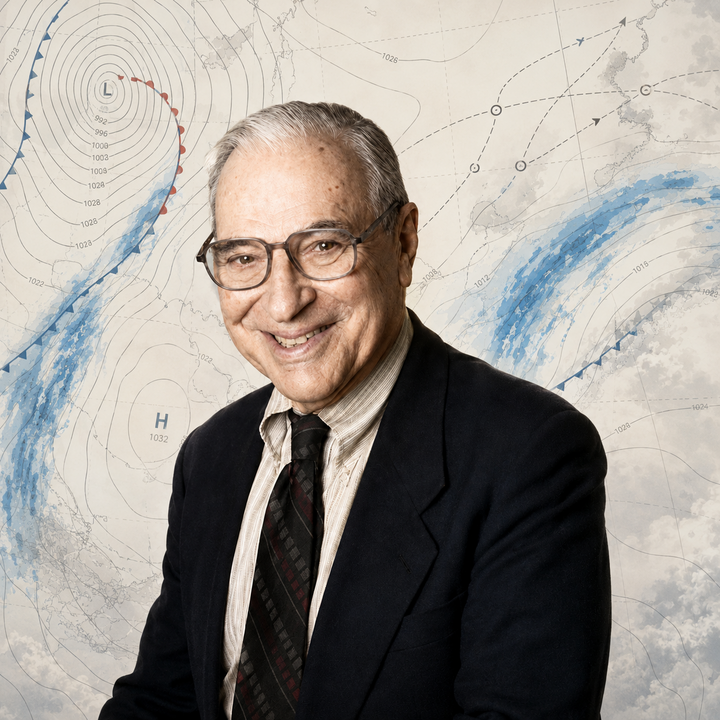
There are anecdotes that characterize a thinker more precisely than many a ceremonial speech. In Kenneth Arrow's case, it is the story from his time as a weather officer in the U.S. Army Air Forces. There, he was involved in weather and rain forecasts derived from historical weather data. Arrow concluded that long-term forecasts had no significant predictive value—in some cases, they were no better than chance. When he reported this, he received a response to the effect that while they were well aware the forecasts were inadequate, they still needed them for planning purposes. This brief scene already reveals a surprising amount about Arrow: his distrust of false certainty, his interest in decision-making under incomplete information, and his insight that organizations must act even when the information base remains fragile. For him, therefore, the economics of risk does not begin with elegant formulas, but with an uncomfortable reality: people and institutions make decisions even though they never know everything—and often do not even know the same amount.
A Mathematician in Economics
Kenneth Joseph Arrow was born in New York in 1921 and belonged to that rare category of scientists who not only expand an entire field but transform it from the ground up. He initially studied mathematics and graduated from the City College of New York in 1940. Mathematical rigor remained a defining feature of his entire body of work, but early on—partly under the influence of Harold Hotelling—he turned to economics. This decision proved to be momentous. Arrow brought to economics a combination of logical precision, statistical thinking, and conceptual radicalism that had scarcely existed in this form before.
During World War II, he served in the Air Force's meteorological service. After the war, he joined a research group at the University of Chicago in 1947. The later years of his graduate studies took him to Stanford University, where he served as Acting Assistant Professor of Economics and Statistics beginning in 1949. These biographical milestones are more than mere career facts. They show how early on Arrow was working at the intersections of mathematics, statistics, decision-making, and economics—precisely where his later thinking on risk and information would develop.
Collective Decisions and Individual Values
Arrow earned his Ph.D. in 1951 from Columbia University with his dissertation "Social Choice and Individual Values", supervised by the economist and monetary theorist Albert Hart. The book immediately became a milestone in economic theory. In it, he formulated his famous impossibility theorem of social choice: Under certain conditions—which at first glance seem very plausible—there is no procedure by which individual preferences can be translated into a collective ranking in a way that is both consistent and fair.
At first glance, this work seems far removed from the topic of risk. In fact, however, it already reveals a fundamental aspect of Arrow's thinking: he was less interested in elegant, reassuring solutions than in the precise identification of limits. He asked: Under what conditions does a theory really work—and under which does it not? It was precisely this attitude that would later shape his reflections on markets, uncertainty, and information.
"Social Choice and Individual Values" established a new branch of economic theory. At the same time, it made it clear that, for Arrow, economics was never merely the study of prices. It was a science of collective decision-making under real-world constraints: limited knowledge, incomplete preferences, institutional rules, and the logical limits of aggregation.
Equilibrium, Rigor, and the 1972 Nobel Prize
In 1972, Arrow shared the Alfred Nobel Memorial Prize in Economic Sciences with John Hicks, one of the leading British economists of the 20th century and a co-founder of modern equilibrium theory. They were honored for their fundamental contributions to general equilibrium theory and welfare theory. Arrow was 51 years old at the time and, at that point, the youngest laureate in the field. Just one year later, he was elected president of the American Economic Association (AEA).
The Nobel Prize citation recognized not only individual results but an entire approach to research: Arrow had introduced complex mathematical methods into economics and made them productive without losing sight of their economic significance. He made the theory both more abstract and more realistic. More abstract, because he made its logical structures visible; more realistic, because he repeatedly demonstrated where idealized assumptions fail in the face of reality.
In addition to social choice theory, this body of work includes, above all, his research on the possibility of economic equilibria. Yet even here lies the seed of what is crucial to the topic of this article: markets do not function well simply because prices exist. They function only under certain conditions—and one of the central conditions concerns the distribution of information.
The real point: Risk is a matter of knowledge
Anyone who views Arrow solely as an equilibrium theorist underestimates him. A significant portion of his later work centered on information as an economic variable. In doing so, he fundamentally shifted the perspective on risk. In his view, risk is not merely the uncertainty of future states. Risk is equally a matter of who possesses what information, who is aware of certain facts, who can conceal them, and who must make decisions amid a lack of information.
It was precisely this insight that made Arrow a pioneer of information economics. Later authors such as George Akerlof, Michael Rothschild, Joseph Stiglitz, and Michael Spence would go on to expand upon this line of thought. But Arrow laid the foundation by showing that real markets often do not suffer from risk in the mathematical sense, but rather from unevenly distributed knowledge.
The significance of this insight can hardly be overstated. In many theoretical textbook models, buyers and sellers essentially know the same things. In such cases, prices become clear signals, markets become efficient allocation mechanisms, and risk appears as a commonly known, neutrally priced phenomenon. Arrow made it clear that this world is merely a limiting case. In reality, one party often knows more than the other—about quality, motives, health status, technical weaknesses, actual costs, or the probability of damage.
Information Asymmetries: When Markets Go Awry
This is precisely where the concept of information asymmetry comes into play. It refers to a situation in which the parties involved in a transaction do not have the same level of information. One party knows more than the other—and this additional knowledge has significant economic consequences. It alters prices, behavior, contracts, and expectations.
Arrow demonstrated that such information asymmetry is by no means merely a disruptive minor flaw. Rather, it can shape the functioning of entire markets. When buyers are less able to assess the quality of a good than sellers, when insured individuals know more about their individual risk than insurers, or when suppliers have a better understanding of their own capabilities than consumers, then classical market logic is no longer sufficient. Prices alone cannot always bridge these gaps.
The economics of risk thus becomes an economics of information distribution. It is not only the future that is uncertain; even the present is known to varying degrees. And it is precisely this asymmetry that gives rise to perverse incentives, trust issues, insurance questions, and institutional responses.
Why Medicine, of All Things, Became a Test Case
Arrow developed this insight most clearly in his famous 1963 essay, "Uncertainty and the Welfare Economics of Medical Care". For him, the healthcare sector became a test case because uncertainty and asymmetric information occur there in a particularly concentrated form. Patients typically know less about diagnosis, the necessity of treatment, and the quality of medical interventions than doctors do. Insurers do not have complete knowledge of the individual behavior and actual health status of their policyholders. Conversely, policyholders know more about themselves than the insurer does.
Arrow demonstrated that it is precisely this structure that explains why medical markets do not function like ordinary markets. Trust, professional ethics, reputation, insurance, regulation, and institutional rules play a much greater role there than in simple exchange models. The uncertainty concerns not only the disease itself but also the quality of information about the disease and its treatment.
It is precisely this analysis that makes the essay a seminal text to this day. It is not only a contribution to health economics but also a general lesson that, from an economic perspective, risk can never be understood in isolation from information problems.
Arrow in Today's Risk Management
This perspective is of immediate relevance to today's risk management. Many risks cannot be adequately understood by modeling only probabilities of occurrence and loss amounts. One must also ask how information is distributed within the system. Who knows more about a system's technical vulnerabilities: the service provider or the client? Who has a better understanding of the true credit risk: the borrower or the bank? Who has the best overview of the actual security situation: management, the operational department, or an external cloud provider?
Information asymmetries thus act as a hidden lever of risk. They influence early-warning systems, governance structures, reporting, the quality of key performance indicators, and the reliability of seemingly sound models. A company can have excellent risk dashboards and yet remain in the dark if critical information is in the wrong places or is not shared credibly.
Arrow's relevance is particularly acute in digital ecosystems, platform markets, supply chains, and insurance relationships. The real problem is often not merely that the future is uncertain. It is that the present and risk exposure are known to varying degrees. Those who take Arrow seriously therefore always view risks as knowledge problems as well.
From Forecasting to Institutions
Arrow, however, was not a naive advocate of ever-improving predictions. The weather anecdote at the beginning illustrates something else: even poor forecasts are used in organizations because decisions must be made. The real question, therefore, is not only how to measure uncertainty, but how to design institutions when knowledge is unevenly distributed and incomplete.
This shifts the perspective from prediction to institution. Good markets, good insurance arrangements, good governance, and good contract forms are then not merely supplements to the rational market, but responses to its limits of knowledge. From this perspective, trust, disclosure requirements, incentive structures, liability rules, and standards do not appear as a bureaucratic burden, but as mechanisms for managing asymmetric information.
This is precisely what makes Arrow so valuable for modern organizations. He shows that risk management is not just a matter of better models, but also a matter of institutional architecture.
Conclusion and Outlook
Kenneth Joseph Arrow was one of the rare economists who both created new theories and exposed the limits of theoretical simplicity. His work on social choice demonstrated that collective rationality does not come without a cost. His equilibrium theory imbued economics with a new mathematical rigor. And his reflections on information made it clear that markets suffer not only from uncertainty but often from the asymmetric distribution of knowledge.
It is precisely in this that his work remains relevant today. In an economy shaped by platforms, insurance, healthcare markets, digital services, cyber risks, and complex supply chains, risk is almost always also a problem of unevenly distributed information. Those who take Arrow seriously therefore view uncertainty not only as a matter of probabilities, but always also as a matter of knowledge, trust, and institutional design.
The outlook is correspondingly clear. As markets become more data-rich and technologically complex, their transparency does not automatically increase. Often, the volume of data actually leads to greater asymmetry: some actors know a great deal, while others see only superficial indicators. For modern risk management, this means that models, controls, and governance must respond not only to volatility and distribution but also to information architectures. Arrow's actual lesson is therefore this: Risk is never just mathematics. It is always also an economy of knowledge.
Bibliography and further reading:
- Arrow, Kenneth J. (1951): Social Choice and Individual Values, John Wiley & Sons, New York 1951.
- Arrow, Kenneth J. / Debreu, Gérard (1954): Existence of an Equilibrium for a Competitive Economy, in: Econometrica, vol. 22, no. 3, pp. 265–290.
- Arrow, Kenneth J. (1963): Uncertainty and the Welfare Economics of Medical Care, in: American Economic Review, vol. 53, no. 5, pp. 941–973.
- Arrow, Kenneth J. (1971): Essays in the Theory of Risk-Bearing, Markham Publishing, Chicago, 1971.
- Arrow, Kenneth J. (1983): Collected Papers of Kenneth J. Arrow, Vol. 1–6. Harvard University Press, Cambridge, MA, 1983.