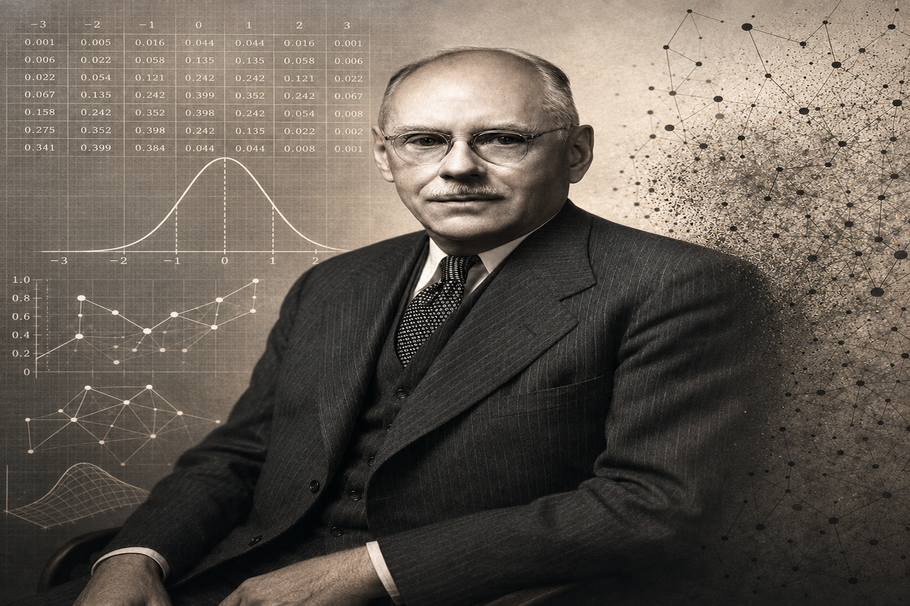

There are moments in the history of economics when an entire field of research emerges from an almost casual remark. In the case of Harry Max Markowitz, the story does not begin on the stock market, but at the University of Chicago, in that unique blend of seminars, a culture of debate, and intellectual serendipity that has shaped generations of economists there. Markowitz had begun to take an interest in questions of decision-making under uncertainty, inspired by John von Neumann, the mathematician and co-founder of game theory; Oskar Morgenstern, the economist and co-author of modern game theory; and Leonard Savage, the statistician and decision theorist. When it came time to choose a dissertation topic, as he himself later recalled, a chance conversation gave him the idea of applying mathematical methods to the stock market. Jacob Marschak, one of the leading minds in his Chicago circle, thought the topic was sound and expressly encouraged him to pursue it. From this seemingly minor decision emerged a theory that would permanently transform the world of finance. For Markowitz saw what was missing from existing theory: It is not only expected returns that matter, but also risk—and not in isolation for each individual investment, but in the context of the entire portfolio.
Chicago: A School of Thought Under Uncertainty
Markowitz studied at the University of Chicago, where he encountered an unusually rich intellectual environment. Among his teachers and formative influences were the economist Milton Friedman, the mathematical economist Tjalling Koopmans, the decision theorist Jacob Marschak, and the statistician and decision theorist Leonard Savage. It is no coincidence that these names appear side by side. They represent precisely the interplay of disciplines in which Markowitz's thinking matured: economics, decision theory, efficiency, statistics, and uncertainty.
His exploration of expected utility became particularly important to him. The arguments of John von Neumann and Oskar Morgenstern on rational decision-making under uncertainty, as well as Savage's reflections on subjective probability, provided him with the conceptual framework. From the very beginning, Markowitz was not merely concerned with stock prices, but with a more general question: How does a rational actor make decisions when returns are uncertain?
Precisely for this reason, looking back, the move toward the stock market does not appear to be a peripheral idea, but rather a logical culmination. The financial markets offered a domain in which decision-making under uncertainty could be observed with particular clarity. At the same time, the traditional understanding of stock prices at that time was still heavily influenced by present-value thinking: the price of a security was derived primarily from expected future dividends. Markowitz recognized that this perspective overlooked something fundamental. Future dividends are, after all, not certain. Anyone who looks only at expected returns has understood only half the truth.
The groundbreaking insight: return and risk go hand in hand
Markowitz's true innovation lay in conceptualizing the problem of investing in two dimensions: expected return and risk. Today this seems obvious, but at the time it represented a break with the prevailing perspective. He no longer asked only which investment promised the highest expected return, but rather which combination of investments carried the lowest risk for a given return target—or vice versa. What is the optimal return that can be achieved for a given level of risk?
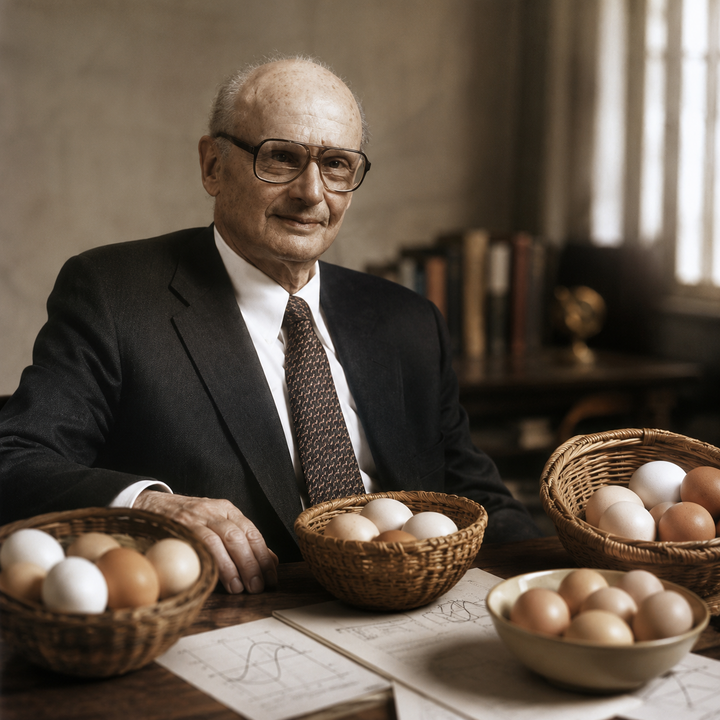
The key here is the concept of diversification. The risk of a portfolio is not simply the sum of the individual risks of its components. It also depends on how the individual securities relate to one another. If price movements do not move in perfect lockstep, combining multiple securities can lower the overall risk without reducing the expected return to the same extent. This is precisely where the old saying—that one should not put all one's eggs in one basket—becomes a precise theory.
Markowitz thus demonstrated that the appropriate unit of analysis is not the individual security, but the portfolio. A security may appear risky when viewed in isolation, yet still contribute to portfolio stability. This was a conceptual shift of considerable significance. Investors should not evaluate securities in isolation, but rather in the context of all other positions they already hold.
Portfolio Selection: The Optimal Balance of Return and Risk
With his 1952 paper "Portfolio Selection," published in the Journal of Finance, Markowitz wrote one of those texts that not only expand a field of research but also redefine it. The paper's basic idea was as simple as it was revolutionary: A rational investor should not select the security with the highest expected return in isolation, but rather construct the entire portfolio in such a way that return and risk are balanced in a reasonable ratio. The focus thus shifted from the individual security to the structure of the portfolio.
Methodologically, Markowitz formulated the investment problem as an optimization problem. The expected return of a portfolio is derived from the weighted expected returns of the individual investments. Risk, on the other hand—measured by Markowitz using variance or standard deviation—depends not only on the individual risks of the included investments but also, to a significant extent, on their covariances and correlations. This made it clear that two risky securities, when held together, can be less risky than each one considered in isolation, provided they do not move in perfect tandem.
This insight made diversification mathematically precise for the first time. Markowitz transformed the old rule of thumb—to spread one's assets—into an exact theory under uncertainty. He demonstrated that some portfolios are inefficient because another portfolio offers a higher return for the same level of risk or a lower level of risk for the same return. This gave rise to the concept of the "efficient frontier"—the set of portfolios that cannot be improved upon from a risk-return perspective.
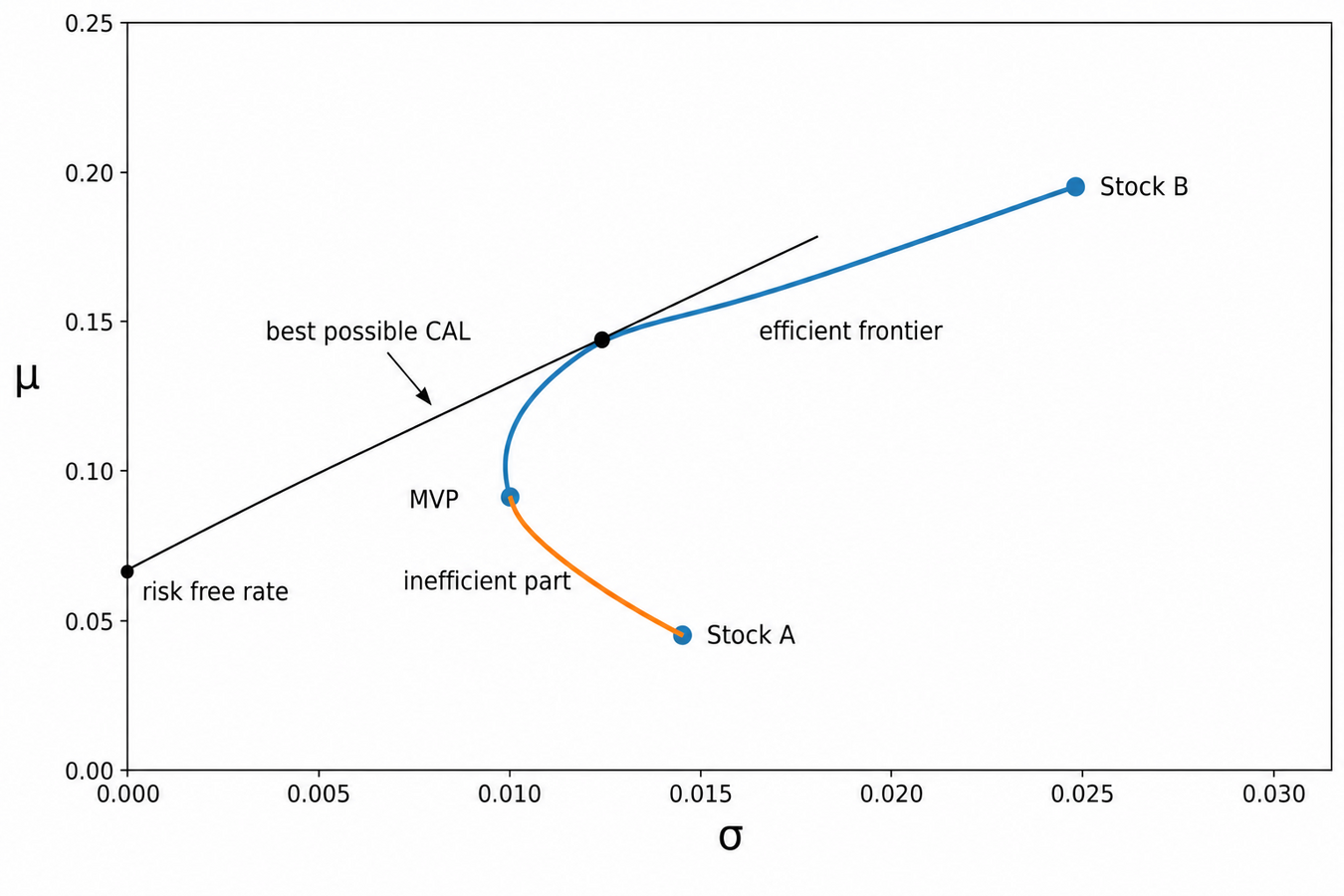 Fig. 01: Efficient Frontier, Tangency Portfolio, and Best Possible Capital Allocation Line (schematic representation)
The figure illustrates Markowitz's portfolio theory for two risky securities in conjunction with a risk-free interest rate. The horizontal axis represents the standard deviation σ as a measure of risk, while the vertical axis represents the expected return μ. The curved line depicts all possible portfolio combinations of Stock A and Stock B. Its upper branch forms the efficient frontier: this is where portfolios offering the highest expected return for a given level of risk are located. The lower branch is the inefficient portion because, for every portfolio located there, there is an alternative with the same return and lower risk or with the same risk and higher return. The point MVP denotes the minimum-variance portfolio—that is, the portfolio with the lowest achievable variance or standard deviation.
The point on the left on the vertical axis marks the risk-free rate. Connecting this point to a portfolio on the efficient frontier yields a Capital Allocation Line (CAL)—that is, the set of all combinations of a risk-free asset and a risky portfolio. The best possible CAL is the straight line that touches the efficient frontier at a point of tangency. This point represents the tangent portfolio: it is the risky portfolio that, when combined with the risk-free asset, delivers the best ratio of expected excess return to additional risk.
The figure thus illustrates that Markowitz's theory goes beyond the mere diversification of individual investments. The key is not to hold as many positions as possible, but to find the combination that generates an efficient risk-return structure and can be optimally combined with a risk-free investment. This is precisely where the analytical power of portfolio selection lies: Portfolios should be evaluated not by the number of their components, but by the structure of their interdependencies and their efficiency.
Bringing Order to Uncertainty
Markowitz's reflections gave rise to the idea of efficient portfolios and, later, the famous efficient frontier. A portfolio is efficient if, for a given level of risk, there is no alternative with a higher expected return—or, for a given return, no alternative with lower risk. In this way, the question of good investment decisions was no longer answered on moral, psychological, or purely intuitive grounds, but was translated into a clear logic of optimization.
His later book, "Portfolio Selection: Efficient Diversification of Investments" (1959) comprehensively expanded this theory. This laid the foundation for what would later become modern financial economics. The Nobel Prize citation explicitly highlighted that his work had created a rigorous theory of portfolio selection under uncertainty and had become the basis for further research.
This is precisely where Markowitz's methodological elegance lies. He did not promise to eliminate uncertainty. Rather, he showed how to deal with it sensibly once its structure is understood. The goal is not certainty, but a better organization of the unknown.
Why Diversification Is More Than Just Spreading Risk
The famous saying "don't put all your eggs in one basket" sounds simple, but Markowitz's theory makes it clear that diversification is more than just spreading out investments. Simply buying a large number of securities at random does not automatically mean you are well diversified. What matters is not just the number of positions, but their structure. If all investments collapse simultaneously during the same crisis, even broad diversification is of little help.
This also explains why Markowitz's theory is relevant to risk management far beyond the capital markets. The fundamental question is always: How do individual risk drivers relate to one another? Where do they offset each other, where do they amplify each other, where are they interdependent, and where do they provide true diversification? This logic applies not only to equity portfolios but also to credit portfolios, supply chains, project portfolios, and strategic business models.
Diversification is therefore not a "buzzword" or an irrelevant catchphrase, but rather a question of interdependence. This is precisely why Markowitz remains relevant today and will continue to be so in the future: He forced analysts to focus on the interplay of the parts. He showed that the whole is not simply the sum of its risks.
Nobel Prize for a New Financial Economy
In 1990, Harry M. Markowitz, together with Merton H. Miller and William F. Sharpe, received the Alfred Nobel Memorial Prize in Economic Sciences. The Nobel Foundation honored them for their "pioneering work in the theory of financial economics." For Markowitz, the award specifically recognized the development of portfolio selection theory.
The committee's official citation highlights particularly clearly what his innovation consisted of: He developed a rigorous yet practically applicable theory for the optimal allocation of assets across securities with varying expected returns and varying levels of risk. It was precisely this combination of theoretical clarity and empirical utility that gave his work its extraordinary influence.
The fact that Markowitz received the prize alongside Sharpe and Miller is also objectively appropriate. Sharpe built upon portfolio theory with the Capital Asset Pricing Model (CAPM), and Miller contributed to modern corporate finance theory. Yet at the beginning of this development stood Markowitz's insight that risk is not a bothersome side effect of return, but rather its necessary counterpart.
Markowitz in Today's Risk Management
Markowitz's thinking remains of central importance to modern risk management to this day. Anyone who manages a portfolio of risks, projects, customers, suppliers, or investments is essentially thinking in a Markowitzian way as soon as they consider not just individual risks but their interplay. The true value of risk aggregation lies precisely in making correlations, concentrations, and diversification effects visible.
This applies not only to securities. A company, for example, may have several business segments, each of which is volatile on its own but behaves differently in response to economic cycles. A project portfolio may consist of initiatives whose schedule, cost, and technology risks do not evolve in parallel. A supply chain may be geographically diverse yet highly dependent on the same transportation routes, energy costs, or regulatory interventions. Everywhere, the same question arises: Where is there true diversification—and where is there only the appearance of broad diversification?
This is precisely why Markowitz is more than just a classic figure in financial economics. He also belongs in the history of general risk thinking. He made it clear that rational decisions under uncertainty must not stop at the evaluation of individual elements. Only by considering their relationships can a collection of positions be transformed into a truly analyzed portfolio.
Conclusion and Outlook
Markowitz's enduring achievement lies in having turned an old rule of thumb into a theory of extraordinary significance. He demonstrated that uncertainty can be made more manageable not only through better forecasts but also through a more intelligent structuring of interdependencies. In this sense, diversification is not merely a precautionary measure but a rational response to the realization that individual expectations about the future remain fallible.
At the same time, his approach is not free of methodological problems. Classical portfolio theory typically measures risk using variance or standard deviation, thereby treating both positive and negative deviations from the expected value symmetrically. From the perspective of many practitioners, this is not always convincing, because an unexpectedly high gain is intuitively hardly perceived as a risk. Furthermore, the theory is based on expected returns, variances, and correlations that must be estimated. Even small estimation errors can significantly alter the recommended portfolio compositions.
Another critical issue is that correlations often rise during periods of stress—precisely when diversification is most urgently needed. What appears to be broad diversification in calm times can turn out to be illusory diversification during crises. Furthermore, the basic model largely ignores practical factors such as transaction costs, taxes, liquidity constraints, regulatory restrictions, or discrete investment limits. The elegant geometry of the efficient frontier is therefore not a complete representation of real markets, but rather an analytical ideal.
Yet it is precisely in this that the approach's enduring strength lies. Markowitz does not provide a perfect recipe for reality, but rather a methodological framework for thinking about portfolios more systematically. His theory compels us to make the relationships between positions explicit, to reveal concentrations, and to answer the question of true diversification not only intuitively but structurally.
The outlook is therefore ambivalent, yet productive. Modern risk models today employ downside risk measures, scenario analyses, stochastic simulations, fat-tail analyses, regime shifts, and more complex dependency structures. All of this goes beyond Markowitz. Yet almost all of these further developments build precisely on the foundation Markowitz laid: the idea that risk can only be understood in the context of the entire portfolio . His theory is thus not the final word on portfolio management, but it is certainly its indispensable starting point.
In a world that remains characterized to this day by concentration risks, herd effects, and spurious diversification, this doctrine remains remarkably relevant. Markowitz's true message is not merely: Diversify your assets. His deeper message is: Understand the structure of interdependencies. Only then does diversification become more than a slogan—namely, a form of rational order amid uncertainty.
Bibliography and Further Reading:
- Gleißner, Werner / Romeike, Frank (2012): Capital Asset Pricing Model – Kapitalmarktorientierung und die Unfähigkeit adäquat mit Unternehmensrisiken umzugehen [Capital Asset Pricing Model – Capital Market Orientation and the Inability to Adequately Manage Corporate Risks], in: RISIKO MANAGER, 06/2012, pp. 1, 6–11.
- Markowitz, Harry M. (1952): Portfolio Selection. In: The Journal of Finance, Vol. 7, No. 1, pp. 77–91.
- Markowitz, Harry M. (1959): Portfolio Selection: Efficient Diversification of Investments. Yale University Press, New Haven.
- Markowitz, Harry M. (1990): Foundations of Portfolio Theory. Nobel Prize Lecture, Nobel Foundation.
- Romeike, Frank (2007): Harry Max Markowitz (Leaders of the Risk Community) [Köpfe der Risk-Community], in: RISIKO MANAGER, Issue 8/2007, pp. 22–23.