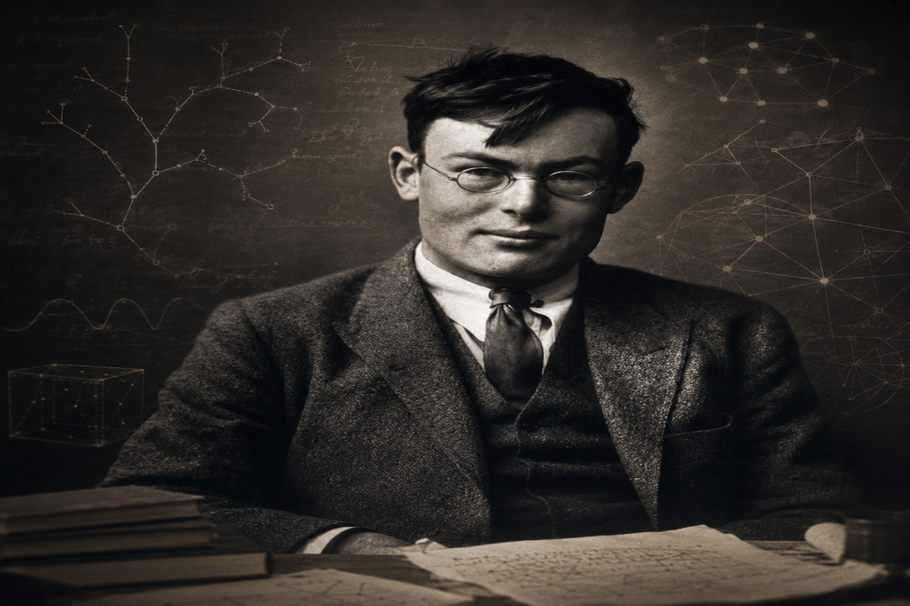


Moscow, shortly after the Revolution. A young man, barely twenty years old, has already worked as a conductor on the railroad, is simultaneously studying mathematics, history, and metallurgy, and is navigating a world in which political orders are crumbling and intellectual orders are emerging anew. He comes from a biographically fractured background: his mother died at his birth, his father was absent, and he was raised by an aunt and her sisters, who organized a small school based on what were then progressive educational ideas. For many, this would have been the stuff of a difficult life story. For Andrei Nikolayevich Kolmogorov, it became the starting point for a way of thinking that sought stability precisely where everything seemed uncertain. Not in the pathos of chance, but in its precise order. When the Russian mathematician Nikolai Nikolayevich Luzin took him on as a student in 1921, a career began that aimed at nothing less than giving probability itself a foundation.
From a turbulent start into mathematics
Kolmogorov's early life was marked by upheaval. His mother died on April 25, 1903, during his birth in Tambov while traveling from the Crimea to Tunoshna near Yaroslavl, where her father lived. His father, Nikolai Katayev, the son of a priest and a farmer, did not care for the boy; he was killed in 1919 during the Civil War. Kolmogorov therefore grew up with his mother's sister, Vera Yakovlevna Kolmogorova. Together with her sisters, she organized a small school based on progressive educational ideas. In retrospect, one can almost see this as a premonition: even before Kolmogorov systematized mathematics, he was learning in an environment that understood education not as mere memorization, but as intellectual development.
After moving to Moscow in 1910, he first attended a private, and later a public, secondary school. In 1920, he graduated from high school, worked for a time as a conductor on the railroad, and then began studying at Moscow University. The breadth of his early interests is remarkable. He took not only mathematics courses but also, in parallel, classes at the Mendeleev Institute of Chemistry and Technology, studied Russian history, and even delved into landowner cadastres in 15th- and 16th-century Novgorod. This intellectual breadth is no biographical footnote. It explains why Kolmogorov later never appeared merely as a specialist, but as a thinker who sought structures—in numbers, in texts, in natural processes, and ultimately even in art, literature, and music.
Lusin, Moscow, and the Rise of an Exceptional Mind
In 1921, Nikolai N. Luzin took him on as a student. This was a decisive step. Luzin belonged to that generation of Russian mathematicians who practiced analysis, set theory, and measure theory at the highest level. Kolmogorov rose through this world at breathtaking speed. Early on, that rare blend of technical prowess and conceptual boldness that would characterize his work became apparent. Later, Kolmogorov published around 500 scientific papers—a body of work of such breadth that it ranges from probability theory, measure theory, and turbulence to information theory, logic, and algorithmic complexity.
And yet it would be misleading to view Kolmogorov merely as a production machine of mathematical originality. His greatness lay not solely in the number of his works, but in their character. He repeatedly sought out the underlying structures. What are the minimal conditions under which a concept truly becomes robust? When is a result merely technical, and when is it truly fundamental? It is precisely this inclination that explains why, of all people, he wrote the book in 1933 that gave probability theory its form, which remains authoritative to this day.
1933: The Book That Gave Chance a Foundation
In 1933, Kolmogorov's textbook "Fundamental Concepts of Probability Theory" ("Grundbegriffe der Wahrscheinlichkeitsrechnung") was published in German by Springer-Verlag in Heidelberg. The title alone is of almost demonstrative sobriety. Here, there is no philosophizing about luck, risk, fortune, or the game of chance. Here, basic concepts are established. That is precisely where the historical achievement lay. Kolmogorov transformed a discipline that had drawn on gambling, statistics, physics, and intuition into an axiomatically clear mathematical theory. | 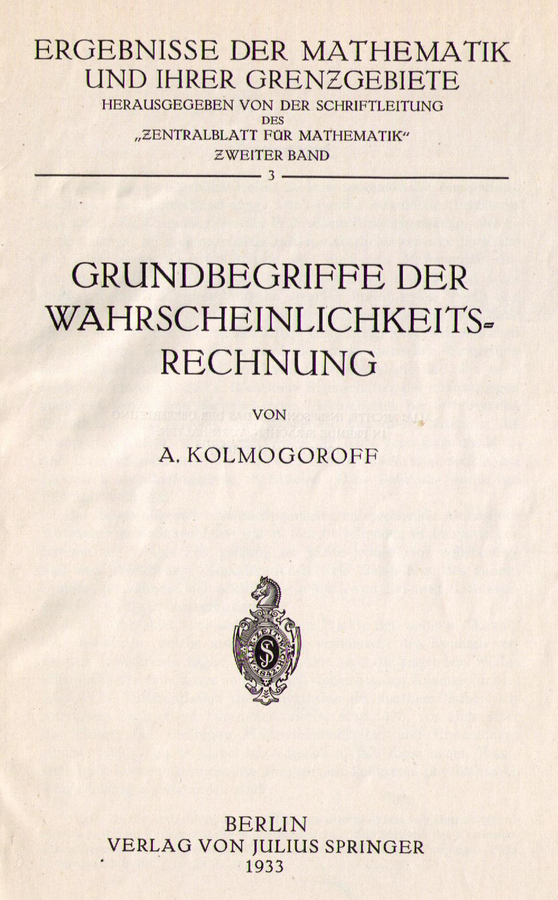 |
The basic idea was radical and elegant at the same time: Probability should no longer be motivated by illustrative examples or loose plausibility, but rest on a few clear rules. He formulated probability as a measure on a set of events. Put simply: First, one describes all the possible outcomes a random experiment can have. Then one defines which subsets of these are considered events. And finally, one assigns numbers to these events based on specific axioms. That sounds abstract, but it was precisely the abstraction the discipline had been lacking.
The Axioms
Kolmogorov's achievement was to give probability theory a form that is both simple and robust. At first glance, his axioms seem almost self-evident, yet it is precisely this simplicity that constitutes their strength. They define the minimum rules that any reasonable probability assignment must satisfy.
The first axiom states that probabilities can never be negative. Thus, for every event the following applies: P(A)≥0.
![Fig. 01: Axiom 1 [Source: Author's own illustration]](/fileadmin/_processed_/1/5/csm_Abb-01_Kolmogorow_20260512_ENG_d4ea20c81f.png "Fig. 01: Axiom 1 [Source: Author's own illustration]") Fig. 01: Axiom 1 [Source: Author's own illustration]
Fig. 01: Axiom 1 [Source: Author's own illustration]
This sounds trivial, but it is fundamental. A probability of minus 20 percent would not be an "unusual" probability, but rather no meaningful probability at all. The axiom thus states: Probabilities measure a form of possibility or weighting, but never a negative quantity.
The second axiom states that the entire sample space has a probability of 1: P(Ω)=1.
Ω denotes the set of all possible outcomes. So if one considers all conceivable outcomes of a random process together, then it must be certain that at least one of them occurs. The number 1 here stands for certainty or the "certain event." This axiom anchors the probability scale: 0 means impossibility, 1 means certainty.
![Fig. 02: Axiom 2 [Source: Author's own illustration]](/fileadmin/_processed_/6/8/csm_Abb-02_Kolmogorow_20260512_ENG_721c719666.png "Fig. 02: Axiom 2 [Source: Author's own illustration]") Fig. 02: Axiom 2 [Source: Author's own illustration]
Fig. 02: Axiom 2 [Source: Author's own illustration]
The third axiom describes how probabilities are combined. For two events and that are mutually exclusive—i.e., cannot occur simultaneously—the following applies: P(A∪B) = P(A) + P(B).
So if either one event or the other occurs, and the two do not overlap, then the probability of the "or" is simply the sum of the individual probabilities. More generally, Kolmogorov even formulates this for any number of pairwise disjoint events. It is precisely this that makes the theory applicable to complex models with many possible states.
![Fig. 03: Axiom 3 [Source: Author's own illustration]](/fileadmin/_processed_/4/0/csm_Abb-03_Kolmogorow_20260512_ENG_a701d00cec.png "Fig. 03: Axiom 3 [Source: Author's own illustration]") Fig. 03: Axiom 3 [Source: Author's own illustration]
Fig. 03: Axiom 3 [Source: Author's own illustration]
It is precisely in this formal restraint that the true power of the axiomatic framework lies. Kolmogorov did not prescribe whether one must choose a binomial distribution, a Poisson distribution, a normal distribution, or a scenario model in a specific case. He did something more fundamental: He defined under which conditions a statement about probability is mathematically consistent in the first place. This made it possible to translate very different problems—coin flips, loss events, loan defaults, machine malfunctions, cyberattacks, or supply chain disruptions—into the same language.
This is precisely why Kolmogorov's 1933 work was not merely a textbook exercise, but a kind of "constitution of modern probability theory." It created the framework within which later models, distributions, and applications could be clearly formulated and tested in the first place. This remains central to risk management to this day: Anyone working with probabilities needs not only data and models, but also a clear understanding of when these models are logically and mathematically sound [see Romeike/Stallinger 2021, p. 53 ff.].
Why this is crucial for risk management
This is where the bridge to modern risk management begins. Anyone modeling risks today almost always works on Kolmogorovian ground—often without realizing it. Loss distributions, scenario distributions, probabilities of default, stochastic simulations, value-at-risk models, or stress tests implicitly assume that there is a well-defined probability space, that events can be clearly described, and that the assigned probabilities are consistent.
This is precisely where the question of model validity lies. A model is not valid simply because it produces numbers. It is valid only if the mathematical structure and the empirical description of reality match. Kolmogorov's axioms do not guarantee that every specific risk model is sound. But they reveal where a model can fail: due to imprecise event definitions, hidden dependencies, incorrectly specified distributions, or a mixed or unclear state space.
Empirical studies on the interpretation of probability concepts show that this is precisely where a practical problem with qualitative risk assessments lies. Even seemingly unambiguous event states are often not treated axiomatically correctly in expert estimates and surveys: the excluded event is not necessarily described with p = 0, and the certain event is not necessarily described with p = 1. In Berger's study, although the median value assigned to the term "excluded" was 0%, 25% of respondents cited values of 10% or higher. The deviation was even more pronounced for the term "certain": the median was 95%, and the 25th percentile was as high as 70%. This demonstrates that linguistic probability terms, without precise event definitions and numerical calibration, do not provide a reliable basis for risk aggregation, scenario analysis, or stochastic simulation.
The Kolmogorov axioms do not automatically solve this problem, but they do make it methodologically visible: A probability model requires that the state space, the events, and the boundary cases of the impossible and the certain be clearly defined.
One could also say: Kolmogorov provided the foundation, but no building is stable simply because its foundation is mathematically correctly described. Anyone who validates a model in risk management is ultimately checking whether the building erected upon it still stands on this foundation or whether cracks have long since appeared between theory and reality.
The Misunderstanding of Certainty
This is precisely where an often-overlooked point lies. Kolmogorov's axioms make probability theory more rigorous, but they do not make the world safer. They do not eliminate uncertainty; they make it formally treatable. That is a major difference. A neatly defined model can still be empirically incorrect. A consistent probability distribution can still miss the mark. An elegant simulation can still be based on inappropriate assumptions.
For risk management, this is a salutary lesson. Model validity is not merely a technical verification of computational steps, but a test of the compatibility between mathematics and reality. Are the event definitions correct? Are the assumptions about independence tenable? Is the relevant state space fully captured? Are extreme events modeled as marginal phenomena, even though they can have systemic effects? Kolmogorov does not answer these questions in individual cases—but he makes them unavoidable.
More Than Probability: Kolmogorov the Teacher
Kolmogorov's work was not limited to basic research. For decades, he was deeply committed to the advancement of gifted children and adolescents. Under his initiative, a boarding school focusing on mathematics and physics was established at Moscow University, which later became Special School No. 18, often simply called the Kolmogorov School. There he not only taught mathematics but also gave lectures on art, literature, and music. This is more than a biographical footnote. It shows that Kolmogorov understood education not as a narrowing of the mind but as the shaping of the whole way of thinking.
As early as the 1930s, he was interested in mathematics education in schools. Together with Pavel Sergeyevich Alexandrov, a prominent Soviet mathematician and specialist in topology, he organized competitions in 1935 for mathematically gifted students—early precursors to the later Mathematical Olympiads. This, too, reveals his fundamental approach: for him, mathematics was never merely a specialized field, but a cultural technique of precision.
From Axioms to Algorithmic Complexity
It is noteworthy that, toward the end of his career, Kolmogorov once again turned to a re-foundation of probability—this time through the lens of algorithmic complexity theory. The question there was no longer merely how to assign probability to events, but how to describe the information content of individual objects. How long is the shortest program that generates a given string? When is something truly random—precisely because it can no longer be compressed?
One could see in this a late, almost poetic loop in his work. The young Kolmogorov gave probability an axiomatic form. The later Kolmogorov once again inquired into the inner structure of randomness itself. The two belong together. It shows that foundation and movement, axiom and application, rigor and openness were never opposites in his work.
Conclusion: The Foundation of Uncertainty
Kolmogorov belongs to those figures in the history of science whose achievements are difficult to describe precisely because they have become so fundamental. One often senses his work rather than seeing it directly. It lies beneath the surface of many models, simulations, tests, and forecasts like an invisible supporting structure. That is precisely why it is worth looking back. For it reminds us that serious work with uncertainty does not begin with spontaneous intuitions, but with clear concepts.
For modern risk management, this is a lasting reminder. Models need more than just data, computing power, and attractive output screens. They need a foundation. And this foundation consists of clear state spaces, consistent event definitions, traceable probabilities, and verifiable assumptions. Where this foundation is lacking, modeling easily devolves into numerical rhetoric. Where it is sound, the possibility of sensible work with uncertainty begins.
Perhaps this is the true relevance of Kolmogorov today. He did not take away the mystery of chance, but he gave thinking about it a structured form. And sometimes that is precisely the greatest achievement of a theory: that it does not reassure the world, but makes our judgment about it more robust.
Bibliography and Further Reading
- Kolmogorov, Andrei Nikolayevich (1933): Grundbegriffe der Wahrscheinlichkeitsrechnung [Fundamentals of Probability Theory], Springer Verlag, Berlin 1933.
- Kolmogorov, Andrei Nikolayevich (1950): Foundations of the Theory of Probability. Chelsea Publishing Company, New York 1950.
- Kolmogorov, Andrei Nikolayevich (1965): Three Approaches to the Quantitative Definition of Information. In: Problems of Information Transmission, Vol. 1, No. 1, pp. 1–7.
- Romeike, Frank / Stallinger, M. (2021): Stochastic Scenario Simulation in Business Practice - Risk Modeling, Case Studies, Implementation in R, Springer Verlag, Wiesbaden 2021.
- Shiryaev, Albert Nikolayevich (ed.) (2000): Kolmogorov in Perspective. American Mathematical Society, Providence, RI 2000.
- Yushkevich, Adolf Pavlovich (ed.) (1992): A. N. Kolmogorov: Selected Works. Vol. II: Probability Theory and Mathematical Statistics. Kluwer Academic Publishers, Dordrecht 1992.