


There are scientific breakthroughs that, in hindsight, seem so inevitable that one might think they were bound to happen. In the case of Black, Scholes, and Merton, the opposite is closer to the truth. In the late 1960s, Fischer Black and Myron Scholes were working on a problem that had long preoccupied the financial world: How do you determine a fair price for an option without getting lost in mere speculation about risk preferences? Almost simultaneously, Robert C. Merton gave the whole endeavor a second, mathematically more far-reaching form. The result was not an isolated flash of inspiration, but a triad: Black contributed the economic intuition and the courage to build models; Scholes, the connection to empirical financial economics; and Merton, the language of continuous time and stochastic dynamics. In 1973, this led to the publication of two papers that permanently changed the way we think about options. From then on, the option was no longer just a contractual curiosity, but a subject of systematic valuation.
The Background: Bachelier and Bronzin
Anyone who describes the Black–Scholes–Merton model as a sudden invention out of thin air is telling an incomplete story. As early as 1900, Louis Jean-Baptiste Alphonse Bachelier had developed a probabilistic approach to price movements in his dissertation "Théorie de la spéculation" and, within the framework of his standard model based on arithmetic Brownian motion, had also derived pricing formulas for options. Vinzenz Bronzin, an actuary and professor at the Commercial Academy in Trieste, published his theory of premium transactions in 1908 and arrived at remarkably early results in option pricing by a different route.
This comparison is particularly revealing. Bachelier thought primarily in terms of stochastic processes—that is, in terms of the movement of the price itself. Bronzin took a more pragmatic approach, starting from the contract and its payout structure. Black, Scholes, and Merton therefore did not start from absolute scratch, but rather at the point where earlier insights were synthesized into a model that was theoretically elegant, practically manageable, and institutionally compatible enough to actually change the markets.
The Three Protagonists
Fischer Black was perhaps the most unusual figure among the three. He did not come from the traditional path of an economist, but rather from physics, mathematics, and systems thinking. His intellectual agility made him particularly receptive to financial topics: he viewed markets less as a moral stage and more as a system of prices, relationships, and replications.
Myron Scholes brought a strong foundation in empirical financial economics to the table. He had been educated at the University of Chicago and moved in circles where data, market prices, and questions of efficiency were taking on a new role. Finally, Robert C. Merton, a student of Paul Samuelson—the Nobel laureate and leading exponent of modern mathematical financial and economic theory at MIT—formulated the same basic idea within a more general mathematical framework, thereby opening up an entire research program.
The true achievement of these three men lay not merely in a formula. It lay in productively integrating different modes of thought: economic intuition, statistical-empirical discipline, and stochastic-dynamic methodology.
The Decisive Step in 1973
In 1973, Fischer Black and Myron Scholes published their paper "The Pricing of Options and Corporate Liabilities" in the Journal of Political Economy. That same year, Robert C. Merton's "Theory of Rational Option Pricing" appeared in the Bell Journal of Economics and Management Science. The historical significance of these works lies not only in the fact that they provided a closed-form expression for the value of European options. More crucial was the insight that an option can be replicated through a dynamically adjusted position in the underlying security and in a risk-free asset.
This fundamentally shifted the perspective. The primary question was no longer: What risk premium does the market demand for this option? Instead, it became: "What trading strategy generates the same payoff path as the option?" If such a strategy can be constructed, then—under the model's assumptions—the option price must match the cost of this replication. It was precisely this concept of dynamic hedging that made the model revolutionary.
The Model in a Form Accessible to the General Public
In its basic form, the famous Black-Scholes formula values a European call option on a non-dividend-paying stock. A call option gives the holder the right, but not the obligation, to purchase the underlying stock at a predetermined strike price. The term "European" means that this right can be exercised only at the end of the term. Thus, the formula values the present price of a claim that is economically valuable only if the stock price on the expiration date is above the agreed-upon strike price. At its core, the formula depends on a few key variables: the current stock price, the strike price, the time to maturity, the risk-free interest rate, and the volatility of the underlying asset. The higher the current price, the longer the remaining term, and the greater the volatility, the more valuable—ceteris paribus—a call option is. Conversely, the higher the strike price, the less valuable it is.
In closed-form, the pricing equation for a European call is:
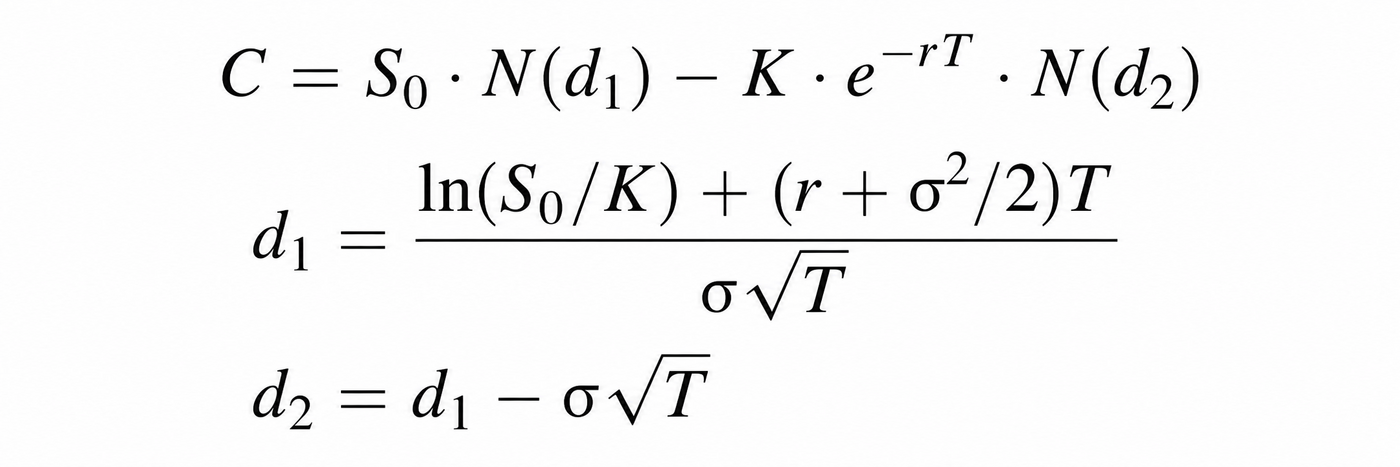 As the equation embedded in the text shows, the Black-Scholes formula condenses several theoretical levels into a single valuation rule. The distribution function expresses the probabilistic structure of the model, the exponential term represents the discounting of the future strike price, and volatility captures the degree of uncertainty regarding future price movements. In its overall structure, the equation indicates that the value of the option is not derived in isolation but rather from the possibility of replicating its payoff profile through a continuously adjusted trading strategy in the underlying asset and the risk-free asset.
From a methodological perspective, the model combines three levels: a stochastic model for price movements, a no-arbitrage argument for valuation, and a partial differential equation whose solution yields the option price. It was precisely this combination that gave the model its persuasive power: it was simultaneously economically plausible, mathematically elegant, and practically applicable for traders.
The Assumptions of the Original Black-Scholes Model
The elegance of the model rests on a series of strong assumptions. First, the price of the underlying asset follows a geometric Brownian motion process; equivalently, the logarithmic returns are normally distributed and the price itself is lognormally distributed. Second, volatility σ is assumed to be constant. Third, the risk-free interest rate is also constant.
Fourth, there are no transaction costs, no taxes, and no barriers to trading. Securities are freely divisible, short selling is possible, and investors can borrow or invest at the risk-free rate at any time. Fifth, the market can be continuously monitored and the hedging portfolio continuously adjusted. Sixth, the basic model does not account for dividend payments. And finally, the standard formula refers to European options—that is, contracts that can only be exercised at maturity.
None of these assumptions is harmless. Taken together, they create a world in which the market appears smooth, liquid, frictionless, and probabilistically well-behaved. It is precisely for this reason that the model became so analytically powerful. But it is also precisely for this reason that it later had to be criticized and expanded upon.
Why the Model Became So Powerful
Despite its simplifications, the Black–Scholes–Merton model was an intellectual shock to the financial world. It transformed a field considered speculative and only half-intuitive into a domain of mathematically formulable prices. The 1997 Nobel Prize citation succinctly summed it up: Scholes and Merton received the award "for a new method of determining the value of derivatives"; the press release explicitly emphasized that they had done so in close collaboration with the late Fischer Black and that their methodology had paved the way for more efficient risk management and new financial instruments.
In practice, the model quickly became far more than just a formula. It became a common language. Traders, risk managers, investment banks, and later regulatory authorities were suddenly able to operate using the same terms: delta, gamma, vega, implied volatility, hedging error, arbitrage relationships. Even where the model was demonstrably incorrect, it remained indispensable as a benchmark. That is the true cultural power of such models: they organize reality, even if they do not fully capture it.
The Weaknesses of the Model
Perhaps the best-known weakness concerns volatility. In the original model, σ is constant. Real markets behave differently. Realized volatility changes over time—it clusters, spikes, calms down, and explodes again. This is even more clearly demonstrated by options trading itself: When implied volatilities are calculated from market prices, the result is typically not a flat line, but a volatility smile or—as is often the case with stock options—a skew in volatility. This, in particular, is a strong empirical signal that the constant-volatility model only partially captures market prices.
A second weakness lies in the distribution assumption. The model is based on normally distributed logarithmic returns and thus on the tail ends of the distribution. From a risk management perspective, this is problematic. Real markets exhibit far more extremes, jumps, and skewness than a Gaussian world allows for. Sharp price declines, sudden gaps following news events, liquidity shocks, or systemic cascades are structurally underrepresented in such a framework. The model thus underestimates precisely those extreme events that become critical during periods of stress.
Third, the model assumes continuous hedging. In reality, no one can continuously adjust their positions without delay or cost. Between two hedging points, the market can move erratically. With illiquid securities, market stress, trading halts, or overnight news, the seemingly clean delta hedge becomes a discrete, error-prone, and potentially costly adjustment process. This is central to risk management: the model does not eliminate risk; it transforms it into rebalancing, liquidity, and model risk.
Fourth, the basic model ignores market frictions. Transaction costs, bid-ask spreads, financing costs, short-sale restrictions, and margin requirements are anything but negligible in practice. Especially for strategies with high gamma, these frictions can massively devalue the theoretical hedge.
Fifth, the basic formula is tailored to European options. American-style options, dividends, exotic payout structures, interest rate uncertainty, and credit risks require additional model layers or numerical methods. The model is therefore not wrong, but it is limited in its original scope.
Finally, the model has an institutional weakness: it can create a deceptive sense of precision. When a formula yields a price with several decimal places, it's easy to get the impression that uncertainty has been mastered. From a risk management perspective, this is precisely what's dangerous. The problem isn't the calculation method itself, but the confusion of model consistency with real-world accuracy. A clean price based on false assumptions remains a cleanly calculated error.
Black-Scholes-Merton and Risk Management
The dual nature of the model is particularly evident in risk management. On the one hand, it is indispensable. Without the Black-Scholes-Merton model, there would be no modern, widely accepted language for sensitivities, no standard methodology for the daily valuation of large option portfolios, and no common reference for implied volatilities. On the other hand, it also represents a classic case of model risk. It is an excellent starting point, but a poor substitute for the ultimate truth.
Anyone who manages risk in derivatives portfolios therefore knows that the real work begins only after the formula is applied: in the calibration of volatility surfaces, in stress tests, scenario analyses, gap risk assessments, liquidity assumptions, correlations, and the question of how a portfolio behaves outside the modeled world. Good risk management uses the model but does not blindly trust it. It treats the Black-Scholes-Merton model as a tool, not as an ontology.
Financial history, in particular, provides ample reason for this. The formula contributed to the professionalization of the markets, but it eliminated neither leverage risks nor incentive problems nor collective faith in the model. In this sense, the model is a triumph of methodology—and at the same time a reminder not to confuse methodology with reality.
Conclusion and Outlook
The Black-Scholes-Merton model remains one of the great intellectual achievements of modern financial economics. It created a quantifiable order out of a complex universe of contracts and placed thinking about derivatives on a new foundation. Black, Scholes, and Merton did not simply solve a technical problem; they changed the language in which markets speak about uncertainty.
Precisely because the model was so successful, its limitations became a source of productive innovation. Criticisms of constant volatility, thin distribution tails, and continuous hedging gave rise to numerous further developments: local volatility models, stochastic volatility models, jump-diffusion approaches, smile and surface calibrations, as well as robust numerical methods. Robert C. Merton himself contributed early on, with his jump-diffusion approach, to taking jumps and discontinuous price movements into account more fully.
Particularly insightful in this context is the CEV (Constant Elasticity of Variance) model. It makes local volatility dependent on the price level of the underlying asset and—especially for stocks—can better capture the empirically observed relationship that volatility rises when the stock price falls. Precisely for this reason, it often yields more realistic results than the original Black-Scholes model and forms an important bridge between analytical elegance and empirical plausibility.
Seen in this light, the enduring significance of Black, Scholes, and Merton does not lie in having discovered the ultimate truth about markets. It lies in having created a model against which, to this day, the capabilities of a good financial model are measured—and where it encounters the inevitable limits of risk, friction, and uncertainty.
Bibliography and Further Reading:
- Bachelier, Louis (1900): Théorie de la spéculation. In: Annales scientifiques de l'École Normale Supérieure, 3rd series, Vol. 17, pp. 21–86.
- Black, Fischer / Scholes, Myron (1973): The Pricing of Options and Corporate Liabilities. In: Journal of Political Economy, Vol. 81, No. 3, pp. 637–654.
- Black, Fischer (1976): Studies of Stock Market Volatility Changes. Proceedings of the 1976 Meetings of the American Statistical Association, Business and Economic Statistics Section, pp. 177–181.
- Merton, Robert C. (1973): Theory of Rational Option Pricing. In: Bell Journal of Economics and Management Science, Vol. 4, No. 1, pp. 141–183.