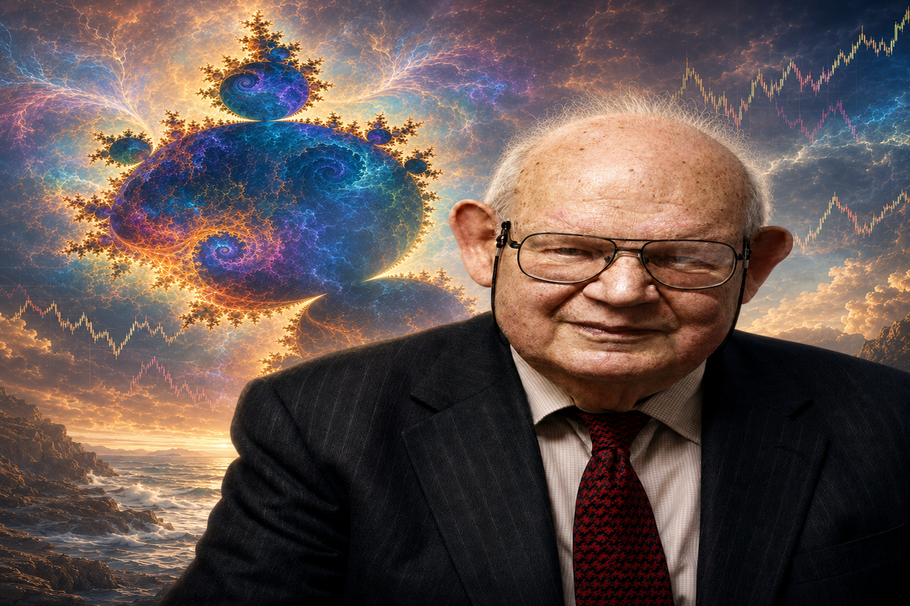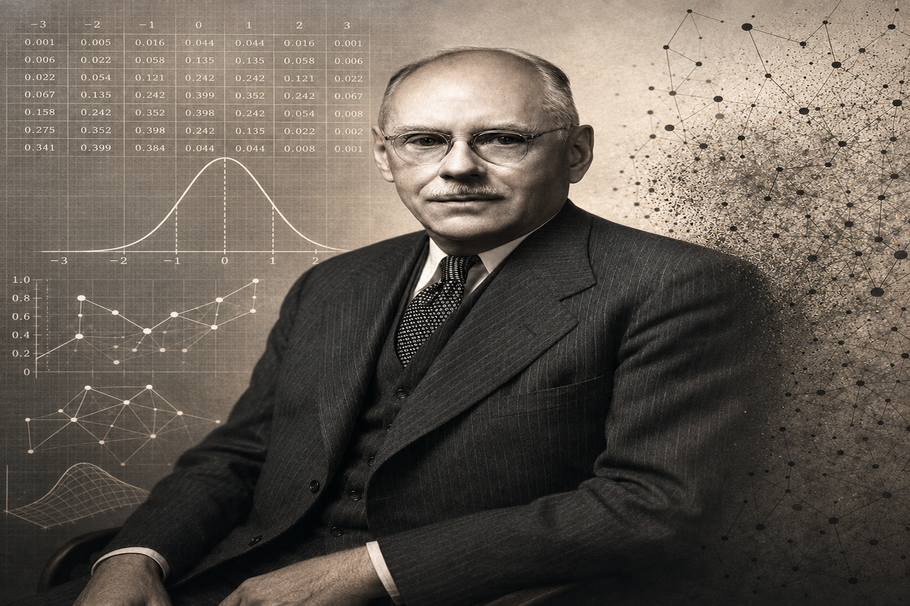

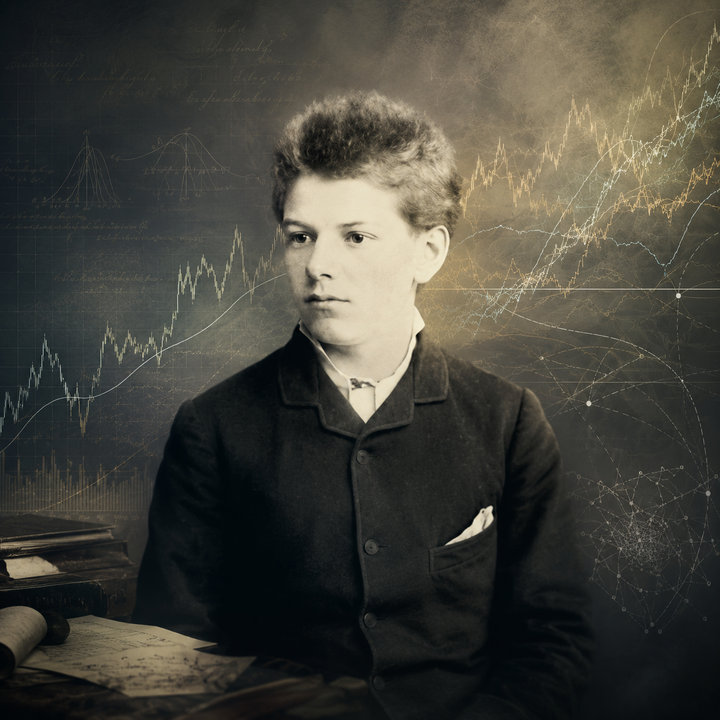
In the history of science, there are those peculiar biographies in which an idea is far ahead of its time and, for that very reason, initially has almost no impact. In the case of Louis Bachelier, this story does not begin in a grand Parisian mathematics salon, but rather amid a biographical upheaval. After his parents died young, he initially joined the family business. There, he came to know the capital markets not as an abstract textbook problem, but as a practical, volatile world driven by expectations and sentiment. It was only later, at the age of 22, that he began studying mathematics at the Sorbonne. One could say: Bachelier did not come to the stock market from pure theory, but rather from the stock market to theory. Perhaps this was precisely where his unique perspective lay. He saw stock prices not merely as prices, but as movements under uncertainty—and wondered whether these movements could be described using the tools of probability. When he submitted his dissertation, "Théorie de la spéculation", in 1900 under the supervision of Henri Poincaré—one of the most prominent French mathematicians, physicists, and philosophers of science of his time—he did something that the academic world would not truly grasp until decades later: he brought stochastics to the markets.
An Unusual Path into Mathematics
Louis Jean-Baptiste Alphonse Bachelier was born in Le Havre in 1870. His background combined commerce, banking, and a middle-class upbringing. It is precisely this background that explains why the financial market was not an exotic subject to him. Following the early death of his parents, he first had to take on responsibilities within his family before he could pursue an academic path. This delayed his career but also gave it a distinctive character: Bachelier never thought entirely like a pure academic, but always also like someone who knew the world of speculation and prices from firsthand experience and entrepreneurial practice.
When he began studying mathematics at the Sorbonne in Paris at the age of 22, his educational path was therefore not a straightforward one, but rather a late start. Yet it was precisely during this later phase that he developed an idea of astonishing scope. Under the guidance of his doctoral advisor, Henri Poincaré, he worked on the question of whether price movements in markets could be described probabilistically. The choice of this topic was bold. For at the time, the stock market was not regarded as a respectable subject of mathematical theory, but rather as a disreputable realm of speculation.
Architect of Modern Financial Mathematics
With his dissertation "Théorie de la spéculation", defended in 1900, Bachelier broke new scientific ground. He sought a probabilistic approach to stock price movements and modeled price paths using a logic that can be interpreted today as a precursor to the Vienna Process. In doing so, he was strikingly ahead of his time. What would later become known as Brownian motion—a cornerstone of modern probability theory and financial economics—already appears in his work five years before Einstein's famous paper on Brownian motion.
Even more remarkable is that Bachelier did not stop at a qualitative intuition. He formulated explicit pricing formulas for standard options—calls and puts—and even for barrier options. In doing so, he analytically addressed problems that would not become world-famous until 73 years later with Black, Scholes, and Merton. In this sense, Bachelier is not only a forerunner of modern financial mathematics but, in a precise historical sense, its first great architect.
His true pioneering achievement, however, runs even deeper. Bachelier no longer treated markets merely as places of trade but as spaces of stochastic motion. He made speculation mathematically respectable by modeling it rather than moralizing about it.
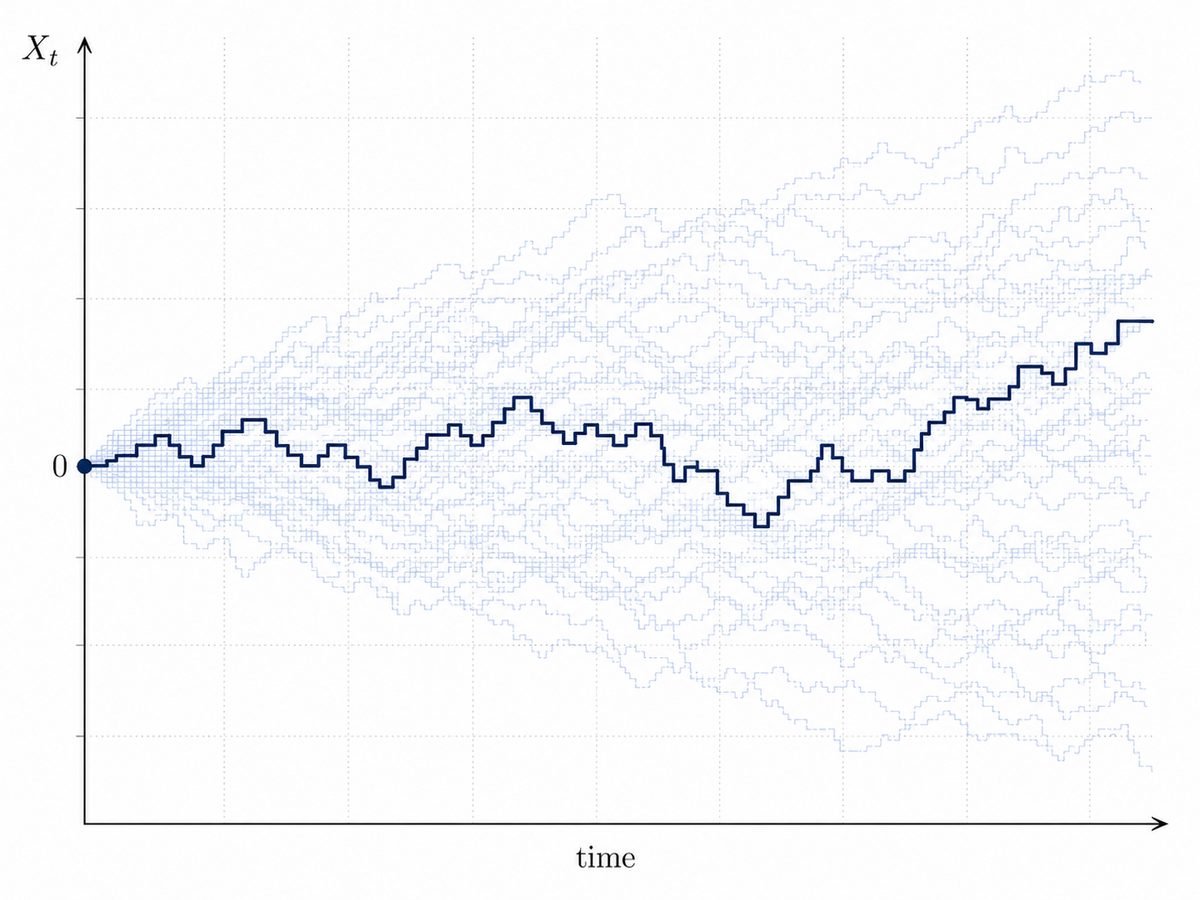 Fig. 01: Simulated price paths using a "stochastic process"
Ahead of His Time
It is precisely this pioneering achievement that also explains his fate. Bachelier was so far ahead of his time that the mathematical and academic community could scarcely grasp his significance. Until the outbreak of World War I, he eked out a living as a scholarship holder and independent lecturer at the Sorbonne. However, he was denied a firm foothold among the mathematical elite in Paris. Many considered his work insufficiently rigorous, too marginal, and perhaps even too focused on a subject perceived as frivolous: speculation.
Particularly fateful was his feud with Paul Lévy. Lévy accused Bachelier of serious errors, thereby contributing to the failure of his appointment to the University of Dijon in 1926. As it later turned out, this criticism was based on a misreading; Lévy did not apologize until 1931. For Bachelier, this belated correction came too late. His academic career remained marked by temporary positions and a limited institutional scope. After the war, he accepted a professorship in Besançon and remained far removed from the center of mathematical attention.
This biographical context lends his work an almost tragic note. Bachelier had found a language for the markets that the 20th century would later desperately need—but his contemporaries scarcely heard it.
Stochastics in Markets: The Real Breakthrough
Why is Bachelier so important today? Not only because he was ahead of his time, but because he framed a problem in a new way. He viewed price movements as realizations of a random process. This was more than just a technical idea. It meant that the future of prices cannot simply be deduced from fixed fundamentals, but must be modeled as a process under uncertainty.
This perspective marks the true beginning of modern financial mathematics. It shifts the focus from speculation as a psychological or moral category to speculation as a stochastic process. In doing so, Bachelier opened up a field of research that would later become a core component of modern financial economics through Brownian motion, diffusion processes, arbitrage considerations, and option pricing.
In a sense, he therefore stands at a remarkable historical turning point. Before him, the market was primarily the subject of economics or commercial practice. With him, the market became the object of mathematical probability theory.
Bachelier and Einstein, Bachelier and Black–Scholes, Bachelier and Bronzin
Historically, Bachelier has often been overshadowed by later figures. The comparison with Albert Einstein, the physicist and founder of the theory of relativity, is evident not only chronologically but also methodologically: Both treated seemingly erratic individual movements not as mere chaos, but as an expression of an underlying random mechanism. Just as Einstein, a short time later, interpreted Brownian motion as the result of many microscopic collisions, Bachelier modeled price movements as a stochastic process—that is, as a sequence of many small influences that are, taken individually, unpredictable. In both cases, the methodological point is not to dismiss irregularity but to formalize it probabilistically.
The comparison with Fischer Black and Myron Scholes, the pioneers of modern option pricing theory, is equally illuminating. Here, too, it is not merely a matter of Bachelier having provided early pricing formulas for options. The deeper parallel lies in the fact that both Bachelier and Black and Scholes view markets as mathematically modelable patterns of movement. Uncertainty is not treated as mere vagueness, but is translated into a formal structure from which valuation rules can be derived. The difference, of course, is just as important: While Black and Scholes were able to build upon a well-developed institutional and mathematical foundation of stochastic analysis, arbitrage arguments, and hedging logic, Bachelier formulated this approach in an early, conceptually astonishingly bold form.
Vinzenz Bronzin, the actuary based in Trieste and an early theorist of futures and options trading, also belongs in this context. Methodologically, Bronzin is closer to Bachelier than the history of science has long recognized: Both sought a precise mathematical language for derivative contracts, and both treated price fluctuations not merely as a matter of commercial experience but as the subject of formal analysis. The difference lies primarily in their approach. Bronzin relied more heavily on payout profiles, tables, and algebraic valuation relationships; Bachelier, on the other hand, thought more in terms of processes—that is, starting from the dynamics of price movement itself. Bronzin primarily developed mathematical models for the valuation of contracts, while Bachelier sought to mathematically describe the market's price movements themselves.
It is precisely in this regard that Bachelier remains the most symbolically significant figure. He linked random walks, speculation, and valuation in a way that can only be fully appreciated in retrospect. His works are therefore not merely historical curiosities, but the embryonic forms of a later paradigm: the insight that markets can be not only described economically but also modeled as stochastic systems and valued on that basis.
Why His Contemporaries Did Not Understand Him
There were several reasons for the skepticism of his contemporaries. For one thing, the mathematical rigor of his argumentation was not always satisfactory from the perspective of the elite of the time. For another, his subject matter cut across disciplinary hierarchies. The stock market was not a traditional subject of complex mathematics or stochastics. Anyone who wrote about speculation quickly found themselves outside the bounds of what was considered serious scholarship.
Yet it is precisely here that a recurring pattern in the history of science becomes apparent. Some ideas fail not because of their own weaknesses, but because of the inability of their environment to recognize their significance. Bachelier did not write for a world that was already waiting for financial mathematics. He wrote for a world that did not yet know it would one day need it.
Belated Recognition
When Bachelier died in 1946, his stature was by no means universally recognized. It was only after his death that people gradually began to appreciate the visionary power of his ideas. Over the course of the 20th century, it became increasingly clear that here had worked a thinker who had anticipated, in a remarkably early way, central elements of modern probability theory, market modeling, and option pricing.
Today, Bachelier is rightly regarded as the founder of financial mathematics. The fact that the international financial mathematics society bears the name "Bachelier Finance Society" in his honor is therefore more than a belated symbolic tribute. It is the institutional recognition of a seminal intellectual achievement.
Bachelier in Today's Risk Management
For today's risk management, Bachelier is not merely an interesting historical figure. His thinking marks the moment when market movements came to be understood as stochastic processes. It is precisely from this that later models of volatility, scenario simulations, derivative valuations, VaR approaches, and many other tools emerged—tools with which modern organizations attempt to structure uncertainty in markets.
Of course, Bachelier's model is not simply identical to today's approaches. For example, it allows for negative prices, which was later discussed as a weakness compared to log-normal models. Yet it is precisely this difference that demonstrates how productive his fundamental idea was. He asked the right question: How can price movements be modeled probabilistically? Whoever asked this question first had, in essence, already pioneered the field.
Conclusion and Outlook
Louis Bachelier is one of those scientists whose significance extends beyond his own lifetime. He brought stochastics to the markets when hardly anyone suspected that it would one day become an entire discipline. He applied random processes to stock prices before Brownian motion became famous in physics. He formulated pricing theories for options long before modern derivatives mathematics turned them into an institutionalized field of knowledge.
Precisely for this reason, his work remains more than just a historical foundational text to this day. It serves as a reminder that financial markets are not only economic phenomena but also probabilistic ones. Anyone who wants to understand markets must consider not only balance sheets, interest rates, and valuations, but also movement, chance, and distribution.
The outlook is thus twofold. On the one hand, Bachelier has long since become part of the foundation of modern financial mathematics. On the other hand, rereading his work is particularly worthwhile today because it reveals how closely markets, stochastics, and risk have been intertwined from the very beginning. Bachelier was not merely a pioneer. He was the first to realize that the language of markets remains incomplete without the language of chance.
Bibliography and further reading:
- Bachelier, Louis (1900): Théorie de la spéculation. In: Annales scientifiques de l'École Normale Supérieure, 3rd series, Vol. 17, pp. 21–86.
- Bachelier, Louis (1901): Théorie mathématique du jeu. In: Annales scientifiques de l'École Normale Supérieure, 3rd series, Vol. 18, pp. 143–210.
- Bachelier, Louis (1914): Le Jeu, la Chance et le Hasard. Ernest Flammarion, Paris 1914.
- Bieta, Volker / Romeike, Frank (2013): Bachelier's Heirs in the Banking Sector—Quantitative Analysis in the Financial Industry, in: RISIKO MANAGER, 01/2013, pp. 16–28.
- Davis, Mark / Etheridge, Alison (2006): Louis Bachelier's Theory of Speculation. The Origins of Modern Finance, Princeton University Press, Princeton/Oxford.
- Romeike, Frank (2007): Louis Bachelier (Köpfe der Risk-Community) [Leaders of the Risk Community], in: RISIKO MANAGER, Issue 21/2007, pp. 24–26.
- Romeike, Frank / Stallinger, Manfred (2021): Stochastische Szenariosimulation in der Unternehmenspraxis - Risikomodellierung, Fallstudien, Umsetzung in R [Stochastic Scenario Simulation in Business Practice—Risk Modeling, Case Studies, Implementation in R], Springer Verlag, Wiesbaden 2021.
- Weatherall, James Owen (2013): The Physics of Wall Street: A Brief History of Predicting the Unpredictable, Houghton Mifflin Harcourt, Boston/New York 2013.