
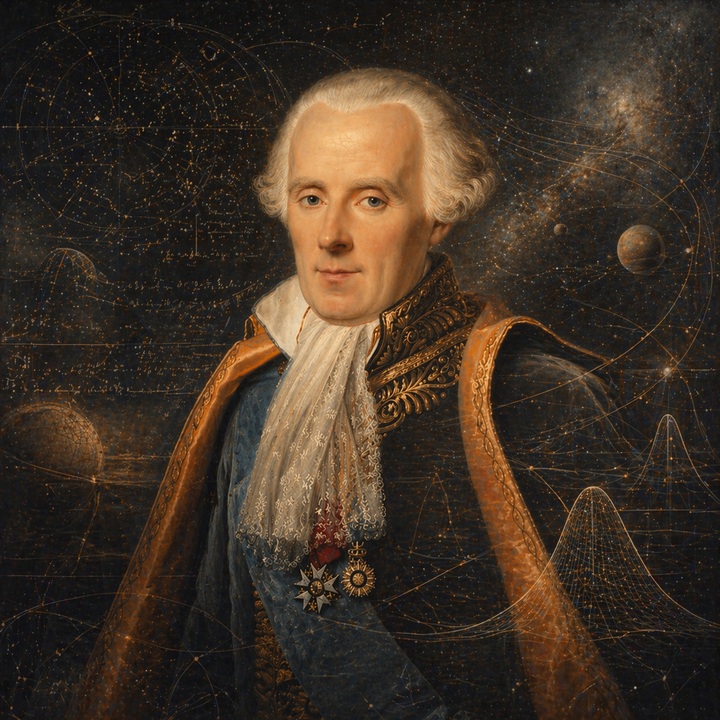
There are certain historical scenes that seem almost too good to be true – and yet, precisely for that reason, they reveal something essential about an era. One such scene takes place in Napoleonic France. The emperor, accustomed to putting generals, ministers, and scholars on the spot, has Pierre-Simon Laplace before him. Before him lies a work that is almost unsurpassed in its audacity: a mathematical description of the heavens, the planetary orbits, the perturbations, the grand order of the cosmos. Napoleon, half curious, half provocative, is said to have asked why there was no mention of the Creator anywhere in this monumental edifice of celestial mechanics. Laplace's reply has become famous: he had no need for that hypothesis.
More than a Calculator of the Heavens
The point of this anecdote lies not in any supposed boldness of conviction, but in a methodological demarcation. Laplace wanted to show that natural processes can be explained by mathematical means to such an extent that no additional auxiliary hypotheses need be introduced to describe their course. It was precisely this stance that made him a key figure in modern science: not merely as an astronomer, physicist, and mathematician, but as a thinker on uncertainty.
Pierre-Simon Laplace was born in Normandy in 1749 and rose to become one of the most influential scholars of his time in Paris. He worked on the stability of the solar system, celestial mechanics, error analysis, statistics, and probability theory. His fame rests on formulas, operators, and theories that still bear his name today. But intellectually, another step is perhaps even more important: Laplace took probability out of the narrow world of games and betting and made it a general tool for judgment under incomplete knowledge.
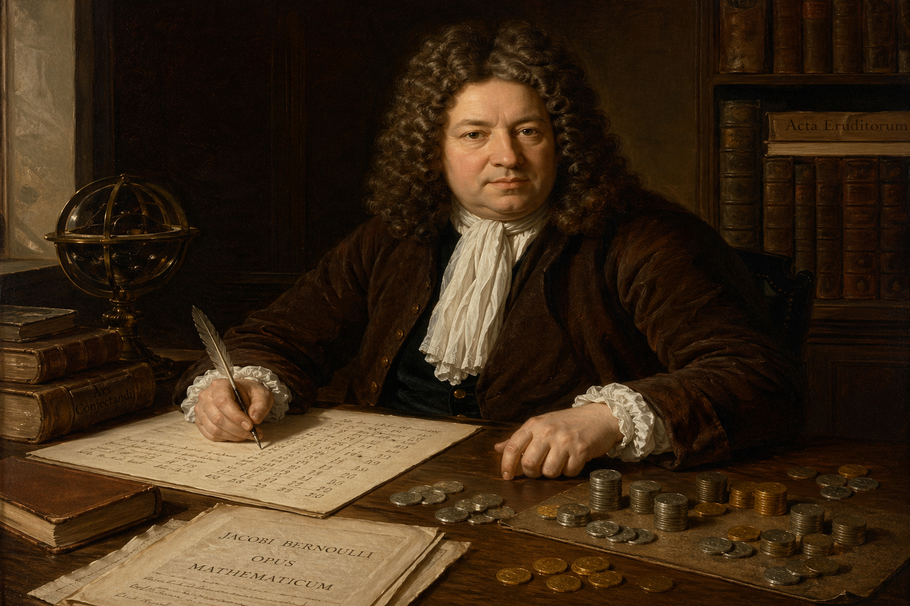
This fundamentally shifted the focus of probability. For Blaise Pascal, Pierre de Fermat, and Jakob Bernoulli, the subject was still heavily centered on dice, coins, sequences, games of chance, and regular repetitions. Laplace took up this legacy, but he systematically expanded it. For him, probability was not merely a mathematical art for random experiments, but a measure of how reasonable a judgment is when the causes are not fully known. It is in this shift that his true breakthrough lies.
From chance to ignorance
Laplace articulated this idea with remarkable clarity: What we call probability is often nothing more than a measure of our ignorance. The world itself may be causally ordered; however, we humans usually lack complete information about forces, initial conditions, dependencies, and disturbances. This is precisely why we need probabilities – not because reality necessarily rolls the dice, but because our knowledge is limited.
The significance of this perspective cannot be overstated. It makes probability an epistemic discipline. Laplace did not merely ask: How frequently does an event occur? Above all, he asked: What can we reasonably believe when we have only incomplete evidence? In doing so, he brought the theory of probability into the realm of forecasting, diagnosis, and decision-making – that is, precisely those areas where risk management begins today.
In his "Essai philosophique sur les probabilités" (Philosophical Essay on Probabilities), Laplace articulated an insight that remains astonishingly modern to this day: Almost all human knowledge is based not on certainty, but on probability. Even where we strive for certainty, we often work with induction, analogy, and incomplete observations. For him, probability is therefore not a marginal phenomenon, but the fundamental form of practical reason. This is the true modernity of Laplace.
The Bayesian Extension
It is precisely here that Laplace's contribution to what is today broadly referred to as Bayesian thinking begins. Thomas Bayes had formulated a rule that allows prior knowledge and new observations to be linked. Laplace, however, turned this idea into far more than a rarely cited mathematical curiosity. He systematically developed it further, generalized it, and applied it to real-world problems: demographic estimates, astronomical observational errors, judgment problems, and forecasts.
What is crucial here is not just the formula, but the line of thinking. One does not start with a blank slate of certainty, but with a preliminary state of knowledge. New evidence alters this state. Probability is then not merely a tally of past frequencies, but the ongoing revision of reasonable expectations. Seen in this light, Laplace is one of the great architects of the idea that learning under uncertainty can be described mathematically.
A classic example of this is the so-called law of succession. If an event has always occurred up to this point, how confident can one be that it will occur again? Laplace sought to answer such questions not intuitively or rhetorically, but formally. It is precisely here that his affinity with modern forecasting models becomes apparent: the past provides information, but never complete certainty; every new piece of data shifts the assessment of the future.
Why Laplace is so relevant to risk management today
Anyone analyzing risks today in companies, banks, insurance firms, or government agencies often thinks along the lines Laplace laid out – often without realizing it. This is because modern risk analysis thrives on translating incomplete information into structured judgments. The question is which future paths are plausible, what probabilities we assign to them, and how new information changes the assessment.
This is precisely where the link to scenario analysis lies. A good scenario is not fiction, but a formalized conjecture about possible future states. Laplace would have grasped the basic idea immediately: We do not know the future, but we can organize our uncertainty based on known influencing factors, plausible assumptions, and new evidence. Scenarios are thus not mere narratives of the future, but analytical testing grounds in which companies can systematically think through, evaluate, and utilize potential developments for decision-making despite incomplete knowledge.
The same applies to forecasts. Whether economic trends, loss frequencies, failure rates, cyber incidents, or sales fluctuations –the goal is always to derive a robust probability structure for future developments from incomplete and often noisy information. In modern statistics, this involves distributions, confidence or credibility intervals, forecast intervals, and ongoing model updates. At its core, however, the intellectual process remains the same: uncertainty is not suppressed, but rather transformed into an explicit, verifiable, and actionable form.
This becomes particularly clear in Bayesian statistics. There, existing assumptions or prior information are not ignored, but are systematically linked to new observations and continuously revised. Forecasting then appears not as a one-time glimpse into the future, but as a learning process under uncertainty.
Laplace's perspective also guards against a common misconception. Forecasts are not certainties in disguise. Those who calculate probabilities do not produce a certain future, but rather a disciplined form of uncertainty. This is precisely why every serious risk analysis includes not only point estimates, but also ranges, alternative assumptions, sensitivities, and extreme cases. Today, Laplace might be seen as a champion of forecast humility.
A simple example from the present
Imagine a European chemical or automotive supplier that sources a critical intermediate product or electronic component primarily from the Gulf region. For years, the supply chain was robust: regular shipments, predictable transit times, few quality issues, and few operational surprises. Yet it is precisely this supposed normality that begins to falter when the geopolitical situation at a maritime chokepoint deteriorates. A current example is the Strait of Hormuz. The International Energy Agency describes it as one of the world's most critical oil transit corridors; in 2025, an average of around 20 million barrels of crude oil and petroleum products were transported there daily, accounting for about a quarter of global seaborne oil trade. At the same time, in mid-April 2026, Hapag-Lloyd reported network disruptions, rerouting, and delays due to the crisis in the Upper Gulf region.
In such a situation, a Laplacian approach would not be satisfied with the observation that "it has always worked so far." Instead, it would model several plausible future scenarios and continuously re-evaluate them. In the Best Case, the passage remains open; ships operate under heightened safety protocols; and there are only moderate delays of a few days, along with limited additional costs for freight and insurance. In the realistic case, military tensions, port congestion, and cautious scheduling by shipping companies lead to repeated rerouting, longer transit times, higher procurement costs, and temporary production bottlenecks. In the worst-case scenario, the bottleneck becomes effectively impassable or commercially unattractive; deliveries are canceled for weeks at a time, safety stock levels are insufficient, alternative sources of supply are not available in the short term, and a logistics problem turns into a risk to earnings, liquidity, and reputation.
This is exactly how modern risk management works at its best: not as a panic reaction or a reassurance, but as a structured process based on incomplete information. New information – such as ship movements, insurance premiums, political signals, port reports, or indications of alternative procurement channels – continuously shifts the weighting of the scenarios. Laplace provided the framework for this: ignorance is not a reason to suspend judgment; it is a reason to make the form of the judgment more precise.
Measuring uncertainty
Perhaps this is precisely where Laplace's enduring greatness lies. He did not simply "further develop" probability, as is often claimed in concise histories of science. He applied it to a new subject: ignorance under uncertainty. This may sound abstract, but it has enormous implications. For once this step is taken, probability becomes a universal tool for decision-making. Then it no longer concerns only dice and cards, but judges and doctors, governments and companies, astronomers and risk managers.
At the same time, there is a productive tension in Laplace's thinking. On the one hand, there is the dream of complete predictability – made famous by the figure of the so-called Laplacean demon, that hypothetical intelligence which, with perfect knowledge of all forces and states, could grasp both the past and the future equally. On the other hand, for real people, this very idea leads to the opposite of a fantasy of omnipotence: because we are not demons, we need probabilities. Not as a substitute for thinking, but as its most sober form under conditions of limited knowledge.
To this day, this remains a key principle of risk management. The quality of a decision rarely depends on the elimination of uncertainty. It depends on whether uncertainty is honestly acknowledged, plausibly structured, and continuously reconciled with new evidence. Scenario analysis, forecasting, early warning systems, and stochastic models thus belong to a tradition that is far older than many of their modern-day tools. They all follow Laplace's insight that forecasts do not serve to make the future certain, but to illuminate the unknown as precisely as possible.
Viewed in this light, the famous scene with Napoleon can be interpreted differently. Laplace did not merely say that he did not need a hypothesis. He demonstrated that science becomes powerful when it learns to work within defined limits. His theory of probability is therefore not the abolition of ignorance, but its methodical taming. And perhaps this is precisely where its enduring relevance lies: not in the illusion of possessing the future, but in the art of approaching it with well-founded caution.
Bibliography and Further Reading
- Hahn, Roger (2005): Pierre Simon Laplace, 1749–1827: A Determined Scientist, Harvard University Press, Cambridge, Mass., 2005.
- Laplace, Pierre-Simon (1814): Essai philosophique sur les probabilités, Courcier, Paris 1814. https://www.digitale-sammlungen.de/view/bsb10082256?page=6%2C7
- Laplace, Pierre-Simon (1812): Théorie analytique des probabilités V. Courcier, Paris 1812. https://www.digitale-sammlungen.de/view/bsb10054066?page=4%2C5
- Laplace, Pierre Simon (1996): Philosophical Essay on Probability: (1814). Edited by Richard von Mises. Reprint, 2nd edition. Thun, Frankfurt am Main 1996.
- Romeike, Frank (2007): Pierre-Simon (Marquise de) Laplace, in: RISK MANAGER, Issue 3/2007, page 20.