
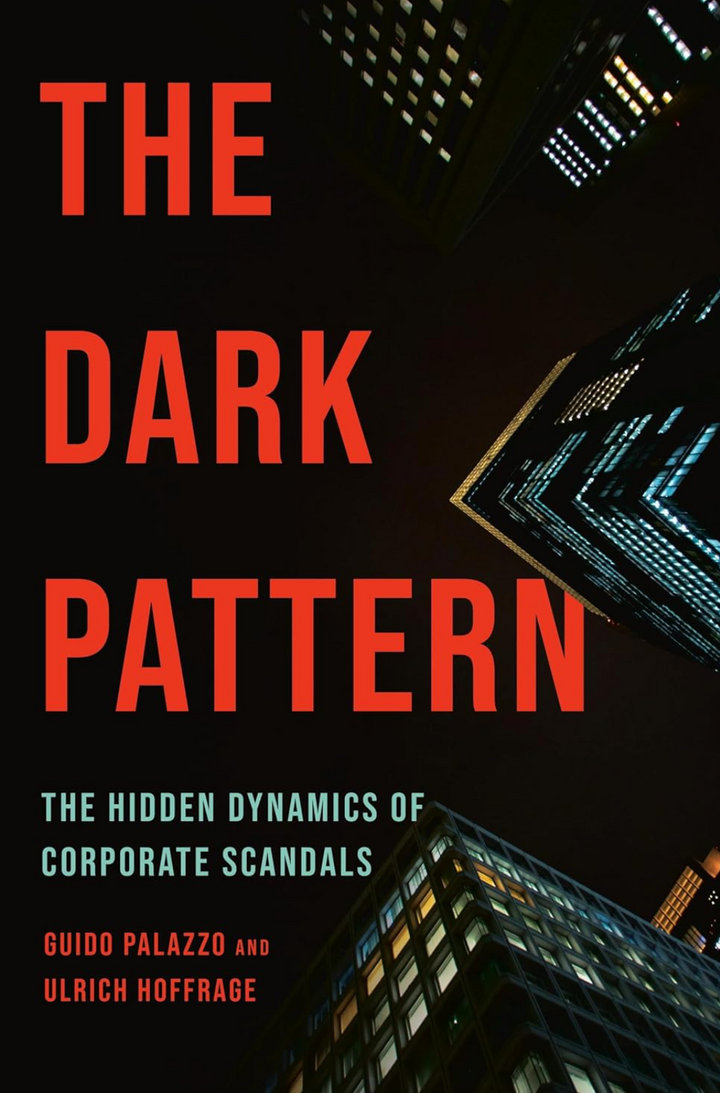
In 'The Dark Pattern', Guido Palazzo and Ulrich Hoffrage examine the hidden dynamics of corporate scandals. The book does not start with the convenient explanation that scandals are primarily the work of a few "bad apples". It is precisely this narrative that is reassuring: one identifies a culprit, gets rid of them, writes a new "Code of Conduct", and can then pretend that the organization itself is healthy. Palazzo and Hoffrage consider this narrative dangerously simplistic. They show that moral failure often arises from a context that gradually leads normal, fundamentally decent people into ethical blindness.
The term "dark pattern" is deliberately used here in a different sense than in the narrower context of digital design, where it refers to manipulative user interfaces. Palazzo and Hoffrage apply the idea to organizations: Companies, too, can develop patterns that steer decisions in a certain direction. These patterns are not always formally prescribed; they arise from strategy, language, goals, power, incentive systems, rules, group membership, and creeping habituation. The danger lies in the fact that those involved often feel rational, loyal, performance-oriented, or even morally justified within this pattern.
The book’s structure follows a clear logic. First, the authors develop the theoretical framework: this refers to mechanisms through which people cease to perceive moral problems, shift responsibility away from themselves, follow cognitive biases, conform to group pressure, and gradually accept questionable behavior in organizations as normal. They then apply this framework to prominent corporate scandals. Based on publicly available examples, Theranos, Uber, Wells Fargo, France Télécom, Boeing, Volkswagen, and Foxconn, among others, are outlined as key case studies. The value of this insight lies in interpreting these cases not as isolated disasters, but as variations of a recurring pattern.
The book’s strength lies in the fact that it does not moralize, but rather diagnoses. It does not primarily ask, " Who was at fault?", but rather: "What conditions had to align for normal management decisions to turn into a scandal?" For governance, risk management, compliance, and internal audit, this shift is crucial. It compels us not only to pursue rule violations but also to observe the conditions under which they arise.
The central message: Corporate scandals rarely begin with a major breach of taboos. They begin with small shifts: a goal that is unattainable; language that renders harm invisible; a boss who punishes dissent; a rule that is officially in place but informally circumvented; and a group that reinforces to one another that "everyone does it this way".
An overview of the nine elements of the Dark Pattern
The nine elements of the Dark Pattern form the analytical core of the book. They are not isolated sources of error, but function as an organizational pattern: a rigid ideology can legitimize toxic leadership; toxic leadership can foster manipulative language; manipulative language can normalize corrupting goals; and individual deviations from goals can lead to a gradual escalation through destructive incentives, ambiguous rules, and peer pressure. It is precisely this interplay that makes the approach interesting for governance, risk management, compliance, and internal audit.
Importantly, the elements do not constitute a checklist in the strict sense. Rather, they are diagnostic spotlights. They help identify early warning signs ("weak signals") in organizations before a scandal becomes visible. A single element does not necessarily trigger a scandal. It becomes dangerous when several elements occur simultaneously and reinforce each other: ambitious goals collide with aggressive bonuses, compliance rules are officially emphasized but informally downplayed, and critical voices are labeled as disloyal or obstructive.
The nine elements are therefore also a tool for prevention: those who recognize them early can take countermeasures before small shifts lead to systemic failure.
Rigid Ideology: When a belief system narrows thinking
The first element is rigid ideology. This does not refer to an abstract political commitment, but rather to a dominant interpretive framework within the company: "The market will sort it out", "Costs must be cut at any price", "Growth is the only truth", "Shareholder value trumps all", or "Disruption justifies harshness". Such an ideology does not necessarily officially replace ethics. However, it effectively renders ethics secondary. Decisions are then no longer evaluated comprehensively, but only according to whether they fit into the prevailing framework.
Palazzo and Hoffrage thus demonstrate that scandals often do not arise in a moral vacuum, but within a seemingly rational management system. Ideologies are particularly dangerous because they simplify decision-making. They provide quick answers, reduce ambivalence, and reward those who conform most consistently to the dominant narrative.
Boeing can be cited as an example where a strong focus on costs, schedule, and competitiveness undermined the safety culture. The two crashes of the 737 MAX in 2018 and 2019 demonstrate how dangerous it becomes when engineering concerns, safety issues, and regulatory transparency take a back seat to market and efficiency pressures. This example does not mean that a single ideology alone explains the accident. However, it shows how a narrow set of priorities can shift the perception of risks.
For risk management and oversight, the lesson is clear: An organization must regularly examine which unspoken assumptions shape its decisions. Not only explicit risks belong on the agenda, but also the question of whether strategic narratives systematically obscure risks.
Toxic Leadership: When Leadership Generates Fear Instead of Responsibility
Toxic Leadership describes leadership that discourages dissent, creates dependency, prioritizes loyalty over truth, and evaluates people based on utility rather than judgment. Such leadership can be authoritarian, narcissistic, Machiavellian, or simply cynical. What matters is not only the character of individual leaders but the effect on the system: People learn that criticism is dangerous and that conformity is rewarded.
The book is particularly effective here because it does not psychologize leadership in isolation. Toxic leadership becomes an organizational mechanism. It changes what employees feel they can say. It determines whether problems become visible early on or whether they disappear into meetings, PowerPoint slides, and reporting chains.
The debate over Uber’s corporate culture culminated in 2017 in investigations and recommendations, following allegations of harassment, discrimination, and an aggressive internal culture, among other things. The so-called Holder Report listed numerous recommendations, including stronger board oversight, revised values, and zero tolerance for harassment and discrimination. This example fits the element of Toxic Leadership because it shows how a celebrated "hard-charging" style can tip into a culture where boundary violations appear to be the price of speed and dominance.
The point is not that strong leadership is problematic per se. Leadership becomes problematic when it leads to a loss of control: Not because there is too little leadership, but because employees learn that success is more important than decency, internal warnings are dangerous, and loyalty means not speaking up about problems.
Manipulative Language: When Language Makes Morality Invisible
Manipulative language is one of the most subtle elements of the Dark Pattern. Companies rarely engage in problematic actions under clear terms like deception, harm, exploitation, or manipulation. Instead, euphemistic phrases emerge: "creative accounting," "optimization", "stretch target", "rightsizing", "patient activation", "turbocharge sales", "regulatory arbitrage", or "aggressive market activation". The language creates distance from the impact.
Palazzo and Hoffrage build on research regarding "moral disengagement". When language neutralizes the harm, internal inhibitions diminish. A term can defuse a warning signal. An ethically relevant decision becomes a technical project, a victim becomes a segment, and manipulation becomes a solution.
In connection with OxyContin, it became public knowledge that the strategy consulting firm McKinsey had advised the U.S. company Purdue Pharma on sales-boosting measures under the term "turbocharge". The word evokes energy, growth, and sales success. That is precisely where the problem lies. Social reality—addiction, overdoses, family breakdown, and a massive health crisis—is pushed out of sight through language. The moral problem does not disappear, but it is framed differently.
For governance systems, this implies: Language scrutiny is no minor issue. If risk reports, strategy presentations, or sales programs consistently use euphemistic terms, this should serve as an early warning signal. The question then becomes: Which affected parties, harms, or unintended consequences are rendered invisible by the chosen language?
Corrupting Goals: When Goal Systems Suggest Rule-Breaking
Corrupting Goals are goals that do not simply motivate people, but morally distort them. Goals become corrupting when they are one-sided, unrealistic, existentially threatening, or associated with strong social control. The goal devours the purpose. Those who do not achieve the goal are considered failures; those who do are rewarded—regardless of how the result was achieved.
The book reveals that goals are not neutral. They structure perception. A good goal directs attention to what is right. A bad goal narrows perception. Then only what is measurable counts, not what is responsible.
In 2016, the U.S. Consumer Financial Protection Bureau (CFPB) found that Wells Fargo employees opened accounts and sold products without customers’ knowledge or consent in order to meet sales targets and receive bonuses. This example is almost textbook: The cross-selling target became the dominant driving force. The organization no longer saw the customer, but the quota. The formal purpose—customer relationships and financial services—was corrupted by the target system.
The lesson is uncomfortable: Not every KPI represents progress. Some metrics create a false sense of accuracy; others lead to misconduct. That is why target systems must be examined not only for efficiency but also for side effects. The key control question is: What would a rational employee have to do to reliably achieve this target—and would that behavior still align with the company’s purpose?
Destructive Incentives: When Reward Systems Make Misconduct Rational
Destructive incentives are closely linked to corrupting targets, but they are not identical. Targets specify what is to be achieved; incentives specify what is worthwhile. It becomes particularly dangerous when bonuses, status, promotions, or job security are tied to results whose quality, sustainability, or legality are only weakly scrutinized. Then, behavior that is morally problematic can become individually rational.
Palazzo and Hoffrage are interested in precisely this shift: People do not necessarily have to be evil to act wrongly. It is enough if the system teaches them that the wrong action is the sure path to recognition, money, or career advancement.
The Enron scandal is often associated with aggressive accounting, mark-to-market valuations, complex special-purpose entities, and massive misalignment of incentives. Short-term deal orientation, fixation on stock prices, and bonus logic created an environment in which reported success became more important than economic substance. Destructive incentives explain here why it was not just individual tricks that were relevant, but a system that rewarded illusory performance.
For today’s companies, the relevance is high. Variable compensation, sales contests, ranking systems, and individual target bonuses are not illegitimate per se. But they must be linked to risk costs, customer impact, compliance quality, and long-term sustainability. Otherwise, companies are paying their employees to create precisely the risks that compliance, auditing, and crisis communication are later tasked with fixing.
Ambiguous Rules: When Official Rules and Informal Expectations Diverge
Ambiguous Rules arise where formal rules appear clear, but informal expectations signal something else. Employees then hear officially: "Follow the rules", but experience in practice: "Deliver the result—we won’t ask too many questions". This double bind creates a moral gray area. Plausible deniability becomes an organizational principle.
The book emphasizes that ambiguity does not arise solely from unclear laws. It can be generated internally: through contradictory messages, unspoken expectations, selective sanctions, or deliberately vague leadership. Particularly dangerous is the combination of compliance rhetoric and pressure to deliver results. The organization claims to be rule-bound but rewards rule-breaking.
In 2015, the U.S. Environmental Protection Agency (EPA) accused Volkswagen of using software that detected emissions tests and fully activated emission controls only under test conditions. Officially, Volkswagen sold "clean diesel" and was required to comply with regulatory limits. In practice, a technical solution was developed that specifically circumvented these limits in real-world operation. This example illustrates how ambiguous rules can function: Formally, a rule exists; informally, a technical, organizational, or linguistic environment emerges in which the rule is circumvented.
For control systems, this means: It is not enough to have guidelines. What matters is whether informal expectations align with the guidelines. Internal audit and compliance should therefore not only review documents but systematically seek out contradictions between policy, the target system, leadership signals, and actual behavior.
Perceived Unfairness: When injustice serves as justification
Perceived unfairness refers to the subjectively perceived injustice from which people derive moral exceptions. Those who are convinced that the system is unfair, that competitors do not follow the rules anyway, or that their own group is being disadvantaged, find it easier to justify bending the rules themselves. This is not the same as objective injustice. What matters is the psychological function: the perception of unfairness facilitates rationalization.
This element is particularly important because it explains the transition from a sense of victimhood to rule-breaking. People then do not tell themselves, "I am acting wrongly", but rather, "I am merely restoring justice", "We must defend ourselves", "Others do it too", or "The market is forcing us to do so". Moral self-images are preserved, even though the behavior becomes problematic. In public investigations of international corruption cases, it has often been described that bribery in certain markets was rationalized as a quasi-necessary condition of competition: If others pay, the one who does not pay loses. This is precisely where the mechanism of perceived unfairness lies. The illegitimate advantage of others becomes an excuse for one’s own misconduct. The organization does not see itself as a perpetrator, but as a realistic market participant in a supposedly unfair game.
This dynamic is central to effective compliance. Anti-corruption rules fail not only due to a lack of oversight, but also because of narratives within sales, procurement, or project operations. That is why compliance must not only formulate prohibitions, but also challenge rationalizations: "Everyone does it" is an early warning sign.
Dangerous Groups: When Peer Pressure Replaces Critical Thinking
Dangerous groups emerge when belonging, loyalty, and conformity become stronger than the search for truth. Groups can provide moral stability; but they can also morally numb. The more homogeneous, insular, and self-assured a group becomes, the greater the risk that critical voices will be viewed as disloyal, naive, or disruptive.
Palazzo and Hoffrage draw on psychological concepts such as groupthink, bystander effects, and diffusion of responsibility. The key point is this: in dangerous groups, not everyone needs to be convinced. It is enough that doubts are no longer voiced. Silence is then mistakenly interpreted as consent.
In 2018, the SEC accused Theranos, Elizabeth Holmes, and Ramesh Balwani of a years-long fraud in which the technology, business development, and performance of the blood testing system had been misrepresented. At the same time, there was widespread public discussion that internal doubts, whistleblowers, and quality issues within the organization were not being adequately addressed. Theranos illustrates the concept of "Dangerous Groups" because the vision—revolutionary blood tests from just a few drops of blood—generated an almost missionary internal logic. Anyone who voiced doubts endangered not only a product, but the grand narrative and, ultimately, their own career.
The practical lesson: Organizations need institutionalized dissent. Whistleblowing channels, a speak-up culture, and independent specialist functions are only effective if they are viewed not as a disruption but as part of value creation. A company that tolerates criticism only when it is harmless does not have a speak-up culture.
Slippery Slope: When small shifts in boundaries pave the way for a major scandal
The "slippery slope" describes gradual escalation. Almost no scandal begins with the final rule-breaking. Often it starts with a small exception, a stopgap solution, a one-time deviation, a retroactive smoothing, or a creative interpretation. If this deviation works and goes unpunished, it shifts the boundaries of what is considered normal. The next step then seems less dramatic.
The book is particularly convincing here because it describes scandals as a process rather than an event. The public scandal is the moment of visibility. The "dark pattern" is the long history of normalization.
The emissions manipulation at Volkswagen can also be interpreted as a slippery slope problem. Amid conflicting technical objectives, regulatory pressure, market promises, and software solutions, a problem may initially arise that is intended to be solved technically. If the first transgression is accepted, the exception can become routine. The software recognized the test conditions and adjusted the emissions controls accordingly. It is precisely this kind of technical normalization that is typical of the slippery slope: The problem is no longer seen as a moral issue, but as an implementation question.
For risk management, this means: Early warning systems must take small deviations seriously. Not every deviation is a scandal, but many scandals begin as deviations. What matters is whether an organization learns from, explains, and corrects deviations—or whether it tacitly operationalizes them.
Conclusion
The Dark Pattern is an important book because it breaks down the convenient distinction between "good organizations" and "evil perpetrators." Palazzo and Hoffrage show that corporate scandals do not necessarily arise on the fringes of the organization. They can grow at the very heart of ordinary management practices: in performance agreements, budget meetings, sales programs, management jargon, career paths, project plans, and board presentations.
The book’s greatest value lies in its diagnostic framework. The nine elements—rigid ideology, toxic leadership, manipulative language, corrupting goals, destructive incentives, ambiguous rules, perceived injustice, dangerous groups, and creeping escalation—together form a kind of early warning system for moral erosion. No single element inevitably leads to a scandal. But when several elements come together, a context emerges in which people can lose their moral judgment without perceiving themselves as immoral.
The book is therefore particularly useful for leaders in the fields of governance, risk management, and compliance. It makes clear that compliance does not begin only when a legal violation occurs, and risk management does not begin only when damage is quantified. The preconditions are crucial: What goals do we set? What language do we use? What incentives do we create? What deviations do we tolerate? What voices are we no longer hearing? What ideology determines what is considered rational within the company?
Particularly compelling is the combination of "Behavioral Ethics" and case analysis. The examples do not come across as moral anecdotes, but rather as laboratories of organizational misdirection. Boeing, Wells Fargo, Volkswagen, Theranos, Uber, and France Télécom do not appear as exotic exceptions, but as cautionary tales. They demonstrate that scandals often arise when organizations cease to question their own patterns of success. What was considered a strength yesterday—speed, toughness, efficiency, disruption, cost discipline, sales orientation—can become a source of risk tomorrow if it is not balanced by accountability, dissent, and oversight.
It remains critical that the model be supplemented by political, economic, and institutional perspectives. Many of the dark patterns described arise not only from internal culture but also from capital market pressure, hypercompetition, ineffective regulation, and societal ideology. Anyone who wants to prevent scandals must therefore consider both the organization and its environment. Nevertheless, this limitation does not diminish the book’s value. On the contrary: the Dark Pattern model provides a precise language to make internal causes visible that would otherwise disappear behind general cultural platitudes.
The final verdict is therefore clearly positive: 'The Dark Pattern' is not light management reading with simple recipes, but a serious, highly relevant analysis of moral systemic risks. The book should be read by executives, supervisory boards, risk managers, compliance officers, and internal auditors—not because it provides ready-made checklists, but because it asks better questions.
The most concise lesson is this: scandals are rarely sudden accidents. They are usually the result of a prolonged drift. Those who recognize this drift early can intervene before small deviations turn into a systemic failure. It is precisely for this purpose that Palazzo and Hoffrage provide, with "The Dark Pattern," a compelling, practical, and at the same time scientifically sound conceptual model.
Guido Palazzo | Ulrich Hoffrage (2025): The Dark Pattern: The Hidden Dynamics of Corporate Scandals, Basic Venture, New York 2025, ISBN: 978-1541705302.