

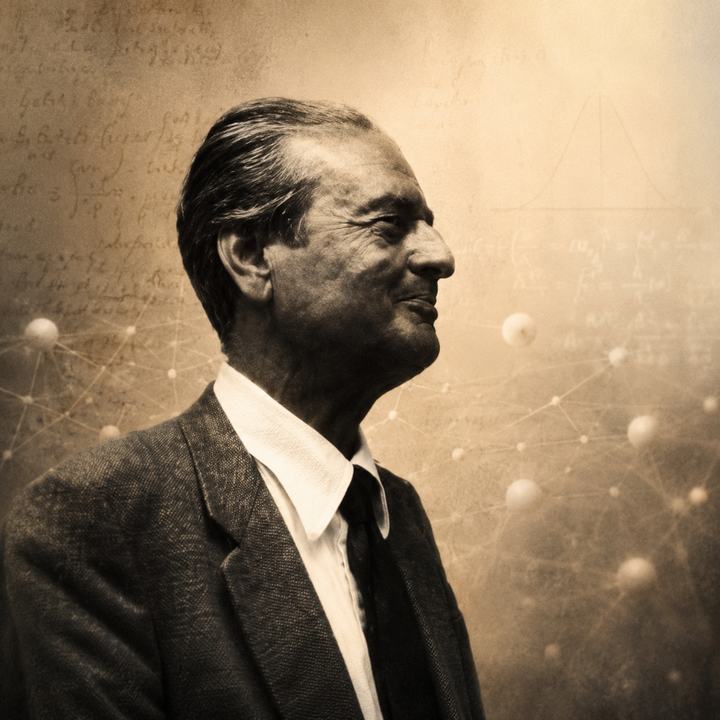
In the history of probability theory, there are few statements that sound as simple and yet pack as much of a punch as this one: "Probability does not exist." You hear it and almost inevitably expect a scandal, or at least an intellectual uproar. How can a mathematician who dedicated his life to probability claim that probability does not exist at all? And yet this was precisely the provocation that made Bruno de Finetti famous. Not as a casual quip, but as a principle. He did not mean to say that we should stop calculating. He meant to say that probability is not a mysterious property inherent in things themselves. It is not a fog that objectively hangs over the world. It is an expression of what we may reasonably believe under conditions of incomplete information. In this shift—from the world to conviction, from the thing to the assessment—lies de Finetti's true revolution.
A philosopher in the guise of a mathematician
Bruno de Finetti was born in Innsbruck in 1906, but grew up in the Italian academic world and became one of the most unconventional figures in 20th-century probability theory. He was a mathematician, actuary, economist, and philosopher of probability all at once. It is precisely this combination that makes him so fascinating to this day. De Finetti did not merely work on formulas; he asked what probabilities actually mean. What kind of statement are we making when we say an event is 30 or 70 percent likely? Are we describing a property of the world—or rather the state of our knowledge?
De Finetti took a radical stand in favor of the second option. For him, probability was not an objective substance of nature, not a metaphysical cloud hovering over random events, not a hidden measure inherent in reality. For him, probability is a judgment. More precisely: a number with which a subject expresses their conviction under conditions of incomplete information. De Finetti understood very well that this must initially have seemed unreasonable to many natural scientists, statisticians, and philosophers. But precisely for that reason, he argued not only mathematically but also with philosophical acuity.
The Mars Experiment: When the Past Becomes a Bet
His most famous thought experiment sums up this stance with almost jarring clarity. De Finetti suggests setting a price for a contract that pays out one dollar if there was life on Mars ten billion years ago, and nothing if there was no life there. The answer would be revealed the next day. The question is not whether there is an "objective" probability for this event. It is about what price someone is willing to pay or demand for this statement today.
This example is particularly powerful because it takes probability out of the realm of classical random processes. Here, no coin is flipped, no die is rolled, no wheel is spun. It concerns a singular, long-past event. Whether there was life on Mars back then is not a matter of chance in the sense that the outcome is still being decided by a roll of the dice. And yet it seems perfectly reasonable to express varying degrees of conviction. For de Finetti, that was precisely the point: the rules of probability theory apply not only to series of random events, but wherever reasonable judgments must be made in the face of uncertainty.
Coherence: Why subjective probability is not arbitrary
At this point, the concept of subjective probability is easily misunderstood. If probability is merely a matter of opinion, isn't any number permissible? Can one simply say 70 percent because it seems convenient at the moment? De Finetti's answer is a decisive no. For him, subjective does not mean arbitrary. A probability judgment is personal, but it must be coherent.
He demonstrates this coherence with the famous argument of the bookmaker's guaranteed loss, which later became popular as the Dutch book argument. Anyone who states probabilities thereby tacitly exposes themselves to certain bets. If one's own pricing or odds structure violates the rules of probability, a skilled opponent can construct a combination of trades in which one is guaranteed to lose, regardless of the actual outcome. It is not the world that punishes you then, but the internal inconsistency of your own beliefs.
This is precisely where de Finetti's genius lies. He justifies probability theory not through supposedly objective random mechanisms, but through rational consistency requirements for beliefs. In his view, the axioms of probability appear as rules of coherent judgment. Whoever violates them does not simply make a theoretical error, but exposes themselves to a certain financial loss. The mathematics of probability thus becomes the logic of reasonable opinions.
Probability as a Product of Insufficient Information
De Finetti goes one step further. For him, probabilities are products of our insufficient information. They arise where knowledge is patchy, observation incomplete, evidence ambiguous, or the future open. Precisely for this reason, in his view, there can be no objective probability in the strong metaphysical sense. There are events, data, states of the world—and there are our assessments of them. Probability belongs to the second sphere.
This idea remains provocative to this day because it challenges the need for objective certainty. Many would like to treat probabilities as properties of the world because that seems epistemically more comfortable. If the number is inherent in the matter itself, the judging subject no longer bears full responsibility. De Finetti takes away this comfort. Anyone who states a probability is expressing a justifiable, but ultimately personal, assessment. The number is an expression of a judgment, not an acquittal from it.
This is precisely why de Finetti's philosophy is intellectually demanding. It demands not less rigor, but more. One must not hide behind the supposed objectivity of the number. One must disclose what the assessment is based on, what information is available, what uncertainty remains, and how a judgment changes when new evidence is added.
From Opinion to Mathematics
That de Finetti, despite all his philosophical exaggeration, was not merely an essayist is evident from the mathematical depth of his work. His name is associated not only with subjective probability but also with fundamental theorems of modern statistics, in particular with the concept of exchangeability and the de Finetti theorem. Roughly speaking, the basic idea is this: if a sequence of observations is symmetrically exchangeable from the perspective of a judge, it can be treated as if it had been generated conditionally independently by an unknown parameter.
This insight has enormous implications. It shows that subjective probability by no means signifies the end of mathematical rigor. On the contrary: de Finetti provides an elegant bridge between personal judgments and statistical models. Precisely because probabilities express beliefs, they must be organized in a form that allows for learning from data. For him, subjectivity is not the opposite of science, but its starting point under realistic conditions of limited information.
Why de Finetti is so relevant to risk management today
Anyone assessing risks in companies, institutions, or projects today often works closer to de Finetti's approach than they realize: namely, with probabilities as reasoned judgments under incomplete information. This is because a significant portion of risk management does not rely on long, perfect data series. Many decisions must be made based on fragmentary evidence: in the face of geopolitical tensions, new cyber threats, disruptive developments, supply chain disruptions, or singular extreme events. Historical data is of limited help in such cases. What remains are expert judgments.
This is precisely where de Finetti's relevance lies. Expert assessments are not a regrettable stopgap on the fringes of actual risk management. In many fields, they are the inevitable core of any serious forecasting work. The question is therefore not whether one should allow subjective judgments, but how to make them coherent, transparent, and verifiable. De Finetti provides the philosophical and mathematical framework for this.
When a risk committee, for example, estimates the probability of an escalation in a geopolitical conflict, the likelihood of a new regulatory intervention, or the probability of a previously unobserved cyberattack, it does not operate with objective probabilities. It operates with condensed judgments based on incomplete information. This is precisely why such judgments must be internally consistent, self-justified, comparable with one another, and updatable with new information. Otherwise, the result is not enlightened subjectivity, but merely numerical rhetoric.
Expert Assessments: Opinion Yes, Arbitrariness No
In practice, this presents a double challenge. On the one hand, one must accept that many risk figures are not "found" but assigned. On the other hand, this assignment must not be arbitrary. Good expert estimates require methodological guidance: clear event definitions, precise time frames, shared assumptions, explicit scenarios, calibration, feedback, and a mechanism for revision.
It is precisely here that de Finetti is closer to modern risk management than many seemingly more technical classics. For he compels us not to relinquish responsibility for probabilities to data fetishism or blind faith in models. He reminds us that every risk assessment is an epistemic act: someone makes a judgment, based on specific information, under certain uncertainties, within a specific framework of coherence.
One could also say: De Finetti strips risk management of the illusion that numbers are automatically objective. But it is precisely this that makes it more mature. For as soon as probabilities are understood as responsible judgments, questions regarding data quality, expert selection, workshop structuring, documentation of assumptions, and ongoing calibration become core methodological issues rather than mere organizational trappings.
The Enduring Provocation
It is no coincidence that de Finetti is both admired and contested to this day. His statement "Probability does not exist" sounds like a rejection of everything that statistics, forecasting, and decision theory promise to deliver. In truth, it is the opposite: a call for intellectual integrity. Probability should no longer be misunderstood as an objective veil over the world, but rather as an explicit form of judgment regarding a world that is only partially known.
It is precisely in this that his enduring modernity lies. De Finetti does not grant a license for arbitrariness, but rather an ethics of probabilistic judgment. One may believe—but only coherently. One may estimate—but only by disclosing one's own information base. One may decide—but not as if the number had fallen from the sky like a law of nature.
Conclusion: The Number as a Responsible Conviction
In the end, perhaps this is what remains most of all from de Finetti: Probability is not something one finds somewhere in nature, but a number with which one assumes responsibility for uncertainty. This insight is uncomfortable because it forces the judging subject out of hiding. But it is precisely for this reason that it is fruitful, because it reminds statistics, forecasting, and risk management of their actual purpose.
Those who assess risks almost always work with incomplete information. The crucial question, then, is not whether one possesses completely objective probabilities. The crucial question is whether one's own judgments are coherent, well-founded, transparent, and capable of learning. De Finetti has shown that this is precisely where the rationality of probability lies—not in its supposed objectivity, but in the discipline with which we use it as an expression of our limited knowledge.
One could therefore say: De Finetti stripped probability of its metaphysical dignity—and in return gave it something more useful. He transformed it into an art of reasonable conviction. For modern risk management, which works with expert assessments, scenarios, and singular decisions, this is no historical curiosity. It is one of the most precise descriptions of what actually happens there.
Bibliography and further reading
- de Finetti, Bruno (1931): Probabilismo: Saggio critico sulla teoria della probabilità e sul valore della scienza. In: Erkenntnis, 31 (later English translation 1989), pp. 169–223.
- de Finetti, Bruno (1936): La logique de la probabilité. In: Actes du Congrès International de Philosophie Scientifique, IV: Induction et probabilité. Paris, pp. 31–39.
- de Finetti, Bruno (1937): La prévision: ses lois logiques, ses sources subjectives. In: Annales de l’Institut Henri Poincaré, Vol. 7, pp. 1–68.
- de Finetti, Bruno (1964): Foresight: Its Logical Laws, Its Subjective Sources. In: Kyburg, Henry E. / Smokler, Howard E. (eds.): Studies in Subjective Probability. New York, pp. 93–158. (English translation of the 1937 essay.)
- de Finetti, Bruno (1974): Theory of Probability. Volume 1. New York.
- de Finetti, Bruno (1975): Theory of Probability. Volume 2. New York.
- de Finetti, Bruno (1972): Probability, Induction and Statistics. London/New York.
- Lindley, D. V. (1986): Bruno de Finetti, 1906–1985. In: Journal of the Royal Statistical Society, Series A, Vol. 149, pp. 252–253.