

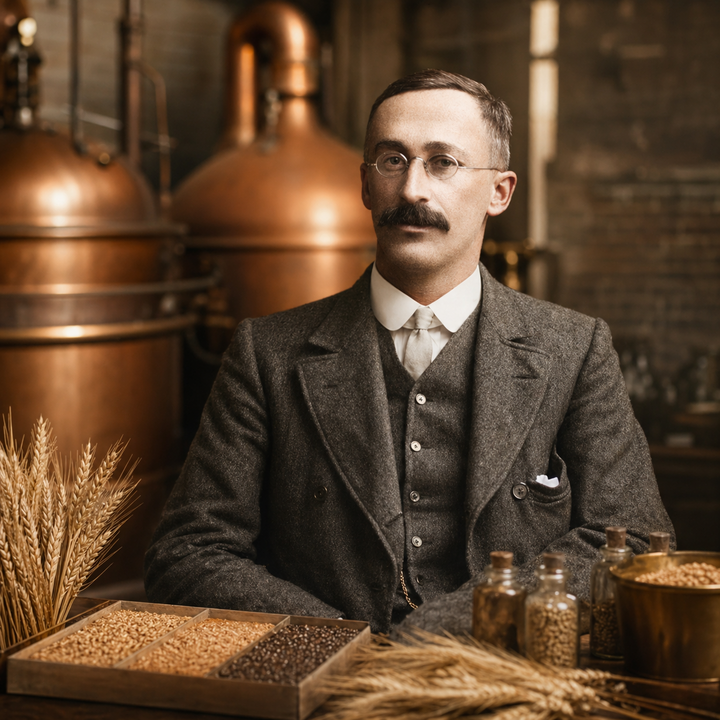
Dublin, at the beginning of the 20th century. The Guinness brewery smells of malt, steam and damp barley. Amidst brewing kettles, laboratory samples and test fields, there is a man whose name is still known to most students and even risk managers only by a pseudonym: Student. William Sealy Gosset is not a university professor, not an academic star and certainly not a scholar in an ivory tower. He works in a brewery – albeit one that is ahead of its time in many respects. Guinness is not merely a drinks company, but a state-of-the-art agro-chemical enterprise that wants to know which variety of barley is best, how quality can be reliably measured, and what to do when one has only a few observations but must nevertheless make a decision. This is precisely where Gosset's real story begins: not in abstract statistics, but in the practical necessity of dealing sensibly with small samples.
Why a brewery needed a statistician
This starting point is more important than it appears at first glance. In classical biometrics, or biometric statistics as coined by Karl Pearson in London, large amounts of data were often available: hundreds of measurements, long observation series and large study populations. Precisely for this reason, the problem of small sample sizes carried far less weight there than in a brewery, where decisions often had to be based on a few trials and limited sample quantities. A brewery relies on batches, raw materials, laboratory trials and costly production steps. One cannot produce as many samples as one likes simply to make the statistics more convenient. Anyone wishing to know which barley malts better, which yeast is more stable, or which process change improves quality, often has to derive a reliable conclusion from just a few observations.
It was precisely in this that the challenge lay, which Gosset recognised with a clarity that was initially scarcely noticed in academic statistics. For him, Guinness was not an exotic workplace far removed from science, but a real-life laboratory of uncertainty. Here it became apparent that statistical methods are not only useful when data is abundant, but precisely when information is scarce and decisions are costly.
Apprenticeship with Karl Pearson
William Sealy Gosset did not acquire these skills out of thin air. In 1906 and 1907, he spent periods of study and research in the biometric laboratory of Karl Pearson (1857–1936). Pearson was one of the leading figures in statistics at the time. A good and productive working relationship developed between the two. Pearson helped with the mathematical details in Gosset's writings, encouraged him and took him seriously – though not always with a full grasp of the significance of Gosset's practical problems arising from a brewery.
For Gosset's research question was unusual from a biometrician's perspective. Whilst Pearson was often able to work with large sample sizes, Gosset was concerned with what constantly occurs in beer production: small samples, incomplete information, and experimental comparisons with few measured values. It was precisely this limitation that made his work so modern. He did not ask how statistics function under ideal academic conditions, but how one can nevertheless arrive at rational decisions under real operational conditions.
Secret research and the name 'Student'
It is an irony of the history of science that Gosset's most famous discovery did not become famous under his own name. The background was decidedly practical – and decidedly entrepreneurial. Another scientist at the Guinness brewery had previously published a paper which, in the view of the company management, revealed critical trade secrets. The reaction was harsh: from then on, employees were strictly forbidden from publishing scientific papers under their own names if this could endanger the company's confidential information.
For Gosset, this was a delicate situation. On the one hand, he was working on problems of great scientific significance; on the other, he was not allowed to harm his employer's interests. The solution was a pseudonym. When he published his famous paper 'The Probable Error of a Mean' in 1908, he did so under the name 'Student'. Thus, an internal precautionary measure became a historical coincidence of considerable significance. To this day, his most important discovery is not simply known as the Gosset distribution, but as the Student's t-distribution.
![Fig. 01: The t-distribution with different parameters (degrees of freedom) [Source: Author's own illustration]](/fileadmin/_processed_/5/8/csm_Fig-01_t_distribution_comparison_20260429_acdf06a1f1.png "Fig. 01: The t-distribution with different parameters (degrees of freedom) [Source: Author's own illustration]") Fig. 01: The t-distribution with different parameters (degrees of freedom) [Source: Author's own illustration]
Fig. 01: The t-distribution with different parameters (degrees of freedom) [Source: Author's own illustration]
A situation that fits well with William Sealy Gosset and his work at the Guinness Brewery serves as an illustrative practical example. A new barley variety is being investigated, of which only a few samples are available. This is precisely where the methodological problem lies: In industrial practice, decisions often have to be made based on small samples, even though the uncertainty regarding variance and mean is still relatively high.
In this example, only six samples are analyzed. The average extract yield of the new variety is measured. The sample mean is 81.2 kg per ton, and the sample standard deviation is 1.8 kg per ton. With n=6, this results in exactly five degrees of freedom (df=5). A target value of 80.0 kg per ton serves as the benchmark. The standard error is 0.735 kg per ton; at a 95% confidence level, this yields a critical t-value of 2.571. The resulting 95% confidence interval ranges from 79.31 to 83.09 kg per ton.
This interval in particular illustrates very clearly why Gosset's way of thinking remains so important today. Although the observed mean lies above the target value, the confidence interval still encompasses 80.0 kg per ton. In other words: The data suggest a tendency toward a higher extract yield, but the small sample size does not yet allow for an overly confident conclusion. This is precisely what the t-distribution represents: it makes it clear that, with small samples, the uncertainty regarding the true variance has not disappeared.
The smaller the number of degrees of freedom, the wider the margins and the more the additional uncertainty is taken into account (see Fig. 01). Fig. 02 shows the estimated mean, the target value, and the 95% confidence interval.
Parameters of the example:
- Sample size: n=6
- Degrees of freedom: df=5
- Measured variable: average extract yield of a new barley variety
- Sample mean: 81.2 kg/ton
- Sample standard deviation: 1.8 kg/ton
- Target value: 80.0 kg/ton
- Standard error: 0.735 kg/ton
- Critical t-value (95%): 2.571
- 95% confidence interval: [79.31; 83.09] kg/ton
![Fig. 02: Practical example: Guinness Brewery [Source: Author's own illustration]](/fileadmin/_processed_/a/e/csm_Fig-02_t_distribution_brewery_example_20260429_063a5b20c6.png "Fig. 02: Practical example: Guinness Brewery [Source: Author's own illustration]") Fig. 02: Practical example: Guinness Brewery [Source: Author's own illustration]
Fig. 02: Practical example: Guinness Brewery [Source: Author's own illustration]
The actual idea: statistics for small samples
The crux of the problem can be stated simply. Anyone wishing to infer a mean from a few observations usually does not know the true variance of the population. It is precisely in such cases that the standard logic of the normal distribution hypothesis is too self-assured. It tacitly assumes that the uncertainty regarding the variance has already been resolved. With small samples, this is precisely not the case.
Gosset's ingenious insight lay in not ignoring this additional uncertainty, but in explicitly incorporating it into the calculation. This is precisely how the t-distribution arises: it resembles the normal distribution, but has heavier tails. These thicker 'tails' are not a mathematical whim, but an expression of intellectual modesty. Those with little data should be more cautious in their judgements. The confidence interval must be wider, the threshold for certainty higher, and the leap to a conclusion smaller.
The t-test follows from the same logic. It allows us to check whether an observed difference in the mean could plausibly be mere chance, or whether there is more to suggest that an actual effect is present. In the practical world of brewing, this was no academic exercise. It was about concrete questions: Is this barley variety better on average? Does this process lead to a higher extract? Is an observed improvement real or merely a quirk of small sample sizes?
Barley, brewing and agriculture
It is precisely this practical context that makes Gosset so interesting. Guinness was not only interested in the quality of the finished beer, but also in the quality of its raw materials. Which soils, which cultivation methods, and which barley varieties provided the characteristics needed for reliable brewing? As a result, Gosset's statistical analysis shifted from the laboratory out into the fields (where, in the spirit of 'bow-tie analysis', the root causes lie). He worked not only on fermentation and brewing processes, but also on agronomic issues, because the quality of the inputs determined the quality of the product.
This can be seen as an early form of data-driven value chain management. The journey from field to glass was not understood as a loose chain of empirical values, but as a system in which measurement, comparison and uncertainty play a role. Gosset was thus far more than just a mathematician in industry. He was a practitioner of quantitative decision-making.
'The Probable Error of a Mean'
The essay "The Probable Error of a Mean" from 1908, published in Biometrika, is one of those texts whose historical significance only becomes fully apparent in hindsight. Karl Pearson assisted with the mathematical details, but initially did not recognise to the same extent as others later did just how fundamental the problem of small samples actually was. To a biometrician dealing with huge datasets, the topic might have seemed marginal. For a brewery, it was central. And that is precisely why it became a cornerstone of statistics.
The punchline is almost paradoxical. What appeared in industrial practice as a vexing constraint – the small number of observations – forced Gosset to adopt a theoretical precision that has permanently transformed statistics. It was not an abundance of data that drove progress here, but a scarcity of data. This is what makes his contribution so intellectually compelling: he shows that science is often most productive where reality defies convenient assumptions.
From beer to general statistics
Today, the t-test is one of the standard tools of empirical research. Students in medicine, psychology, economics, engineering and quality management often learn it as if it had always been there. That is precisely why it is worth looking back at its origins. The t-test is not an invention born of the world of lavish data collections or academic circles, but a tool for situations in which one must make a decision despite having very little information.
Therein lies Gosset's true greatness. He did not develop a statistics of abundance, but a statistics of scarcity. It does not say: We have enough data to be certain. It says: We have little data, but we can clearly describe the remaining uncertainty and base our decisions on it. It is precisely this idea that makes Student's t-distribution one of the most elegant symbols of scientific rigour.
What this has to do with risk management
Gosset is therefore surprisingly relevant to modern risk management. In textbooks, risk analysis often gives the impression that a rich database is available at all times: long time series, robust frequencies, stable distributions. In practice, this is frequently not the case. Many critical risks – operational losses, rare cyber incidents, early warning signs in supply chains, malfunctions of new technologies, anomalies in pilot projects or exceptional cases in the compliance sector – do not, in fact, appear in large, convenient datasets.
Anyone who has to assess mean values, comparative values or differences in effectiveness under such conditions is essentially dealing with a Gossetian problem. It is a matter of small sample sizes, unknown variance and the risk of drawing either too many or too few conclusions from a few observations. The benefit of the t-test and the associated mindset then lies less in a mechanical significance routine than in an attitude: uncertainty with small sample sizes is not defined away, but explicitly incorporated into the decision.
This applies, for example, to the analysis of a small number of claims in a new insurance line, to the assessment of initial failure rates for a newly introduced technical component, or to the question of whether an observed decline in fraud cases following a control measure is already reliable. Gosset's fundamental problem also immediately resurfaces in the early detection of crises in small sub-populations or in the assessment of scarce near-miss data in operational safety: little data, high relevance, costly misjudgements.
It is precisely here that we see how closely statistics and risk management are linked. Good risk analysis does not consist of masking uncertainty with false precision. It consists of adapting the scope of the statement to the available data. And it is precisely in this that Gosset remains a silent mentor to this day.
The moral of the brewery
Perhaps the finest thing about this story is that it begins with a brewery and ends with a principle of scientific judgement. William Sealy Gosset did not set out to discover the universal formula for chance. He wanted to know how to use limited samples to select better barley, identify better processes and avoid poor decisions. It was precisely this practical modesty that made his work so influential.
From Guinness, secret research, agronomic field trials and the pseudonym 'Student' emerged one of the most enduring ideas in statistics. To this day, Student's t-distribution serves as a reminder that small samples are not a footnote, but a central problem of knowledge. And that one can indeed learn something from a few observations – provided one is disciplined enough to factor in one's own uncertainty.
Viewed in this light, Gosset is a figure of astonishing relevance. He embodies a way of thinking that is equally needed in laboratories, breweries, insurance companies, banks and risk departments: the art of making sound judgements with limited evidence. Statistics from the brewery – that sounds trivial. In truth, it was a giant step towards the civilisation of ignorance.
Bibliography and further reading
- Pearson, Egon Sharpe (1990): Student – A Statistical Biography of William Sealy Gosset. Clarendon Press, Oxford 1990.
- Student (1908): The Probable Error of a Mean. In: Biometrika. Vol. 6, No. 1, 1908, pp. 1–25.
- Student (1917): Tables for Estimating the Probability that the Mean of a Unique Sample of Observations Lies between −∞ and Any Given Distance from the Mean of the Population from which the Sample is Drawn. In: Biometrika, Vol. 11 / 1917, pp. 414–417.