
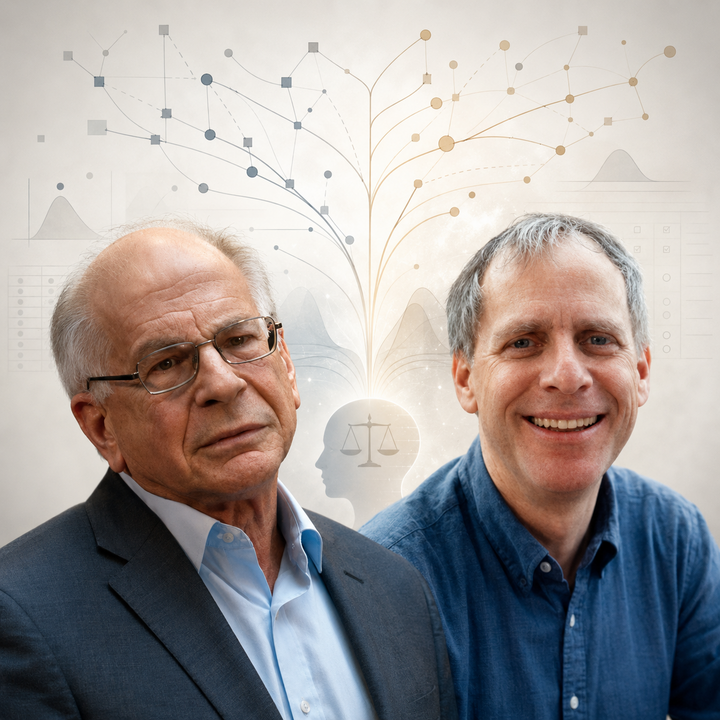
There are scientific partnerships that explain more than entire libraries. In the case of Daniel Kahneman and Amos Tversky, this was perhaps inherent in the nature of their partnership itself. One, Kahneman, was cautious, skeptical, and almost existentially drawn to the psychology of uncertainty; the other, Tversky, was brilliant, quick-witted, intellectually fearless, and possessed of an almost playful analytical energy. Those who witnessed them together often reported that their conversations felt less like sober academic debates and more like a constant stress test for common sense. One of their most powerful insights arose precisely from this style: people are not just occasionally mistaken about risks, but systematically so. We overestimate the intuitive, underestimate the statistical, fear losses more than we value gains, and repeatedly confuse plausibility with probability. This observation gave rise to one of the most far-reaching shifts in recent scientific history: the realization that good decisions cannot be measured solely by standards of rationality, but rather by the actual psychological mechanisms through which people make judgments under uncertainty.
An Unlikely Intellectual Alliance
Daniel Kahneman was born in Tel Aviv in 1934 and spent part of his childhood in France before his family faced existential threats during the Nazi era. For him, therefore, the experience of uncertainty was never merely a theoretical topic. Later, he studied psychology and turned his attention to questions of perception, attention, and judgment. Amos Tversky, born in Haifa in 1937, had a different temperament. He served in an elite Israeli unit, was considered exceptionally astute, quick-witted, and bold in his arguments, and became one of the most brilliant cognitive scientists of his generation. Whereas Kahneman grappled with his own doubts, Tversky possessed the self-assurance of a man who practically loved contradictions.
It was precisely this contrast that made their collaboration so productive. The two met in Jerusalem and initially began discussing errors in judgment, intuitive statistics, and the curious fact that educated people often use surprisingly primitive mental shortcuts when dealing with probabilities. These casual conversations evolved into one of the most fruitful collaborations in postwar science. Their work transformed psychology, economics, behavioral science, medicine, finance, and ultimately risk management as well.
When Intuition Trumps Statistics
A particularly striking aspect of their research is linked to the experiments that are now almost a cornerstone of behavioral economics. Kahneman and Tversky presented test subjects with brief descriptions and then asked them to estimate probabilities. One famous example is the so-called Linda case (also known as the Linda problem): A person is described as politically engaged, intelligent, socially critical, and interested in issues of justice ("Linda is 31 years old, single, open-minded, and very smart. She studied philosophy. As a student, she was deeply concerned about issues of discrimination and social justice and participated in anti-nuclear demonstrations"). Respondents are then asked to decide which is more likely: that Linda is a bank employee, or that she is a bank employee and active in the women's movement. Although, according to the basic rules of probability, a conjunction can never be more likely than one of its elements, many people choose the second option because it fits the story better psychologically.
It is precisely this simplicity that makes the experiments so ingenious. They required no complicated laboratories, no elaborate equipment, and no artificial experimental settings. Rather, they demonstrated that errors lie at the very heart of ordinary thinking. People are not poor at calculating because they lack information; they are often fallible because they rely on the wrong kind of plausibility.
Heuristics: Why Errors in Judgment Are Systematic
Kahneman and Tversky have shown that people do not primarily assess risks like amateur statisticians, but rather with the help of heuristics—that is, simplifying rules of thought. These heuristics are not merely sources of error; they are, first and foremost, a necessary response to the complexity of the world. Anyone who tried to calculate every decision completely analytically would hardly get anywhere in everyday life. This is precisely where Kahneman's later distinction between fast thinking and slow thinking comes in, which he systematically elaborates in his book "Thinking, Fast and Slow". Fast thinking—which he often refers to as System 1—works automatically, effortlessly, associatively, and intuitively. It recognizes patterns, fills in gaps in information, generates spontaneous judgments, and immediately provides a sense of what seems plausible, dangerous, or likely. Slow thinking—System 2—is, by contrast, deliberative, rule-based, calculative, and effortful. It becomes active when we need to consciously compare options, weigh probabilities, question assumptions, or correct a first impression.
This division of labor has significant implications for risk perception. In many decision-making situations, System 1 initially dominates. It does not ask about statistical representativeness, base rates, or distribution assumptions, but rather reacts to vividness, availability, and emotional impressions. This is precisely what gives rise to the biases described by Kahneman and Tversky: We overestimate risks that are spectacular, easy to remember, or vividly imaginable; we underestimate dangers that are insidious, abstract, or less vivid. We regularly replace difficult questions with simpler ones. Instead of asking, "What is the actual probability of this scenario occurring?", the mind imperceptibly answers the easier question: "How easily can I think of an example?", "How threatening does this feel?" or "How similar is this case to a familiar pattern?" The availability heuristic, the representativeness heuristic, and the anchoring heuristic are precisely such mental shortcuts.
The fact that people tend toward this form of judgment is no coincidence; it also serves a functional purpose. Analytical thinking is cognitively more demanding. In many everyday situations, the brain therefore prefers the path of least mental resistance: It relies on routines, judgments of plausibility, and familiar patterns because these are available more quickly and with less cognitive effort. Kahneman refers to this as cognitive ease. When an impression appears smooth, familiar, and coherent, people tend to accept it rather than scrutinize it critically. Although System 2 is, in principle, capable of checking, correcting, or completely rejecting these initial intuitions, it is sluggish, resource-intensive, and is often activated only when contradictions become apparent or institutional procedures deliberately compel it to do so. This is precisely why intuitive judgment is often surprisingly useful in everyday life, yet at the same time dangerous when it comes to complex risk issues: It saves mental effort, but often comes at the cost of systematic misjudgments.
This is of central importance for risk management. Those who assess risks never operate in a vacuum of rational calculations, but are always influenced by intuitions, frames, and mental shortcuts. Good risk management processes must therefore not only collect data and run models but also ensure, at the institutional level, that System 2 is actually given a chance to play a role: through explicit counterhypotheses, structured scenario analyses, the examination of base rates, pre-mortem analyses, independent reviews, and the deliberate separation of initial intuition from subsequent evaluation. The real point made by Kahneman and Tversky is thus not that intuition is worthless. Rather, it is that intuition, without methodical cross-checking, fails precisely where uncertainty, complexity, and rare events come into play.
Prospect Theory: The Major Revision of Decision-Making Under Risk
The real breakthrough came in 1979 with Prospect Theory. With it, Kahneman and Tversky did not attack classical expected utility theory head-on as a formal theory, but rather undermined it psychologically. The traditional view assumes that people compare alternatives based on final states and expected utility values. Kahneman and Tversky, however, showed that real-world decisions are often made relative to a reference point. What matters, therefore, is not only how large an outcome is objectively, but whether it is experienced as a gain or a loss relative to the status quo.
Two elements are central to this. First, the value function is not symmetric: losses hurt more than gains of the same magnitude bring joy. This loss aversion is one of the most robust findings in behavioral research. Second, probabilities are not weighted linearly in psychological terms. Small probabilities are often overweighted, while medium and high probabilities are distorted in specific ways. This is why lotteries seem attractive and rare catastrophes seem overwhelming, while everyday probability structures are frequently processed incorrectly.
This was revolutionary for the theory of risk. Since Kahneman and Tversky, risk has not merely been a property of external situations, but has always also been a property of how they are psychologically processed. Two decision-makers can look at the same numbers and yet perceive different risks because they apply different reference points, loss sensitivities, and probability weights.
Concrete Experiments That Changed the Way We Think
Among Kahneman and Tversky's most influential experiments, alongside the Linda problem, is above all the so-called Asian Disease case, which has become a classic in decision psychology. Participants are asked to imagine that the U.S. is preparing for the outbreak of an unusual Asian disease and that 600 people are at risk. In the first version of the experiment, the decision is framed in terms of gain: Under Plan A, 200 people are certain to be saved; under Plan B, there is a one-third probability that all 600 will be saved and a two-thirds probability that no one will be saved. Although both options have the same expected value, in this version about 72 percent chose the safe option, A. In the second version, the same decision is presented in a way that is logically equivalent but framed in terms of loss: Under Program C, 400 people are certain to die; under Program D, there is a one-third probability that no one will die and a two-thirds probability that all 600 will die. Now the preference reversed: About 78 percent of respondents preferred the riskier option D. Objectively, A and C are just as equivalent as B and D; psychologically, however, they have completely different effects. This is precisely the point of the experiment: People react not only to outcomes but also to the linguistic framing of those outcomes. If a situation is presented as a rescue, a focus on safety often dominates; if the same situation is described as death, the willingness to take risks increases. The experiment thus became key evidence for Prospect Theory and demonstrated with rare clarity that risk perception is not neutral but frame-dependent.
Equally important are the anchoring experiments, because they show how easily quantitative judgments are distorted by irrelevant initial values. In a famous experiment by Tversky and Kahneman, participants were first shown a seemingly random result from a "wheel of fortune"—such as the number 10 or 65—and were then asked to estimate the percentage of African countries in the United Nations. Although the number shown earlier had absolutely no factual connection to the actual question, the subsequent estimates were systematically closer to this anchor. The mechanism is as simple as it is far-reaching: People base their judgment on an initially given value and then correct it—but not sufficiently. This is precisely why anchoring is so significant for risk management. Damage figures mentioned early on, probabilities of occurrence, historical loss figures, budgets, external benchmarks, or the first comment made in a workshop often set a reference point around which the rest of the discussion unconsciously revolves. The problem, then, is not that people don't think at all or never reevaluate their initial reaction. The problem is that their subsequent correction is usually too weak. Even when teams deliberate, calculate, and check for plausibility, that initial numerical impression often remains surprisingly influential. Particularly in risk workshops, scenario analyses, or loss estimates, this can lead to supposedly consensual results that were, in reality, "pulled" in a certain direction very early on.
Why Risk Management Is Directly Affected by This
For risk management, the work of Kahneman and Tversky is not a marginal psychological illustration, but methodologically central. Risk management does indeed rely on catalogs, scenarios, data, models, and key metrics. Yet nearly every step in this chain is permeated by judgments: Which scenarios are considered plausible? What level of loss still seems realistic? Which data series is considered relevant? Which vulnerability is prioritized? Whenever such assessments are made, heuristics and biases come into play.
The availability heuristic is particularly powerful, especially in the early stages of risk identification. Organizations often focus on risks that were most recently visible, that dominate the media, or that have already caused damage in the past. In contrast, silent, new, complex, or difficult-to-articulate risks are underestimated. A company may then discuss the latest cyberattack in the press at length, but pay too little attention to long-term concentration risks, creeping quality defects, disruptive stress scenarios, or entirely new threat scenarios (such as those resulting from AI or future quantum computers).
Added to this is the representativeness heuristic. In workshops, the question is often not how high the base rate of a loss is, but whether the scenario fits one's own conception of a "typical" risk. As a result, new, hybrid, or systemic risks often seem too unlikely as long as they do not fit into familiar mental patterns. This is particularly dangerous when it comes to novel technology, reputation, or third-party risks.
"Anchoring" is also ubiquitous in risk management. A manager's initial estimate, the historical loss amount from the previous year, or a figure from a consulting paper can act like a magnet. Subsequent discussions then revolve around a random starting point rather than openly exploring the parameter space. Even carefully facilitated scenario workshops are not automatically immune to this.
Bias in Risk Analysis
A detailed look at bias in risk management reveals just how deeply the work of Kahneman and Tversky permeates practice. First, loss aversion: Measures are often excessive because decision-makers fear the political or personal pain of a loss more than they value the benefits of an appropriate but less spectacular solution. Second, the status quo bias: Organizations cling to existing controls, models, or risk maps, even when new evidence suggests a revision is warranted. Third, overconfidence: Experts overestimate the precision of their judgments, underestimate confidence intervals, and formulate point forecasts with excessive certainty.
Fourth, confirmation bias: Information that supports the preferred scenario is more readily accepted than information that challenges it. Fifth, the planning fallacy: Projects, transformations, and crisis responses are systematically planned with excessive optimism; costs, duration, and side effects are underestimated. Sixth, framing effects: Whether a risk decision is framed as avoiding a loss, securing a gain, or seizing an opportunity often influences the choice more than the factual content itself.
From a methodological perspective, this leads to an uncomfortable realization: Bias is not merely an individual problem of poor decision-makers, but a structural problem of organizations. Risk management therefore requires not only better data and models, but also procedures for practical debiasing—such as pre-mortems, red teams, counterhypotheses, explicit base rate checks, independent second estimates, interval estimates instead of point forecasts, and the deliberate variation of frames.
What Prospect Theory Means in Practice
Prospect Theory is particularly important for companies because it shows that attitudes toward risk are not stable. The same decision-maker may act cautiously when facing potential gains but take risks when facing potential losses. This explains why organizations appear conservative in good times but suddenly take risky bets during crises: losses psychologically trigger a different decision-making mode. In the loss zone, the willingness to take risks increases if doing so might allow the decision-maker to finally move away from the unpleasant reference point.
For risk management, this means that decisions must be understood not only in terms of numbers but also in terms of their psychological context. A restructuring situation, a budget shortfall, a looming failure to meet targets, or a loss of reputation can alter the reference level in such a way that previously rational actors suddenly begin to make decisions systematically differently. This is precisely why governance is so important: it is not meant to banish emotion from decisions—that would be illusory—but rather to institutionally cushion psychological imbalances.
Kahneman, Tversky, and Their Scientific Contribution
The scientific achievement of the two lies not only in individual experiments but in a shift in the entire style of research. They legitimized discussing irrationality mathematically and formally without resorting to cultural criticism or mere anecdotal evidence. Their experiments were precise, often surprisingly simple, and highly compatible with theory. In doing so, they built a new bridge between psychology and economics.
When Daniel Kahneman received the Nobel Prize in Economic Sciences in 2002, Amos Tversky had already passed away and could no longer be honored alongside him. Precisely for this reason, the story of their collaboration is often told with a tinge of sadness. Although the honor was bestowed upon Kahneman, it was at the same time a belated institutional recognition of an intellectual dual movement that would have been inconceivable without Tversky.
Conclusion and Outlook
Daniel Kahneman and Amos Tversky did not prove that people are irrational in the trivial sense. They demonstrated something more interesting: that human rationality under uncertainty relies on quick heuristics that are often surprisingly useful but systematically go off the rails under certain conditions. This is precisely why their work has such far-reaching implications for risk management. It makes it clear that risks can not only be mismeasured but also psychologically misunderstood.
The outlook is accordingly twofold. On the one hand, Prospect Theory remains a foundational text for anyone reflecting on decision-making under risk. On the other hand, today's practical realities demand further institutional development: bias must not only be reflected upon individually but also addressed at the organizational level. Good risk management therefore does not arise solely from models and metrics, but from an architecture of cross-checking—from procedures that anticipate one's own errors. Perhaps this is precisely the most enduring lesson from Kahneman and Tversky: It is not the self-assured decision-maker who is the better one, but the one who knows how easily judgments under uncertainty can go astray.
Bibliography and Further Reading:
- Kahneman, Daniel / Tversky, Amos (1974): Judgment under Uncertainty: Heuristics and Biases. In: Science, Vol. 185, No. 4157, pp. 1124–1131.
- Kahneman, Daniel / Tversky, Amos (1979): Prospect Theory: An Analysis of Decision under Risk. In: Econometrica, Vol. 47, No. 2, pp. 263–291.
- Tversky, Amos / Kahneman, Daniel (1981): The Framing of Decisions and the Psychology of Choice. In: Science, Vol. 211, No. 4481, pp. 453–458.
- Tversky, Amos / Kahneman, Daniel (1986): Rational Choice and the Framing of Decisions. In: Journal of Business, Vol. 59, No. 4, Part 2, pp. S251–S278.
- Kahneman, Daniel / Slovic, Paul / Tversky, Amos (Eds.) (1982): Judgment under Uncertainty: Heuristics and Biases, Cambridge University Press, Cambridge 1982.
- Kahneman, Daniel (2011): Thinking, Fast and Slow, Farrar, Straus and Giroux, New York 2011.
- Romeike, Frank (2006): Der Risikofaktor Mensch – die vernachlässigte Dimension im Risikomanagement [The Human Risk Factor—The Neglected Dimension in Risk Management], in: ZVersWiss (Zeitschrift für die gesamte Versicherungswissenschaft), Issue 2/2006, pp. 287–309.
- Romeike, Frank (2013): Fooled by Randomness, in: FIRM Yearbook 2013, Frankfurt am Main 2013, pp. 25–29.