

There are those peculiar moments in history when one realizes that an era misunderstands itself. Our present loves to portray itself as radically new. We are smarter and more innovative today than any generation before us, so the narrative goes. Everywhere, people are talking about data analytics, artificial intelligence, generative AI, agentic AI, predictive intelligence, digital twins, real-time risk intelligence, stress testing, explainable AI, decision intelligence, and evidence-based decision making. That sounds like data centers, cloud infrastructure, neural networks, and major innovation. And yet the true history of these methods begins much earlier—in correspondence about gambling problems, in life tables, in teacups, in the question of rational judgment under uncertainty, in market prices that resemble random walks, and in the hard axioms that make probabilities mathematically manageable in the first place. Anyone who takes this genealogy seriously will discover something unexpected: A large part of the methodological foundations we use today to manage risks, analyze data, and train AI systems was not laid in Silicon Valley, but was developed over the course of centuries by polymaths, mathematicians, statisticians, economists, and philosophers who often lived in completely different worlds—yet asked the same core questions we ask today.
From Pascal to Kolmogorov: The Long Birth of Probability
Before uncertainty became the subject of mathematical analysis, the way it was dealt with for centuries was primarily shaped by religious and cosmological perspectives. In the ancient Indian doctrine of karma, fate appeared as the result of a fixed order of cause and effect, leaving little room for an independent concept of chance [see Romeike/Stallinger 2021, p. 8 ff.]. In ancient Greece, too, good fortune, misfortune, and strokes of fate were predominantly attributed to the actions of various deities. Religion provided guidance, explained the unpredictable, and partially relieved people of the notion that they could control the future themselves. This way of thinking continued in the medieval worldview of a hierarchically structured cosmic order: God determined the course of events and thus, ultimately, what from today's perspective would be called chance or risk.
It was not until the Renaissance that this closed interpretive framework began to undergo fundamental change. Traditional authorities and religious explanations were increasingly called into question, while human action and the earthly world took center stage [see Romeike/Hager 2020, p. 2ff.]. The experience of the Black Death, which wiped out a significant portion of the European population between 1346 and 1353, likely also contributed to shaking traditional certainties. As the exclusively religious interpretation of uncertainty waned, the need arose to understand the future, chance, and potential harm using one's own methodological tools. This transformation represents a key intellectual-historical root of modern risk management.
The decisive methodological starting point lies where intuition first gave way to calculation. Blaise Pascal and Pierre de Fermat demonstrated that open-ended future scenarios can be evaluated not only morally or emotionally, but also mathematically. Jakob Bernoulli later developed this insight into a theory of collective stabilization through the law of large numbers. Laplace transformed probability into a science of ignorance under uncertainty. Abraham de Moivre brought together probability theory and life tables, thereby paving the way for actuarial science. William Sealy Gosset showed that even small samples, when handled correctly, allow for reliable judgments. Ronald Aylmer Fisher shifted the focus from the result to the design of the observation and taught that good models cannot save bad data.
Bruno de Finetti insisted that probability is not a mystical substance of the world, but rather a responsible judgment made under incomplete information. Frank Ramsey showed how closely beliefs, betting, and rationality are intertwined. Andrei Kolmogorov gave probability its mathematical framework with his axioms. Frank Knight distinguished calculable risk from genuine uncertainty. Harry Markowitz turned diversification into a theory of interdependence. Kenneth Arrow showed that risks often depend less on probabilities than on asymmetric information. Louis Bachelier brought stochastics to the markets, and Benoît B. Mandelbrot shattered the comfortable illusion that the world is normally distributed.
One can view these names as a loose gallery of great minds. But one can also understand them as parts of a single methodological edifice. This edifice consists of a few recurring fundamental questions: How do we deal with the uncertainty of the future? How do data, opinion, and knowledge differ? How do we learn from few or many observations? When is it permissible to state a probability—and when would that merely be a false sense of precision? How do you recognize dependencies, outliers, fat tails, model errors, or conceptual confusion? These very questions are not outdated; rather, they form the fundamental underlying structure of today's risk management.
What Data Analytics and AI Owe to Their Ancestors
Even in the fields we now refer to as data analytics and AI, the genealogical lineage is surprisingly clear. Bayesian models and probabilistic updates would be inconceivable without Bayes and Laplace. Estimation, likelihood, hypothesis testing, and experimental design are deeply rooted in the tradition of Fisher and Gosset. The question of how degrees of belief, prior knowledge, and new evidence interact bears the hallmark of Ramsey and de Finetti. Every model architecture that works with probabilities rests on Kolmogorov's axioms—even if its users have never taken a look at the basic concepts of probability theory.
Even modern machine learning methods, which like to present themselves as a break with the past, rely methodologically on older disciplines. Training requires data; data requires definitions; definitions require sound observation; and sound observation requires a design that controls for confounding variables, recognizes biases, and identifies the limitations of the model itself. Those who believe that computing power can replace method are usually merely repeating an old fallacy—albeit on faster hardware.
Precisely for this reason, returning to this tradition is not an academic exercise in politeness, but a matter of intellectual hygiene. It serves as a reminder that our current tools have a history—and with it, conditions, limitations, and implicit assumptions. Methodologically, modernity is often less inventive than it claims to be, and at the same time far more dependent on old foundations than it is willing to admit.
Strategy, Markets, and Perceptual Distortion
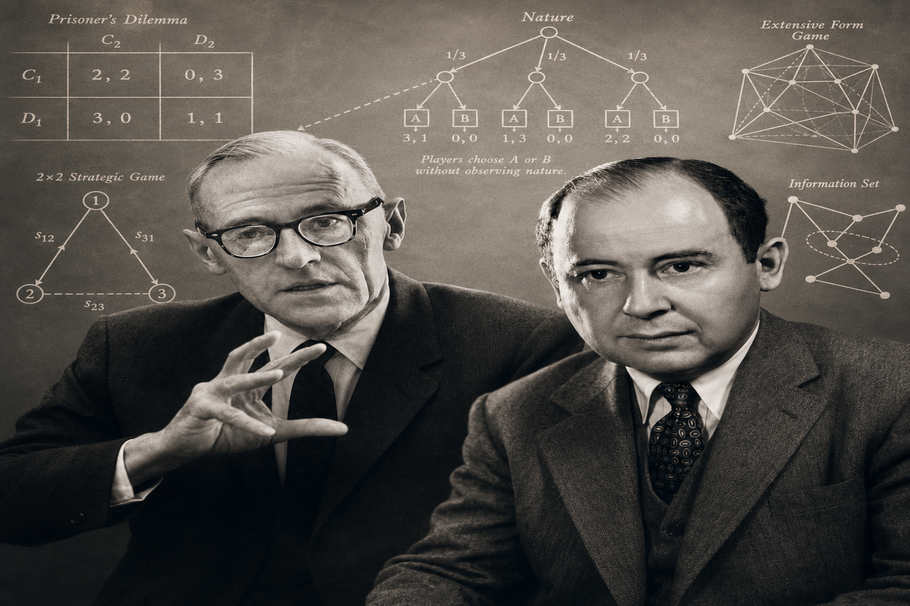
The longer I've been writing the "Leaders in Risk Management" series over the past few months, the clearer it has become that the deep methodological structure of the present consists of more than just probability theory and statistics. With John von Neumann and Oskar Morgenstern came the insight that many risks are strategic: They do not arise in a vacuum, but in situations where other actors observe, react, threaten, cooperate, or escalate. This is directly relevant to modern risk management—from price wars and negotiations to geopolitical conflicts and cyberattacks. Anyone facing an attacker, a competitor, or a regulator cannot treat risks like weather events. They must factor in the opponent's perspective.
With Louis Bachelier, Harry Markowitz, Kenneth Arrow, as well as Fischer Black, Myron Scholes, and Robert C. Merton, a second major complex emerges: the mathematization of markets, portfolios, and contingent claims. Bachelier modeled price movements as stochastic processes; Markowitz demonstrated that risk is never confined to individual securities but lies in interdependence structures; Arrow made it clear that information and risk are unevenly distributed economically; and the Black–Scholes–Merton model brought the logic of replication and model valuation to a point that continues to shape the field to this day. It is precisely from the criticism of this model—constant volatility, the thin tails of the normal distribution, and the underestimation of extreme events—that another lesson can be drawn: Good models are indispensable, but dangerous as soon as their assumptions are forgotten.
Daniel Kahneman and Amos Tversky ultimately added to the series the dimension without which no serious risk management is complete: the systematic fallibility of human judgment. Risks are not only modeled incorrectly; they are misperceived even before that. Framing, anchoring, the availability heuristic, loss aversion, and the inertia of analytical thinking distort loss estimates, workshop discussions, scenario selection, and management decisions. Thus, these contributions are not on the periphery of the series, but at the very heart of its central point: modern risk and opportunity management is always simultaneously a matter of model logic, strategic interaction, risk perception, and cognitive self-correction.
When More and More Scientists Produce Fewer and Fewer Results
It is precisely at this point that the present holds up an uncomfortable mirror to itself. While the methodological foundations of modern statistics, risk analysis, and decision theory have in many cases been known for decades or even centuries, the human and financial resources required to continue pushing the frontiers of science and technology are growing. Nicholas Bloom, Charles I. Jones, John Van Reenen, and Michael Webb examine this imbalance in their study "Are Ideas Getting Harder to Find?" not by looking at the mere number of publications or patents, but by using an economic production account for ideas. They define research productivity as the ratio between the progress achieved in knowledge or productivity and the research effort expended to achieve it. From a macroeconomic perspective, they measure the output of idea production via the growth in total factor productivity and the input via the effective number of researchers, derived from real expenditures on research and intellectual property. This distinction is crucial: More articles, patents, projects, or research expenditures do not necessarily prove that more relevant knowledge is generated per resource expended.
The macroeconomic outcome for the United States is remarkable. According to the authors' baseline estimate, effective research expenditure has increased by a factor of 23 since the 1930s, corresponding to an average growth rate of approximately 4.3 percent per year. At the same time, measured research productivity declined by a factor of 41, or by an average of about 5.1 percent per year. Based on this annual rate of decline, productivity is mathematically halved approximately every 13 years. This frequently cited rule of thumb is a simplified interpretation of the long-term empirical trend. Of particular importance is the counter-movement of the two curves: Relatively stable growth rates were not achieved through constant research productivity, but rather because the declining output per researcher was offset by an ever-expanding research apparatus.
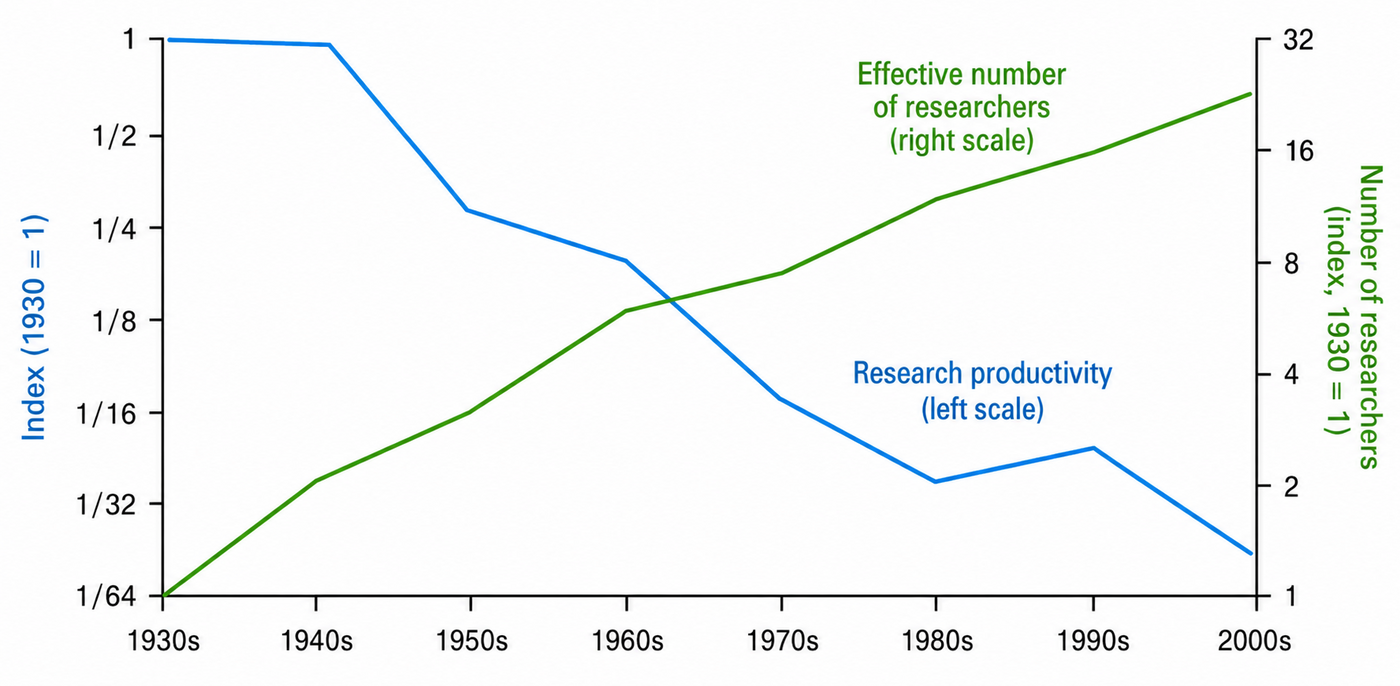 Fig. 01: Schematic representation based on Bloom et al. – if research productivity halves approximately every 13 years, the index declines steadily despite growing research efforts.
This logic is most clearly illustrated by Moore's Law. The number of transistors on a computer chip doubled at roughly the same rate over decades. Behind this seemingly stable technical rule, however, lay a sharp increase in resource use. Bloom and his co-authors estimate that, in recent years, maintaining the same rate of doubling required more than 18 times as many researchers as in the early 1970s. At the same time, research productivity in semiconductor development declined by about seven percent per year. This is not evidence of a failure in chip research. On the contrary: the industry sustained extraordinary progress over decades. However, the study shows the price paid for this continuity—ever-larger teams, more complex facilities, higher investments, and greater organizational effort for the same proportional progress.
The authors find a similar pattern in very different fields. According to their calculations, research productivity declines by approximately five percent per year in the context of increasing agricultural yields for corn, soybeans, cotton, and wheat. For medical innovations, as measured by improvements in mortality rates for cancer and heart disease, the decline is of a comparable magnitude. The decline is also evident at the corporate level: In the Compustat data, research productivity falls by an average of about ten percent per year, and in the data from the "U.S. Census of Manufacturing," by around eight percent. The figures vary considerably across industries, companies, and measurement methods. However, the overall trend remains striking: In nearly all areas that the authors examined rigorously, research input is increasing significantly faster than the resulting output of ideas.
Nevertheless, this finding should not be oversimplified. The study does not prove that today's scientists are less intelligent or less committed, nor that fundamental discoveries are no longer being made. Nor does it measure the total value of scientific knowledge, nor does it provide direct evidence that a certain proportion of the published literature is irrelevant. Rather, it examines fields in which both research input and a plausible output can be quantified over extended periods of time. Nor does the study conclusively identify the causes of the decline in productivity. Possible factors include the growing complexity of the research front, the exhaustion of more readily accessible findings, the increasing volume of existing knowledge, larger and more coordination-intensive teams, and rising technical and regulatory requirements. Precisely because the study leaves the question of causes open, its main finding should not be ideologically overburdened, nor should it be downplayed.
This leads to an uncomfortable implication for scientific organizations and for the practice of risk management. Bloom et al. remind us that the production of knowledge itself is subject to a risk: the risk of confusing increasing effort with growing progress.
More Papers, Fewer Breakthroughs
This impression is supported by other studies, though not always without contradiction. A widely discussed study by Michael Park, Erin Leahey, and Russell Funk concludes that, on average, scientific papers and patents have become less "disruptive" over time—that is, they are less likely to depart from established paths and force new directions. To this end, the authors analyzed approximately 45 million scientific papers and 3.5 million patents from several large datasets and found, over a span of six decades, a decline in the probability that new work would truly break away from existing lines of research. The finding is controversial and has been criticized for its methodology; that is precisely what makes it interesting. For even its critics rarely dispute that the issue of declining originality and growing inertia is a real one.
However, it would be too simplistic to derive from this merely a lament about "science." Historically, many major advances in knowledge did not arise in a closed ivory tower, but rather at the intersection of mathematical ideas, technical challenges, and practical applications. Carl Friedrich Gauss is a classic example of this. His error analysis, adjustment calculations, and method of least squares were not merely abstract mathematics but were closely linked to astronomical and geodetic measurement problems; during the surveying of the Kingdom of Hanover, mathematical methods became direct tools for practical orientation. Many other figures in this series also exhibit this dual structure: Bachelier came into contact with capital markets through the stock exchange and his family business; Bronzin developed option pricing based on the world of premium and futures trading; Markowitz developed portfolio theory not as a purely theoretical exercise, but in response to the question of how investors make decisions under uncertainty; von Neumann worked simultaneously on logic, quantum mechanics, computing machines, and military problems; Shannon and Bell Labs exemplify a research culture in which communications engineering, electrical engineering, and mathematical abstraction were intertwined. The transistor, invented in 1947, did not emerge from an academic seminar debate either, but rather at Bell Labs—that is, in an industrial research laboratory grappling with concrete technical problems.
The recent past also shows that breakthroughs often emerge from hybrid spaces: from companies, laboratories, platforms, development departments, and applied research teams. The Transformer architecture, which today underlies many large language models, was introduced in 2017 by a team at Google in the paper "Attention Is All You Need"; the actual breakthrough lay not only in an elegant idea but in the practical scalability of a new architectural principle. AlphaFold, in turn, was developed at DeepMind and shifted the protein folding problem toward an AI-assisted high-throughput challenge; the work of Demis Hassabis and John Jumper was later honored with the 2024 Nobel Prize in Chemistry. Similarly, the reusability of rocket stages was not driven by a traditional university discipline alone, but rather by iterative engineering practice, a culture of testing, and industrial system integration—as demonstrated, for example, by SpaceX with its Falcon 9 system.
This does not imply a devaluation of academic science. On the contrary: many of these practical breakthroughs would be hardly conceivable without decades of basic research and public research infrastructure. But they show that knowledge does not automatically arise where the most is published. Progress often arises where a real problem is taken seriously enough: a measurement error in geodesy, a price volatility problem in the market, a communication problem in telecommunications, a structural problem in protein folding, a scaling problem in AI, or a reusability problem in spaceflight. Practical application demands proven results. It leaves little room for rhetorical detours, because in the end, a method must measure, support, calculate, protect, heal, or function.
What we see today in many fields, however, is a peculiar mix of overproduction and a lack of relevance. The number of published texts is rising, as is the number of administrative documents related to research; the number of conferences, calls for proposals, peer review rounds, programs, and self-descriptions is increasing all the more. Yet none of this is the same as knowledge. Quite a few articles add little to the world beyond further occupying bibliometric spaces. The crucial distinction, therefore, lies not between universities and companies, but between knowledge-driven work and mere output production.
Good science—whether at a university, in a research laboratory, in a company, or in practical application—does not begin with a list of publications, but with a problem that engages with reality. This is precisely where science, risk management, and factfulness intersect: It is not ideologies, narratives, or institutional routines that should determine what is relevant, but rather evidence, impact, tolerance for error, data quality, and the willingness to let a hypothesis fail in the face of reality.
Where Method Is Replaced by Rhetoric
At this point, Karl Popper regains an almost oppressive relevance. In the context of his polemic against obscurantism and "grandiloquent rhetoric," he is credited with the following statement: "The procedure—where arguments are lacking, replace them with a torrent of words—was successful." The exact wording is not always cited consistently; but as a distillation of his attack on intellectual obfuscation, the phrase hits the nail on the head. Popper took aim at theories and styles of debate that use ambiguity not as a shortcoming, but as a bulwark against criticism. This is precisely where part of the current problem lies. In some fields, texts are published whose main merit lies not in empirical validity, theoretical rigor, or methodological innovation, but in the skillful use of morally charged terms, identity markers, political buzzwords, or rhetorical smokescreens. The aim is then less to solve problems precisely than to symbolically signal that one is on the right side. This is particularly disheartening when ideas are defended with great conceptual effort, even though they have long since been shattered by empirical reality. In such cases, research ceases to be a process of criticism and becomes a process of immunization. It is not the best explanation that prevails, but the stance that is hardest to attack. It was precisely this reversal that Popper opposed.
For Popper, therefore, science is neither a collection of definitively proven truths nor a social authority that pronounces infallible judgments. In his view, science can be understood as a methodically organized process in which provisional hypotheses are formulated, subjected to the strictest possible testing, and corrected or rejected in the event of contradictory findings. An empirical theory is therefore not scientific simply because numerous confirmations can be found for it. Rather, it is scientific if it is formulated so precisely that conceivable observations or experimental results could conflict with it. Popper therefore identified falsifiability, refutability, or testability as the criterion for a theory's scientific status. A theory that is compatible with every conceivable result eludes testing and thus loses its empirical-scientific character.
Against this backdrop, the frequently used phrase "science says" is also problematic. As a linguistic shorthand, it can be useful, for example, when a large number of independent studies arrive at comparable results. However, it becomes misleading as soon as it suggests that science is a monolithic entity with a single, definitive voice. Science does not "say" anything in the strict sense. Scientists formulate hypotheses, collect data, use models, make assumptions, assess uncertainties, and discuss competing explanations. Some findings are exceptionally robust, while others are preliminary, controversial, or heavily dependent on model assumptions. Even a scientific consensus is therefore not a dogma. It describes the best-supported state of knowledge at any given time, but remains fundamentally subject to review and correction.
Precisely for this reason, criticism of scientific statements is not "anti-science" per se. On the contrary: methodologically grounded criticism is a constitutive part of science. It would be far more anti-science to reject findings regardless of data and arguments, or to indiscriminately downplay all expertise. Yet it is equally far removed from science to fundamentally fend off criticism by invoking institutional authority, majority opinion, or moral urgency. Not all criticism is valid, but every scientific claim must, in principle, remain open to criticism. The appropriate response to an objection is therefore not, "Science has decided," but rather: What data, assumptions, and methods underpin the claim? What uncertainties exist? What findings would contradict it? And which alternative explanation has greater empirical validity?
At this point, Popper's critical rationalism intersects with Richard Feynman's famous warning against "cargo-cult science." Feynman used this term to describe research practices that outwardly mimic all the hallmarks of science: experiments are conducted, data is collected, statistical methods are applied, technical terms are used, and publications are produced. The form may appear nearly perfect—and yet the crucial element is missing. Just as in the cargo cults described by Feynman, which replicated runways, control towers, and headphones without thereby bringing back the hoped-for airplanes, the visible rituals are reproduced without understanding the conditions under which they actually yield insights.
According to Feynman, what such "cargo cult science" lacks above all is scientific integrity: the active effort not to deceive oneself. This includes not only presenting findings that support a preferred hypothesis, but also disclosing potential sources of error, alternative explanations, conflicting results, and methodological limitations. It is not enough to formulate individual statements in a formally correct manner if selection, omission, or suggestive presentation creates a misleading overall impression. Scientific integrity, rather, requires providing readers with all the relevant information they need to assess the value of a study for themselves. This also includes a willingness to publish negative results and to test theories regardless of whether the outcome aligns with one's own expectations, interests, or political convictions.
Science is therefore not primarily demonstrated by holding an academic title, using a complex method, or publishing in a scholarly journal. It is demonstrated by a specific intellectual attitude: the willingness to formulate precise statements, to highlight potential errors, to take counterarguments seriously, to disclose uncertainties, and to correct one's own position when better reasons emerge. The scientific process is not complete once a result has been published or a consensus reached. Rather, it begins anew at that point. Hypotheses, methods, models, and approaches must be continuously reviewed and adjusted as needed. Scientific strength, therefore, does not lie in never being able to err, but in making errors systematically detectable and correctable.
Where this attitude is lost, the outward trappings of science may still remain: institutes, conferences, metrics, citation networks, and a highly specialized technical language. Yet its epistemological core is hollowed out. Science then becomes a performance of certainty, criticism a test of loyalty, and methodological procedures a decorative ritual. The runway is lit, the control tower is staffed, the headphones are on—but the planes aren't landing. It is precisely this confusion of scientific form and scientific substance that Popper and Feynman warn against, each in their own way.
John Ioannidis and the Misery of Poor Research
In 2005, John P. A. Ioannidis published one of the sharpest critiques in recent scientific history in PLOS Medicine: "Why Most Published Research Findings Are False." Ioannidis is a physician, statistician, and epidemiologist, and one of the most internationally renowned figures in meta-research—a field of study that focuses not primarily on individual diseases, technologies, or social phenomena, but on science itself: How are research questions selected? How are studies designed, analyzed, and published? What biases arise from statistical methods, institutional incentives, and conflicts of interest? Today, Ioannidis is a professor of medicine as well as of epidemiology and population health at Stanford University and co-director of the university's Meta-Research Innovation Center, or METRICS for short. His role in science thus consists not merely in critiquing individual studies, but in systematically examining the procedures by which scientific knowledge is generated, consolidated, and validated as reliable.
The provocative title of his essay is often misunderstood. Ioannidis does not claim that most scientists cheat or that every single published finding must be false. His argument is methodological and probabilistic. He examines the conditions under which the probability decreases that a formally "significant" result actually reflects a real association. A low p-value does not, in fact, directly answer the question of how likely a hypothesis is to be true. Instead, the prior probability of the hypothesis, the statistical power of the study, the magnitude of the effect under investigation, the number of hypotheses tested, and the extent of possible biases are also decisive factors. Ioannidis thus focuses on the positive predictive value of a research result: After the study has been conducted, how likely is it that a reported finding is actually true?
In his model, this predictive value deteriorates particularly when studies are small and statistically weak, when the effects being sought are only minor, and when, from a large number of possible associations, those are selected that happen to yield a striking result. Added to this is what is known as analytical flexibility: researchers can experiment with different definitions, endpoints, time periods, subgroups, control variables, or statistical methods. The greater this leeway, the easier it is to generate a formally positive result from data that was originally unremarkable. These adjustments do not even have to be made with fraudulent intent. They often arise from honest curiosity, from attempts to explain findings after the fact, or from the desire to extract a publishable finding from data that was collected at great expense. Methodologically, however, the problem remains the same: a hypothesis developed only after examining the data is treated as if it had been established from the outset.
Ioannidis also points out that biases do not arise solely from financial conflicts of interest. Scientific schools of thought, prevailing ideologies, personal convictions, career interests, institutional expectations, and commitment to one's own theory can also influence the selection and interpretation of results. Scientists invest years of their lives in specific models and research programs. It would be unrealistic to assume that they always remain completely neutral toward results that confirm or refute their life's work. This effect is amplified in particularly "hot" fields of research, where many teams compete simultaneously for attention, funding, and the first spectacular publication. In such fields, the incentive to quickly publish striking positive results increases, while negative, unspectacular, or contradictory results often disappear into drawers. As a result, the published literature can appear much more conclusive than the evidence actually available.
This warning is also directly relevant to risk analysis. There, too, small data sets, selectively chosen loss events, flexible scenario definitions, and strong prior assumptions can produce results that look mathematically precise but are hardly robust in practice. Anyone who tests numerous risk drivers, time periods, and model variants will almost inevitably find individual striking correlations. Anyone who documents only successful predictions and overlooks failed ones overestimates the quality of their model. The central question is therefore not merely: Is the result statistically significant or formally correct? It is: What data, assumptions, selection decisions, and incentives produced this result?
With this, Ioannidis leads directly to the concept of factfulness. It means measuring claims against verifiable data, taking order of magnitude and base rates into account, not confusing dramatic individual cases with general trends, and openly acknowledging uncertainty.
Factfulness Instead of Risk Rhetoric
At this point, we can align with Hans Rosling. His concept of "factfulness" was neither naive optimism nor a call to downplay existing problems. Rather, it refers to a methodological discipline of judgment: Anyone who wants to understand the world should base their assessments as much as possible on reliable data, long-term trends, base rates, and appropriate benchmarks—and less on ideological preferences, dramatic individual examples, and morally charged narratives. Factfulness thus does not mean viewing the world positively, but rather seeing it in proper perspective.
Hans Rosling was not primarily the popular "statistics guru" as he was often perceived later on. He was a physician, researcher, and professor of international health at the Karolinska Institutet in Stockholm. In the late 1970s, he worked as a doctor in northern Mozambique, where he investigated a previously little-studied paralytic disease that was later identified as konzo. During a study visit to Bangalore, he had already realized that his own notions of so-called "developed" and "underdeveloped" countries were shaped by outdated and, at times, arrogant assumptions. These experiences led him to a lifelong exploration of the question of why even well-educated people hold a systematically distorted view of global health, poverty, and social development.
Rosling's particular achievement, therefore, lay not solely in the presentation of large amounts of data. He combined his experience in medicine and development policy with the ability to make long-term changes visible and understandable. Together with his son Ola Rosling and his daughter-in-law Anna Rosling Rönnlund, he founded the Gapminder Foundation in 2005. The visualization technique developed by Ola and Anna made it possible to depict countries not as static categories, but as data points that shift over decades. This allowed income, life expectancy, child mortality, education, and fertility to be viewed simultaneously. This revealed a world that had changed significantly, while many mental models were still based on conditions from the 1960s or 1970s.
The term "Factfulness" itself was coined by Ola Rosling in 2014. The book that was later published under this title was a joint project by Hans Rosling, Ola Rosling, and Anna Rosling Rönnlund. It grew out of Gapminder's so-called Ignorance Project. Since 2010, the Roslings had been systematically testing people's perceptions of global trends. Their findings revealed that students, journalists, executives, and policymakers did not merely have gaps in their knowledge when it came to simple questions about poverty, health, education, or population trends. Their answers were often systematically more pessimistic than the available data. These errors were not randomly distributed but followed recurring patterns of perception. Work on the book began in 2016, and it was published in 2018, one year after Hans Rosling's death.
Factfulness is therefore less a collection of specific facts than a method for recognizing typical cognitive biases. Rosling and his co-authors described ten "dramatic instincts," including the negativity instinct, the fear instinct, the scale instinct, and the urgency instinct. According to this framework, people overestimate information that is emotional, new, vivid, and threatening. Slow improvements, successful prevention, and unspectacular normal trends, on the other hand, receive little attention. The human perception filter favors the extraordinary. As a result, a series of spectacular news stories can create the impression that a risk is constantly increasing, even though long-term data show a stable or even declining trend.
This approach can be translated into a few simple but challenging rules: Individual values should be compared with trends over time; absolute numbers require an appropriate denominator; exceptional events must be put into perspective relative to their baseline frequency; global averages should be broken down by region, income group, and cause; and the observation that a situation is bad must not be confused with the claim that it is getting worse and worse. For example, a high number of claims can simultaneously mean that a problem is serious and that the situation has improved significantly compared to the past. "Bad" and "improving" are not logical opposites.
This is a key point, especially for risk management. Risk scenarios should neither be reassuringly sugarcoated nor apocalyptically exaggerated. They should be based on evidence as much as possible. This is more difficult than it sounds. In many organizations, risk analyses fall prey to institutional trends, political narratives, or media dramatization. As a result, scenarios are given high priority not because data, reference groups, and verifiable mechanisms of impact support them, but because they resonate symbolically, generate moral pressure, or fit into preconceived worldviews.
Rosling's analysis of deaths resulting from natural disasters provides a particularly vivid example. The Gapminder surveys asked how the annual number of disaster-related deaths had changed over the past hundred years. The options were: a doubling, a level that remained roughly unchanged, or a decline to less than half. Only about ten percent of respondents chose the correct answer. According to data from the international disaster database EM-DAT cited by Gapminder, an average of about 325,000 people died each year from natural disasters between 1907 and 1916. Between 2007 and 2016, the average was around 80,000. The annual figure had thus declined by about 75 percent, even though the world's population had grown by more than five billion people during the same period.
For risk management, it is not just the decline itself that is decisive in this example. What is particularly relevant is the question of why our intuitive perception of risk diverges so sharply from empirical trends. Earthquakes, floods, and storms are reported intensively and accompanied by striking images. Every single disaster is real, and every death is tragic. However, media coverage of individual major events says nothing about whether long-term mortality is rising or falling. Attention focuses on spectacular incidents of damage, while successful early-warning systems, better buildings, more reliable weather forecasts, medical care, and organized evacuations go largely unnoticed. Prevention rarely makes for compelling images. This is precisely why its impact is systematically underestimated.
From a risk management perspective, this example also shows that risk must not be equated with the mere existence of a hazard. Natural hazards have not disappeared. Exposure and asset concentration can also increase. The actual consequences, however, depend just as much on vulnerability, protective measures, early warning, responsiveness, and recovery capacities. A well-founded risk analysis must therefore distinguish between hazard, exposure, vulnerability, and impact. It must not infer from the decline in historical fatalities that natural disasters have become insignificant, nor conclude from individual extreme events that all risks inevitably lead to catastrophic outcomes. Rosling's analysis thus does not give the all-clear, but rather provides an argument for a nuanced breakdown of risk.
The same applies to cyber risks. A spectacular ransomware attack, a widely discussed data breach, or a politically charged buzzword is not a sufficient substitute for frequency analyses, damage data, stress tests, and transparently disclosed assumptions. At the same time, an average low frequency of damage must not lead to the disregard of rare but existential events. Factfulness requires us to consider frequency and loss severity separately. An event can be highly unlikely and yet strategically relevant. Conversely, a frequently reported event may have a low objective probability of occurrence. Good risk analysis therefore examines base rates, distributions, and dependencies—not just high-profile cases.
Anyone who wants to seriously assess cyber risks needs evidence regarding attack vectors, vulnerabilities, recovery times, dependencies on service providers, the frequency of specific incidents, the quality of detection, and the effectiveness of existing controls. They must also distinguish between observed data and unreported cases, between average losses and extreme losses, and between historical experience and structural changes. This applies equally to geopolitical, operational, and supply chain risks. A cluster of negative news reports may indicate a real trend; however, it may also result from increased attention, improved tracking, or a change in reporting methodology. Only the analysis of appropriate time series and benchmarks allows for a reliable assessment.
An evidence-based risk culture first asks: What do we know, what do we suspect, and what data supports these assumptions? What population and time period were considered? Are these absolute numbers or relative frequencies? Are we seeing a short-term fluctuation or a structural trend? What countermeasures are already reflected in the historical data? Which correlations are being prematurely interpreted as causes? And where does the realm of statistically sound statements end and the zone of genuine uncertainty begin?
It is precisely on this point that Rosling, Fisher, Kahneman, and the great probability theorists of this series converge: sound judgments arise not from volume, but from the clear separation of findings, interpretation, and speculation.
Conclusion and Outlook
It is precisely at this point that the series on its historical figures becomes relevant to the present once again. The thinkers of the past provide not merely venerable quotes, but antidotes. Fisher reminds us that design comes before calculation. Gosset, that small samples call for caution. Knight, that not every uncertainty can be translated into probabilities. De Finetti and Ramsey, that judgments must be explicit and coherent. Kolmogorov, that even simple probability statements require consistent axioms. Mandelbrot, that smooth normality assumptions can be dangerously wrong. Arrow points out that information asymmetries systematically distort markets and decisions.
In other words: precisely when the present publishes too much, labels too quickly, and slips too easily into data fetishism or blind faith in models, the old foundations become urgently relevant again. They compel a return to the fundamentals of methodology: clear concepts, clean data, sound models, and rigorous criticism. This is not a step backward into the past, but rather a prerequisite for ensuring that data analytics and AI do not remain merely powerful tools, but become tools of insight.
Perhaps this is the real point of this entire series. The intellectual future rarely emerges from nothing. It usually arises where old, robust insights meet new contexts. Anyone today who models risks, evaluates scenarios, calculates Bayesian updates, interprets small samples, structures expert judgments, aggregates portfolios, simulates markets, or takes "fat tails" seriously is almost always standing on the shoulders of giants whose work predates today's terminology by a long shot.
This does not mean that the present produces nothing new methodologically. It does mean, however, that progress in science must not be confused with trendy language. If research is to become more productive, smarter, and more relevant, it does not first need more self-description, more committee jargon, or more academic noise, but rather better selection, stricter methodological discipline, and greater intellectual discernment.
This is precisely where Richard Feynman's views align with this perspective. In his lecture "What is Science?," he warned against confusing science with the watered-down rhetoric of textbook prefaces and substitute philosophies of methodology. According to Feynman, what is crucial is not merely "making observations," but developing a judgment about what is even worth observing and where to focus one's attention. This remark strikes at the methodological core of the entire series. Whether with Pascal, Bayes, de Finetti, Fisher, Knight, or Mandelbrot: progress never began with a flood of words, but with the disciplined selection of the relevant question, the relevant pattern, and the relevant counterexample.
Feynman's second insight is hardly less important. "Mathematics is looking for patterns," he said in retrospect about his own education. This is precisely where the deeper unity lies between historical probability theory, modern risk management, data analytics, and artificial intelligence. All these fields thrive on recognizing viable patterns in complex data, observations, and experiences—while at the same time knowing when an apparent pattern is merely noise. Where this distinction is lost, science becomes mere decoration; where it succeeds, it becomes capable of yielding insight.
In this context, an answer is attributed to Nobel laureate Max Perutz. When asked how he had managed to produce nine Nobel laureates from his laboratory, he is said to have replied: "No politics, no committees, no reports, no expert opinions, no interviews. Just talented, highly motivated people, selected by a small number of men with sound judgment." Whether or not the exact wording can be verified down to the last detail, the spirit of this remark strikes a sensitive chord. Great science rarely emerges where administration is confused with insight. It arises where method, courage, criticism, and sound judgment come together.
So anyone wishing to draw a summary lesson from this series might phrase it this way: The tools of our present are strong only when their ancient foundations are taken seriously. And the science of the future will be more than just an ever-louder paper-pushing machine only if it recommits itself more strongly to that rare, hard, and often unfashionable virtue that united nearly all the great figures in this series: intellectual integrity.
Bibliography and further reading:
- Arrow, Kenneth J. (1963): Uncertainty and the Welfare Economics of Medical Care. In: American Economic Review, Vol. 53, No. 5, pp. 941–973.
- Bachelier, Louis (1900): Théorie de la spéculation. In: Annales scientifiques de l’École Normale Supérieure, Sér. 3, Tome 17, pp. 21–86.
- Black, Fischer / Scholes, Myron (1973): The Pricing of Options and Corporate Liabilities, in: Journal of Political Economy, Vol. 81, No. 3, pp. 637–654.
- Bloom, Nicholas / Jones, Charles I. / Van Reenen, John / Webb, Michael (2020): Are Ideas Getting Harder to Find? In: American Economic Review, Vol. 110, No. 4, pp. 1104–1144.
- Feynman, Richard P. (1969): What is Science? In: The Physics Teacher, Vol. 7, No. 6, pp. 313–320.
- Fisher, Ronald A. (1935): The Design of Experiments, Oliver & Boyd, Edinburgh.
- Ioannidis, John P. A. (2005): Why Most Published Research Findings Are False. In: PLOS Medicine, Vol. 2, No. 8, e124.
- Kahneman, Daniel / Tversky, Amos (1979): Prospect Theory: An Analysis of Decision under Risk, in: Econometrica, Vol. 47, No. 2, pp. 263–291.
- Markowitz, Harry M. (1952): Portfolio Selection, in: Journal of Finance, Vol. 7, No. 1, pp. 77–91.
- Merton, Robert C. (1973): Theory of Rational Option Pricing. In: Bell Journal of Economics and Management Science, Vol. 4, No. 1, pp. 141–183.
- von Neumann, John / Morgenstern, Oskar (1944): Theory of Games and Economic Behavior, Princeton University Press, Princeton 1944.
- Park, Michael / Leahey, Erin / Funk, Russell J. (2023): Papers and Patents Are Becoming Less Disruptive over Time. In: Nature, Vol. 613, pp. 138–144.
- Perutz, Max F. (1998): I Wish I’d Made You Angry Earlier: Essays on Science, Scientists, and Humanity. Cold Spring Harbor Laboratory Press, Cold Spring Harbor.
- Popper, Karl R. (1971): Wider die großen Worte [Against the Grand Words]. In: Die Zeit, 24. September 1971; later reprinted in: Auf der Suche nach einer besseren Welt [In Search of a Better World]
- Romeike, Frank / Hager, Peter (2020): Erfolgsfaktor Risikomanagement 4.0: Methoden, Beispiele, Checklisten – Praxishandbuch für Industrie und Handel [Risk Management 4.0 as a Key to Success: Methods, Examples, Checklists—A Practical Handbook for Industry and Commerce], 4th Fully Revised Edition, Springer Verlag, Wiesbaden 2020.
- Romeike, Frank / Stallinger, Manfred (2021): Stochastische Szenariosimulation in der Unternehmenspraxis - Risikomodellierung, Fallstudien, Umsetzung in R [Stochastic Scenario Simulation in Business Practice—Risk Modeling, Case Studies, Implementation in R], Springer Verlag, Wiesbaden 2021.
- Rosling, Hans / Rosling, Ola / Rosling Rönnlund, Anna (2018): Factfulness: Ten Reasons We’re Wrong About the World – and Why Things Are Better Than You Think, Sceptre, London 2018.