

On October 15, 2026, the Governing Board of the International Energy Agency decided to expedite the remaining releases from emergency reserves. Approximately 330 million barrels had already been mobilized; the next concrete steps included more than 20 million barrels of diesel. Nevertheless, supply remained tight. The oil market report from the previous day had already described how crude oil exports from the Gulf were recovering, while shipments of refined products remained significantly below pre-crisis levels. For a logistics specialist, an industry executive, or the operator of critical infrastructure, there is little to be gained if the oil price merely signals a easing of tensions. What matters is whether the required product arrives at the right place on time.
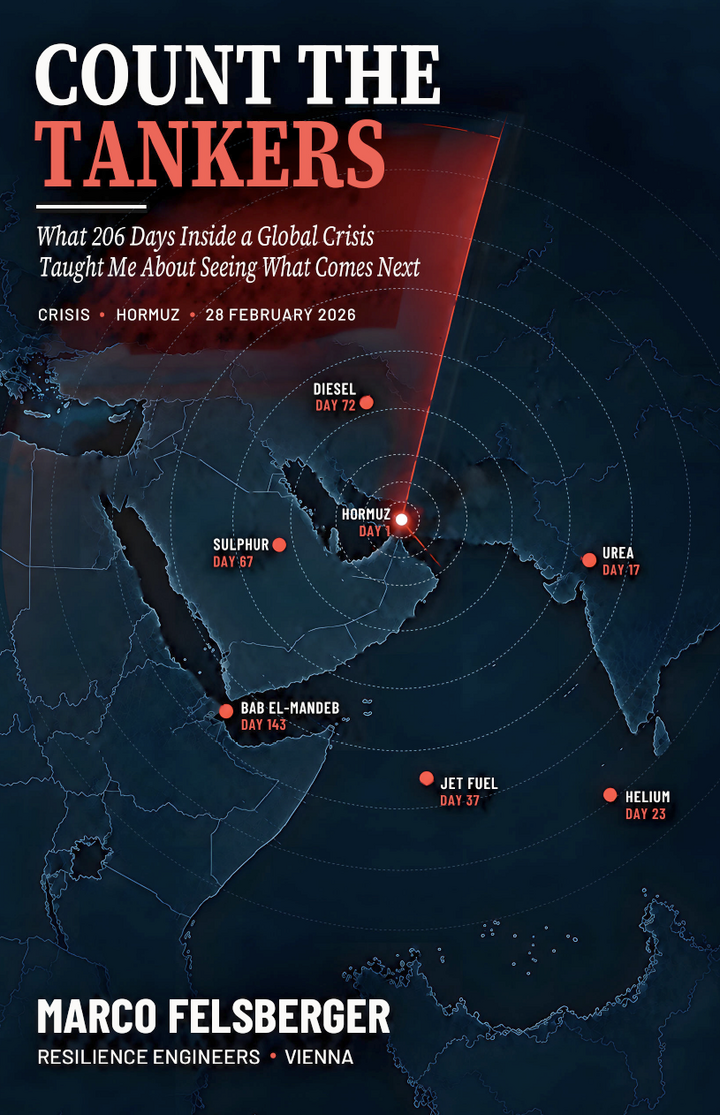
This is precisely where Marco Felsberger's *Count the Tankers* comes in. The Vienna-based risk and resilience expert reconstructs his analyses during the 2026 Hormuz crisis and examines which warnings proved accurate, which forecasts were exaggerated, and which recommendations could have cost a client dearly. The result is a compelling and practical book on dealing with uncertainty and risks in the real world. Its particular strength lies in its combination of specific supply chains, verifiable statements, and openly acknowledged errors.
Marco Felsberger is the founder and managing director of Resilience Engineers GmbH in Vienna. He has been working in crisis, risk, and resilience management for nearly twenty years and has also published regularly on the RiskNET expertise portal in recent years. His company provides analyses of supply chains and critical infrastructure for government ministries, companies, and investors. In addition, he teaches at universities and publishes regularly on security and supply issues. In the book, he combines this professional perspective with experiences from his time in the Austrian Armed Forces and subsequent crises. He writes as a practitioner who, under time pressure, must provide guidance and a basis for decision-making and is subsequently willing to be held accountable for his statements. (See pages 17–22, 169)
The full title is "Count the Tankers. What 206 Days Inside a Global Crisis Taught Me About Seeing What Comes Next." The English-language book was self-published a few days ago (Resilience Engineers) and comprises approximately 170 pages.
Before the Crisis and in the First Hours
The prologue and introduction explain the significance of the Strait of Hormuz and provide context for the author's personal situation at the outset. Part I, "Before," comprises Chapters 1 through 3. Felsberger describes how he identifies critical dependencies, assesses the signs of an escalation, and develops a situational picture within the first 48 hours. His starting point is the specific supply structure: Which locations produce which goods, who needs them, and how long will the available stocks last? Particularly vivid is the warning against alternative solutions that share the same vulnerability or cover only a small portion of the demand. (pp. 1–36)
Even at this early stage, it becomes clear how useful analytical approaches can be distorted by incomplete initial data. As Felsberger himself explains, his original estimate of India's crude oil supply lasting about 9.5 days took into account only the government's strategic reserves. Following a customer's suggestion, he also includes the inventories of Indian oil marketing companies and revises the supply duration to approximately 74 days. In his subsequently recalculated simulation, the timeframe for a potential crude oil shortage shifts significantly later. In contrast, he identifies the supply of liquefied petroleum gas (LPG)—which is used primarily for cooking—as a specific vulnerability. The chapter thus highlights a key distinction: Exposure describes the extent to which supply depends on a disrupted link; the actual impacts also depend on available inventories, alternative supply routes, and precautionary measures already in place. For risk managers, this provides a significant insight: A high degree of dependence alone does not allow for a reliable assessment of the expected extent of damage. To do so, the specific available buffers and options for action must also be considered.
Reading Supply Chains and Recognizing Reliable Signals
Part II, "Count the Tankers," forms the core of the book with Chapters 4 through 12. First, Felsberger traces the less visible connections between energy production and industrial feedstocks. Helium serves as an example of a concentrated supply that is difficult to substitute. Sulfur, sulfuric acid, fertilizers, and refinery products illustrate how a regional bottleneck affects different industries with a time lag. The description makes it clear why a raw material that is unremarkable in terms of price can be more critical to operational capability than a much more expensive procurement item. (pp. 39–46, 55–72)
Chapter 5 introduces two tools: the CARVER framework—adapted from a military context—for a structured analysis of vulnerability, and a tracker for force majeure notifications. According to the author's presentation, CARVER comprises six criteria: Criticality refers to the importance of an infrastructure or a supplier to the system under consideration; Accessibility refers to the accessibility to an attacker or the exposure to a disruption; Recognizability refers to the recognizability of this importance to outsiders; Vulnerability refers to susceptibility to disruption; Effect refers to the consequences of a failure; and Recuperability refers to the ability to recover.
Felsberger first uses the framework to shift perspectives: He examines critical infrastructure from the perspective of a potential attacker to identify particularly vulnerable supply nodes. He then applies the criteria to the assessment of his own critical suppliers. In doing so, he asks, among other things, what proportion of his own output would be lost in the event of a supplier failure, how easily the supplier's operations could be disrupted, which other customers would be affected simultaneously, and how long it would take to resume operations or find a replacement. The simultaneous impact on multiple customers is particularly relevant because it creates competition for alternative sources of supply. Each of the six criteria is rated on a scale of one to five points and then totaled. The resulting ranking provides an initial guide for in-depth assessments and preparation for disruptions; however, its significance depends on the underlying assessments. Added to this are vessel movements, allocation notices, and physical market indicators. The chronology in Chapter 6 shows how such signals are consolidated into situational assessments. The book's title reflects a verifiable observation: A political announcement alters expectations; actual shipments reveal whether the behavior of the parties involved has already changed. (pp. 47–63)
Three Stages of Scarcity and the Consequences of Misclassification
Chapter 7 distinguishes three stages: a product is expensive, it is rationed, or it is no longer available to a specific customer. Felsberger calls them Wave 1, 2, and 3. Each stage requires different decisions. Higher prices initially affect costs and financing; rationing makes delivery priorities and inventory lead times critical; actual unavailability can force substitution, production adjustments, or a halt in operations. However, these stages do not necessarily follow one another in sequence. Different buyers of the same commodity can be in different states simultaneously. (pp. 65–72)
The following chapters examine this logic using examples of reports of easing supply constraints, aviation fuel, and fertilizers. Particularly revealing is the misinterpretation of refueling restrictions at Italian airports. In several reports, a limited supply disruption is portrayed as physical unavailability. In the case of urea, an overestimation of the shortage leads to a recommendation to secure supplies for several months, even though prices subsequently fall significantly. The comparison with phosphate fertilizer illustrates why production processes, seasonality, political export decisions, and available additional capacity must be considered separately. (pp. 73–94)
Geopolitical Actors and Artificial Intelligence
Chapter 11 broadens the perspective to include the second maritime chokepoint at Bab el-Mandeb. Felsberger recognizes its significance early on but fails to give sufficient weight to the Houthis' independent interests. This leads to an important insight: an actor cannot be reliably modeled as merely an offshoot of another conflict. Chapter 12 ("The Machine in the Room") then describes how AI enables the research, modeling, and ongoing monitoring of numerous value chains. The author also identifies incorrect input variables, outdated figures, and missing links in a dependency model. (pp. 95–105)
Error Analysis and the Difficult Return to Normalcy
Part III, "After," comprises Chapters 13 through 15. Here, Felsberger explains the systematic tendency of his models to overemphasize supply-side disruptions: supply shortfalls were recorded in detail, whereas declines in demand and adjustment responses were underestimated. There is also a second gap. A tool that detects deteriorations does not automatically map out the conditions for a sustainable recovery. The return of security, insurance coverage, transportation, inventories, and reliable contract volumes requires separate observations. The conclusion therefore distinguishes between initial recovery, sustained recovery, and normalization. (pp. 109–128)
The epilogue continues this approach with dated forecasts for the winter of 2026/27. A methodological report on the book's development discloses the use of AI. The comprehensive "ledger" in the appendix documents statements, subsequent findings, assessments, and potential implications for customer decisions. It contains 86 entries for the core dataset; the additionally updated winter forecasts are listed separately. The book thus concludes with verifiable commitments for the future, the results of which are not yet fully available at the time of publication. (pp. 129–166)
Dependencies are tracked through to the decision
The greatest strength lies in the consistent linking of cause, transmission path, and operational consequence. This reminds me of the bow-tie analysis, an important tool for the structured description of risk scenarios. Felsberger rarely stops at simply stating that a supply chain is at risk. He inquires about the bottleneck, the actually available substitute, the range of inventory, and a customer's position in the distribution of scarce quantities. This is immediately useful for the target audience: A second supplier is of little help if it requires the same upstream production; a full crude oil tank does not resolve a bottleneck in the required end product. The examples make such connections understandable even for executives who do not work with models themselves. (pp. 19–20, 31–33, 44–45)
The discussion of allocation is particularly well done. A global supply gap does not necessarily indicate which shipment will be missed at the factory gate. The decisive factors are contract terms, customer priority, technical feasibility, and the supplier's behavior. This gives the often-abstract topic of resilience concrete substance. For BCM and procurement, this creates a useful basis for discussion between purchasing, production, engineering, and the crisis management team: What do we actually need, who decides on our supply, and what level of performance can we still deliver with reduced allocations? (pp. 43–45, 68–72)
Early warning is given verifiable conditions
The call to count tankers is a compelling working principle. Felsberger calls for observations that can alter one's own assessment. This is more challenging than illustrating a crisis scenario—once formulated—with a constant stream of new reports. The approach is also applicable to other threats: An organization must determine what real change justifies an escalation or an all-clear. It is commendable that the author addresses the limitations of individual data sources. Transponder signals may be missing; prices and reports are subject to their own distortions. Therefore, multiple observations from different perspectives should be combined. (pp. 35–36, 73–78)
For decision-oriented risk management, the distinction between cautious planning and expectations is also valuable. An early quantile threshold can serve as a useful preparation deadline. However, it must not go unnoticed in the report and become the supposedly expected date of occurrence. Felsberger describes precisely this linguistic shift in his own work. The example shows that risk communication requires more than just the specification of ranges: the meaning of the number and the decision associated with it must also remain stable. (pp. 61–62, 113, 126)
Recovery is treated as a distinct management task
Chapter 14 is, in my view, one of the sections in the book that offers significant practical value. The restart of a system is described, along with its prerequisites and delays. An initial shipment, the resumption of operations, or a new insurance offer can represent real progress without necessarily signifying a reliable supply yet. At the same time, a prolonged crisis alters the structure: customers switch suppliers, alternative routes become permanent, and contract terms shift. This perspective is helpful for risk management and BCM professionals because it focuses on restoring the required service levels and ensuring the stability of the new state. (pp. 115–121)
Felsberger links this insight to decisions that must be made after a situation appears to have eased: reducing special inventories, scaling back additional sources of supply, terminating hedges, and freeing up tied-up capital. Premature scaling back can be costly. It is precisely here that the book takes on significance beyond the commodity crisis. It calls for determining, as early as the crisis preparedness phase, which conditions must be met for a safe return to normalcy. (pp. 119–121)
Where the book falls short
The disclosure of the ledger is a strength. Nevertheless, its key figures should be read carefully. As of September 21, the table shows 45 confirmed statements, ten partially confirmed statements, and 23 incorrect statements; in addition, there are two errors caught in time, one outdated statement, and five open entries. A later addendum increases the number of incorrect statements to 24 and reduces the number of open entries to four. The mechanism level is particularly favorable: 32 out of 34 entries are considered confirmed. In contrast, regarding order of magnitude and scarcity level, the original table shows five confirmed statements compared to 15 incorrect ones. These differences are more meaningful than an aggregated accuracy rate. (pp. 141, 165–166)
This limitation also applies to probabilities. Felsberger himself explains in the epilogue that a single result cannot validate a probability estimate. With regard to intervals, however, the proposed test remains incomplete: a result outside an 80-percent interval is an observed interval violation, but in and of itself is not yet evidence of a poorly calibrated procedure. Occasional overshoots are to be expected. What would be required is an ongoing evaluation of the frequency, magnitude, and direction of the deviations. The ledger primarily documents a learning process; its entries do not yet provide independent statistical evidence of superior forecasting quality. (pp. 133–134, 141–166)
The book reports on Monte Carlo simulations, distributions, sensitivity analyses, and numerous model runs. However, the underlying input distributions, dependencies, parameter estimates, and validation procedures are not disclosed in sufficient detail to allow expert readers to reproduce the models presented in the book. The mentioned search among 600,000 parameter combinations for a winter model is a good example: It is interesting that 68 combinations match two operator scenarios and one observed pre-winter period. However, this alone does not allow one to assess how well this calibration holds up outside the references used. (pp. 59, 101–104)
The situation is similar with pragmatic corrections and threshold values. The blanket reduction in the predicted severity, the relaxation rule with three moving indicators, or the lower limit of 25 percent for a structurally anchored scenario may be working rules grounded in experience. However, their generalizability is not systematically demonstrated. Furthermore, multiple indicators may react to the same cause; their simultaneous movement does not automatically constitute confirmation through independent evidence. This does not diminish their practical value as a guide, but it does limit the claim to methodological validation. (pp. 77–78, 98–99, 109–113)
Market stabilization can go hand in hand with operational disruptions
The explanation of why the predicted physical shortage failed to materialize is one of the book's strongest sections. For risk management and BCM, however, it must be supplemented with the perspective of service delivery. When airlines cancel flights and consequently require less fuel, this can stabilize the market. The lost service and its economic consequences remain. Similarly, a mine that procures a raw material at exorbitant prices has avoided a disruption but may have accepted significant impacts on its bottom line. The absence of an empty tank is therefore not a complete measure of success in crisis management. (pp. 70, 82–86, 111)
Added to this is the chosen system boundary. A market as a whole may ration supplies, while a single small customer may experience a complete outage. Felsberger explicitly recognizes this problem and illustrates it using the example of helium. For practical application, this clarification must be consistently maintained: Which organization, which location, which process, and which required quantity are being referred to? Otherwise, the statement "only Wave 2" might reach a manager whose critical process has already come to a standstill. The three levels are a useful model for understanding; they do not replace a company-specific business impact analysis. (pp. 44–45, 68–72)
Overall Impression
"Count the Tankers" is particularly strong where it makes analytical work visible: from the initial suspicion of incomplete data and concrete recommendations to the subsequent correction. After reading the book, one better understands why a knowledgeable analyst can identify a real mechanism and yet still overestimate its consequences. It also becomes clear why a correctly identified cause of a risk scenario can be overlooked if the ongoing updating process is not organized.
Executive management and supervisory boards are provided with a solid foundation for asking more sophisticated questions about management reports: Which specific dependency affects us, what observation would change the assessment, and what is the cost of a cautious decision? For them, the chapters on dependencies, scarcity levels, forecast errors, and recovery are particularly worth reading. The book helps readers evaluate reports based on their decision-making value and avoid confusing the certainty of an explanation with the certainty of its numbers.
Experts in risk management, crisis management, and BCM will find a wealth of material for workshops, scenario exercises, and the revision of early-warning and recovery processes. Particularly useful are the case studies on mutually dependent alternative solutions, positioning in supplier allocation, distinguishing between planning dates and forecasts, and premature all-clear declarations. Purchasing, supply chain management, and operators of critical infrastructure will benefit from the detailed questions regarding inventories, production processes, and alternative capacities. Quantitative specialists, on the other hand, will particularly appreciate the case study on model risks; as a technical reference for simulation and validation, however, the book lacks sufficient detail.
For collaborative work within a company, it makes sense to examine a single critical input material using the questions posed in the book. What quantity is actually achievable? How long can the process run with reduced supply? Which alternatives share the same bottleneck? And what would indicate a robust recovery? The next step is to link these answers to one's own performance requirements, impacts on results, and the costs of corrective measures. It is precisely at this point that reading the book becomes a basis for decision-making.
The book comes highly recommended for decision-makers and practitioners who want to improve their analysis of supply crises and their approach to forecasting. It combines an accessible systems perspective with an unusually concrete examination of one's own mistakes. Its limitations lie in the only partial reproducibility of the models, the inconsistent evaluation of the forecast register, and the need to translate these findings into company-specific decisions regarding economic viability and business continuity. These limitations diminish the book's value as a source of experience and reflection less than they do its potential claim to methodological rigor.
Felsberger's strongest contribution is his call to evaluate false alarms and to examine de-escalation with the same care as escalation. Anyone who applies this approach to their own organization will gain a great deal from reading this book. Counting the tankers is a good start. To make one's own decision, it must then be clear what their cargo, their absence, or their return means for one's own operations.