


A new BIS database documents 568 government-issued or authorized currencies since 1850. For risk managers, this historical perspective offers insight into risks that traditional FX models capture only incompletely: redenomination, regime change, inflation, contractual uncertainty, and loss of institutional trust.
Currencies are among the most taken-for-granted institutions of modern economies. Companies use them for calculations, governments incur debt in them, banks maintain their balance sheets in them, and investors value assets in them. Yet it is precisely this everyday nature that can obscure the fact that, historically speaking, currencies are by no means immutable institutions.
The BIS Working Paper "Gaining (and losing) currency: a global database of currencies, 1850–2026" provides an unusually broad empirical basis for this. Iñaki Aldasoro, Jon Frost, Rudraksh Kansal, and Catherine Schenk have compiled a global database of 568 currencies from six continents. Only 163 of these were still in circulation as of October 2026. 405 currencies had already disappeared during the study period. The median lifespan of a currency is just 33 years.
For risk managers, this long historical perspective is particularly relevant. It expands the usual focus on exchange rate, interest rate, or inflation risks to include a more fundamental dimension: the risk that the monetary unit itself will be altered, reformed, replaced, or transferred to a different monetary system.
Currencies Are Not Natural Constants
In everyday economic life, a currency often appears to be a stable unit of measurement. But unlike the meter or the kilogram, it does not measure an objective physical value. Its value is based on social acceptance, institutional credibility, and the expectation that it will continue to be accepted as a medium of exchange and unit of account in the future.
This is precisely where a key point for risk management lies: currency stability is ultimately a matter of trust. This trust is directed not only toward price stability but also toward the institutions behind the currency—fiscal policy, the central bank, the political order, and, ultimately, the stability of the state itself. Accordingly, the authors emphasize the close historical link between modern statehood and territorial currencies. Since the 19th century, national currencies have become an instrument of state sovereignty, fiscal authority, and national identity.
Thus, currency risk fundamentally differs from a purely market-price-oriented view of exchange rate risk. An exchange rate can change while the underlying monetary units remain the same. A currency change, on the other hand, potentially alters the unit in which contracts, receivables, liabilities, collateral, prices, and balance sheet items are defined.
From 67 to 192—and Back Again
The long-term trend is remarkable. In 1850, there were approximately 67 currencies worldwide. After that, their number increased steadily. World War I and the collapse of the Ottoman, Austro-Hungarian, and Russian empires gave rise to new states—and thus new currencies. Decolonization following World War II provided another significant boost.
The number of currencies reached its historic peak in 1994, at 192. The main drivers were the collapse of the Soviet Union and the emergence of new states in Eastern Europe and Central Asia. After that, the trend reversed. By 2026, the number had fallen to 163. A key factor in this was the introduction of the euro, which replaced 23 previously existing currency units.
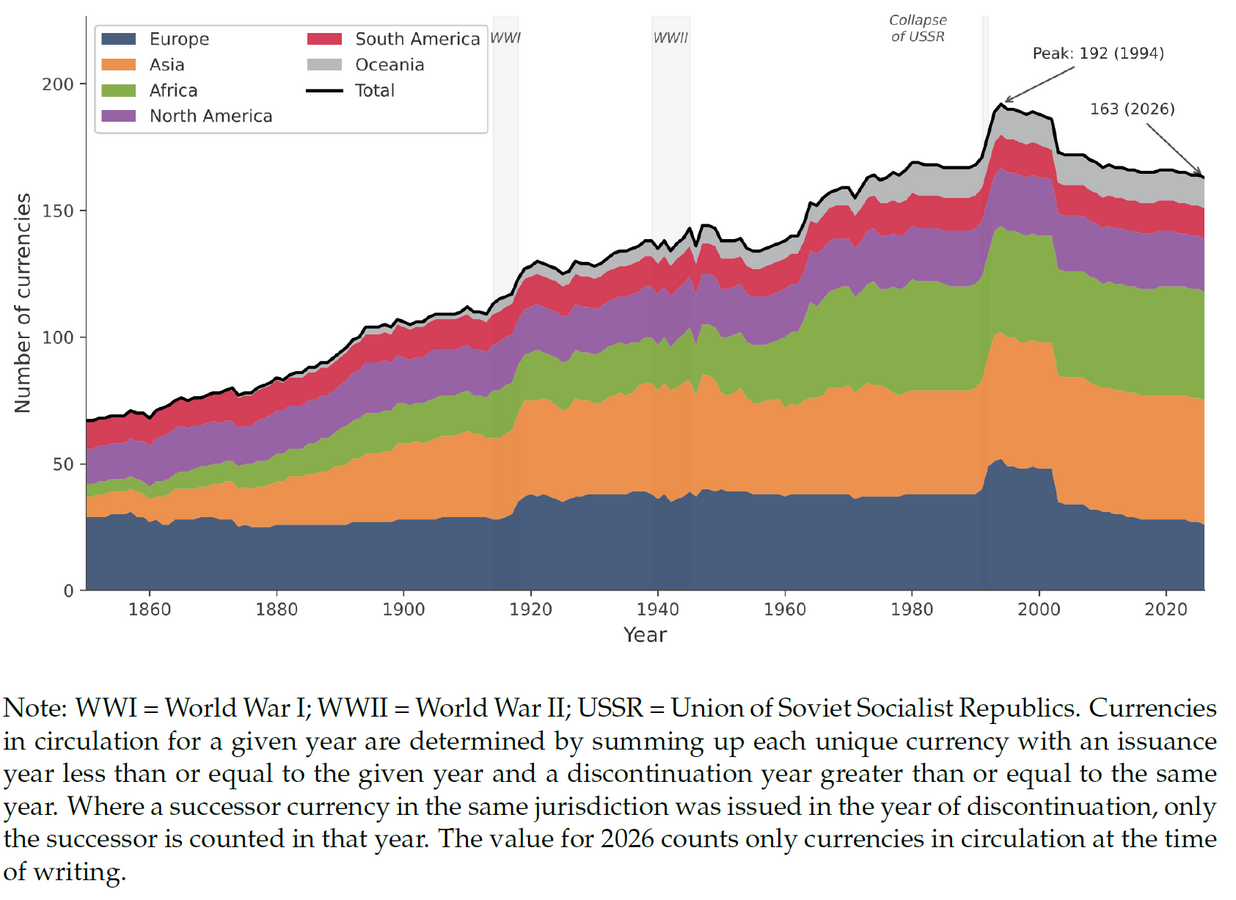 Fig. 01: Evolution of the number of currencies in circulation worldwide from 1850 to 2026: [Source: Aldasoro / Frost / Kansal / Schenk (2026): Gaining (and losing) currency: a global database of currencies, 1850–2026, BIS Working Papers No. 1392, Figure 2, p. 17]
The figure illustrates that the global currency landscape is closely linked to major political turning points. State reorganization gives rise to new currencies; political and economic integration reduces their number.
This observation is relevant for scenario analyses. Currency risk should not be derived exclusively from historical exchange rate distributions. Political structural breaks in particular—secessions, state collapse, currency unions, wars, or fundamental regime changes—can generate discontinuous monetary shifts for which classical value-at-risk models are only of limited use.
Currencies Are Born Politically
The authors classify both the emergence and the demise of a currency according to seven categories. These include independence, the merger of political entities, war or civil war, monetary unions, loss of value due to inflation, changes in name or unit, and other reasons.
The most common specific reason for the introduction of a new currency is the political independence of a territory. 156 of the total 568 currencies surveyed—about 28 percent—were created in this context. Another 45 currencies were created in the immediate wake of wars or civil wars.
This illustrates the political function of money. Alongside a flag, a constitution, and institutions, a currency of one's own is often an instrument for establishing state sovereignty. Four major waves can be identified: the formation of Latin American states in the 19th century, the reorganization of Europe after World War I, the decolonization of the 1960s, and the collapse of the Soviet Union, Yugoslavia, and Czechoslovakia in the 1990s.
For companies with operations in politically fragile states, this means that country risk and currency risk are structurally linked.
Currencies are more often "defunct" in an economic sense
In contrast, a different pattern emerges when it comes to the abolition of currencies. Of the 405 currencies that no longer exist, 143—about 35 percent—were abolished due to a change in name or unit. In 79 cases, or just under 20 percent, inflation was the decisive factor. War and the dissolution of political entities each accounted for about 14 percent.
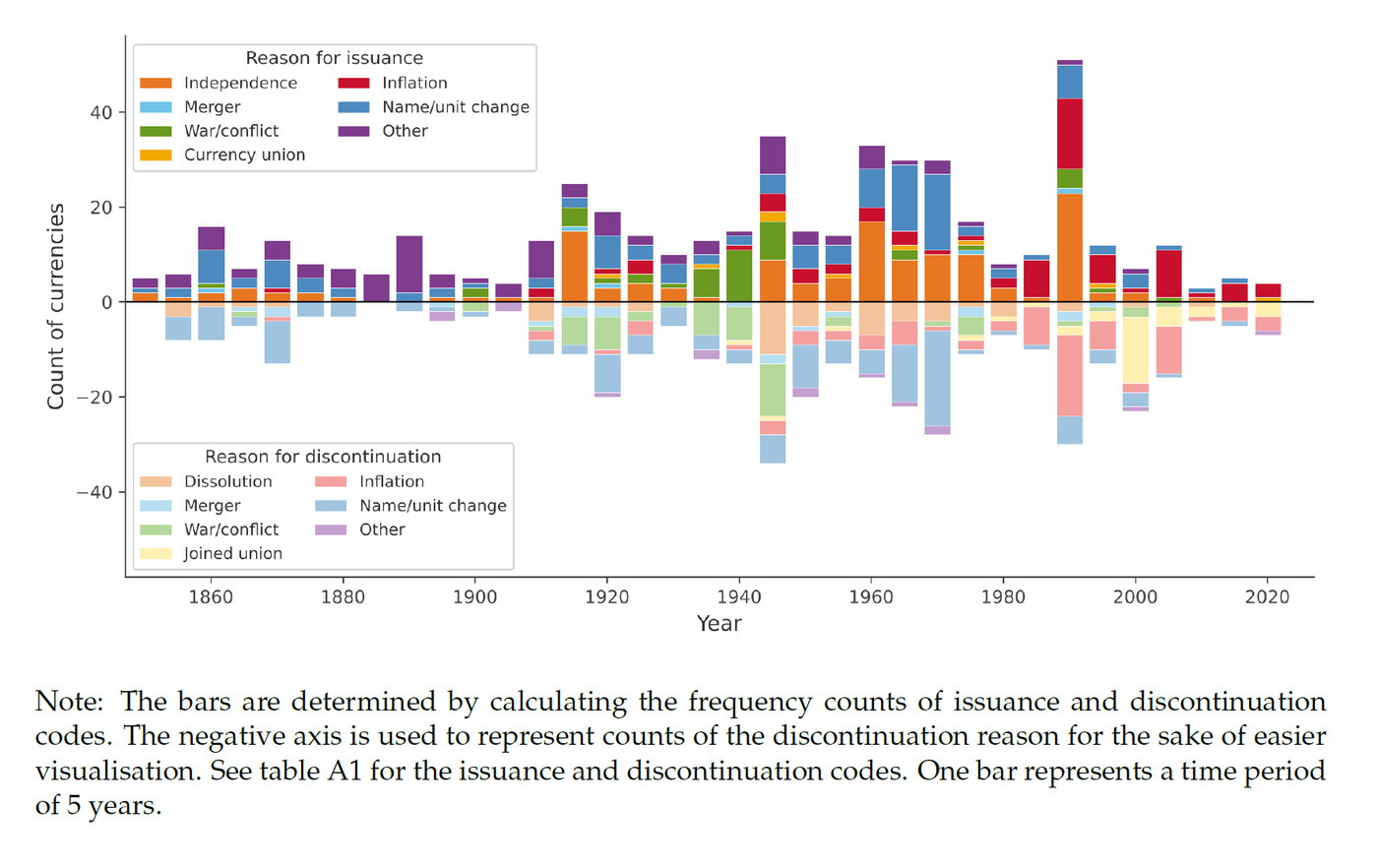 Fig. 02: Reasons for the introduction and abolition of currencies over time: [Source: Aldasoro / Frost / Kansal / Schenk (2026): Gaining (and losing) currency: a global database of currencies, 1850–2026, BIS Working Papers No. 1392, Figure 3, p. 19]
An analysis of the transitions between reasons for creation and abolition underscores this asymmetry. Of the 156 currencies that emerged in the wake of independence, only seven later disappeared due to the dissolution of the respective state. In contrast, 73 of these currencies—about 47 percent—ceased to exist due to inflation or a change in name or unit.
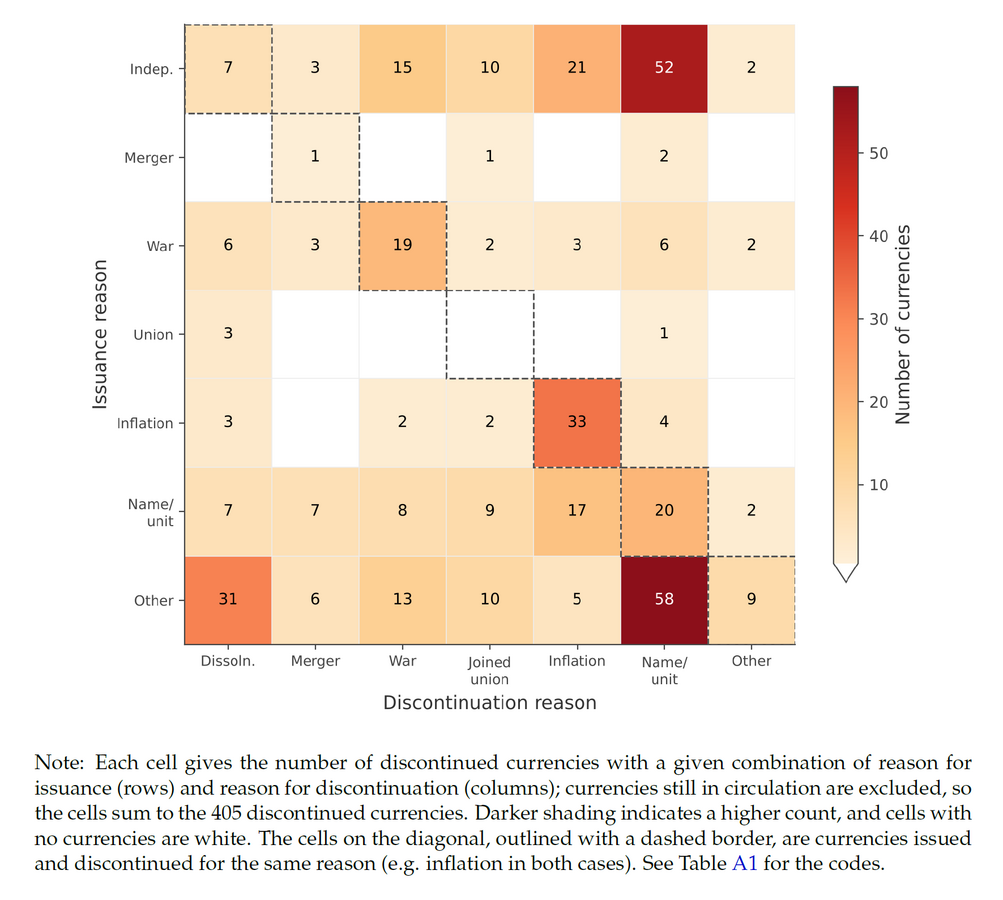 Fig. 03: Transition matrix between reasons for the creation and abolition of currencies: [Source: Aldasoro / Frost / Kansal / Schenk (2026): Gaining (and losing) currency: a global database of currencies, 1850–2026, BIS Working Papers No. 1392, Figure 4, p. 20]
For risk managers, this is a crucial distinction. Political stability does not guarantee lasting monetary stability. Even a continuing state can replace a currency as a result of inflation, a loss of credibility, or institutional reform.
Inflation as a Destructive Feedback Loop
Particularly striking are those cases in which currency reforms did not lead to lasting stabilization but instead generated a sequence of ever-new currencies. Thirty-three currencies in the dataset emerged as a result of inflation and subsequently disappeared again due to inflation. This pattern is concentrated in a relatively small number of countries. Argentina, Brazil, Venezuela, and Zimbabwe account for a significant proportion of these cases.
The problem here is not the technical introduction of a new currency. A redenomination can eliminate zeros and make prices easier to calculate. However, it cannot compensate for a lack of fiscal or monetary credibility.
Brazil went through five currencies between 1986 and 1994 alone: the cruzado, cruzado novo, cruzeiro, cruzeiro real, and finally the real. Yugoslavia also changed its currency five times between 1990 and 1994. A dinar introduced in January 1994 existed for less than a month before it was replaced by the Novi Dinar at a ratio of one billion to one.
From a risk management perspective, this is a classic case of path dependence: a prior loss of credibility increases the likelihood of further reforms as long as the underlying causes are not addressed.
The first ten years are particularly critical
The study also shows that the lifespans of currencies vary extremely widely. The median is 33 years. About 23 percent of all currencies lasted less than ten years; at the same time, 12 percent existed for more than a century. North American currencies are particularly long-lived, with a median lifespan of 57 years. For Europe, the median is 29.5 years; for Asia, 31 years; and for Africa, 28 years.
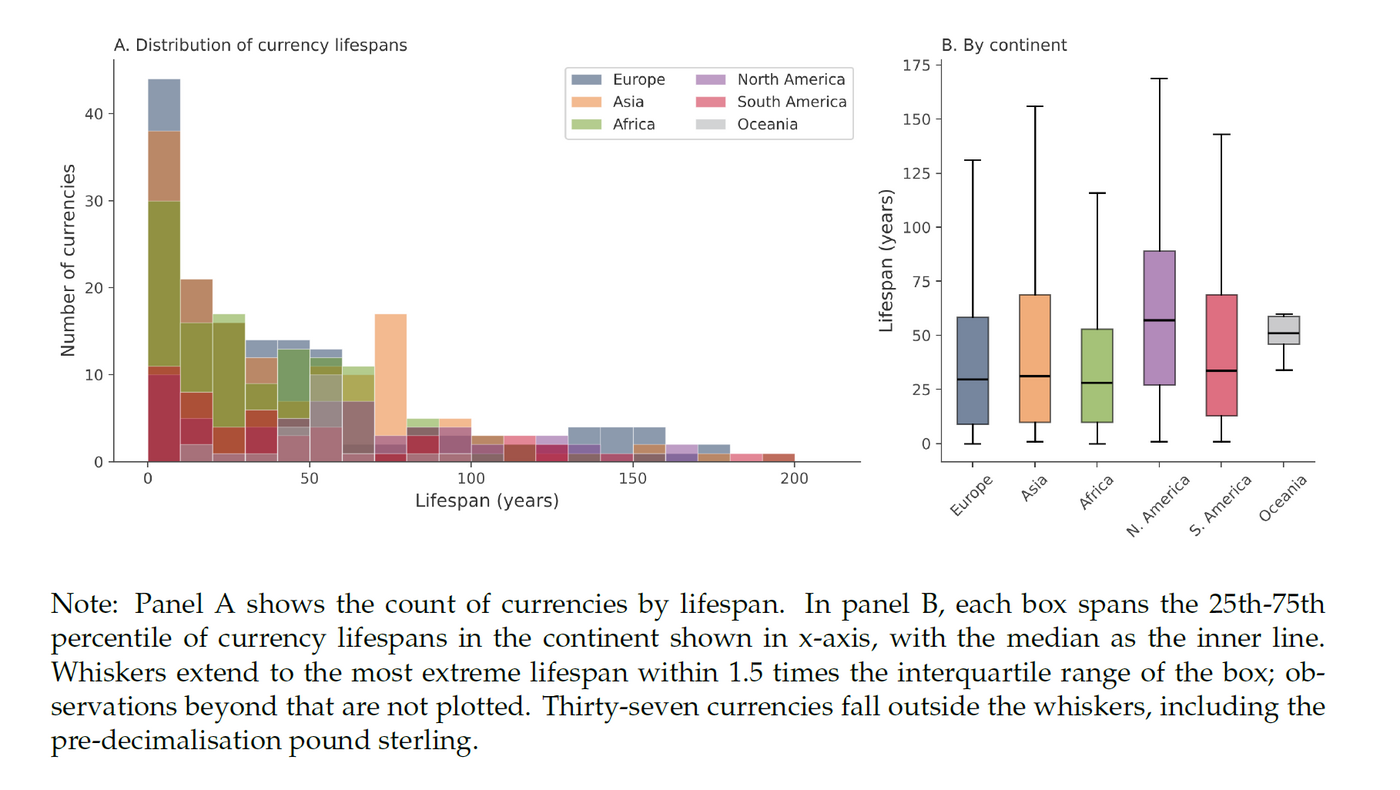 Fig. 04: Distribution of the lifespans of government-issued currencies by region: [Source: Aldasoro / Frost / Kansal / Schenk (2026): Gaining (and losing) currency: a global database of currencies, 1850–2026, BIS Working Papers No. 1392, Figure 6, p. 22]
Even more revealing is the survival analysis. Taking into account currencies still in circulation, about half of them have disappeared after 44 years. Only a little over a third reach 75 years; about 13 percent survive 150 years.
Particularly noteworthy is the trend in the probability of failure: the risk of abolition is especially high in the first decade after introduction and then declines significantly. According to historical data, a currency that has survived three decades has a much higher probability of continuing to exist for a very long time. The authors therefore interpret the first decade as a kind of institutional filter.
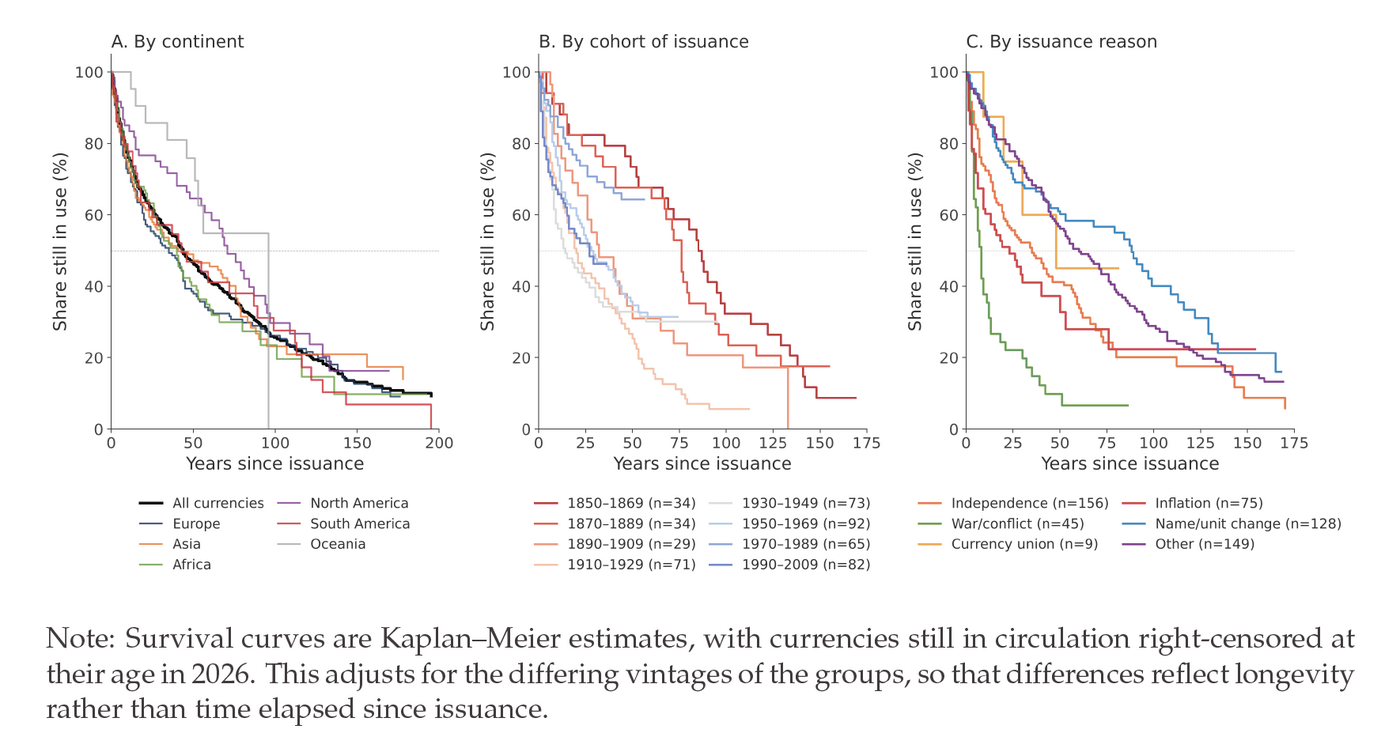 Fig. 05: Currency survival curves by continent, period of introduction, and reason for creation: [Source: Aldasoro / Frost / Kansal / Schenk (2026): Gaining (and losing) currency: a global database of currencies, 1850–2026, BIS Working Papers No. 1392, Figure 7, p. 23]
For risk managers, this does not allow for a mechanical prediction of future currency reforms. However, historical statistics show that young monetary institutions were systematically more affected by political realignment, reforms, and credibility issues.
The global currency landscape has stabilized
Of the total of 568 documented currencies, 405—about 70 percent—had already been discontinued by 2026. At the same time, the ratio between new currency creations and discontinuations has changed. Until the mid-1990s, the gap between newly issued and discontinued currencies widened. Since then, this gap has been closing again, as more currencies are disappearing than are being created.
The authors assume that the record of 192 currencies set in 1994 is unlikely to be matched again in the foreseeable future. New sovereign states have become rarer, additional European countries could join the euro, and dollarization often exhibits high persistence. While digital innovations could trigger changes, they have so far created hardly any new official state currency units.
Currency unions alter the risk profile
Historically speaking, currency unions are a relatively recent driver for the abolition of national currencies. This is particularly evident with the euro. In the 2000s alone, 18 currencies were discontinued due to accession to a currency union. Prior to the 1990s, this mechanism played only a minor role.
 Fig. 06: Currency unions and the shift in reasons for currency abolition: [Source: Aldasoro / Frost / Kansal / Schenk (2026): Gaining (and losing) currency: a global database of currencies, 1850–2026, BIS Working Papers No. 1392, Figure 13, p. 31]
From a risk management perspective, however, a monetary union does not mean the disappearance of currency risk, but rather its transformation. The classic bilateral exchange rate risk within the union no longer applies. At the same time, other risk dimensions gain in importance—such as institutional risks within the union, fiscal divergences among member states, or exit scenarios.
Currency Risk Is More Than Just FX Risk
The most important practical conclusion for risk managers, therefore, lies in broadening the definition of risk. Traditional FX risk management, for example, asks how much the EUR/USD, USD/BRL, or USD/TRY exchange rates might fluctuate within a defined time horizon. The historical database suggests an additional question: What happens if the currency itself ceases to exist?
Such a scenario affects several risk categories simultaneously:
- Redenomination risk: Assets, liabilities, and contracts may be converted into a new unit. The central question then is not only at what exchange rate two currencies are traded, but also at what conversion ratio an old unit is legally transformed into a new one.
- Contractual and legal risk: In cross-border contracts, the law governing the currency can be decisive. Local and foreign legal systems can lead to different outcomes in the event of a currency conversion.
- Country risk: Currency reforms rarely occur in isolation. They may coincide with sovereign crises, inflation, capital controls, political upheavals, or fiscal problems.
- Liquidity risk: Markets may become illiquid during a transition. Official and actual trading conversion rates may diverge.
- Counterparty risk: A receivable with a nominal value that remains unchanged may lose significant economic value if the currency changes or if a counterparty is weakened by inflation, capital controls, or economic disruption.
- Operational risk: ERP systems, treasury systems, accounting, payment processing, price lists, contracts, collateral valuations, and regulatory filings may need to be converted to a new currency.
As a result, what appears to be a purely market-based risk can quickly turn into a multidimensional risk scenario.
What Historical Data Can Contribute to Stress Tests
The study itself does not develop a risk management model. However, its data provides an interesting starting point for historical and hypothetical scenarios. Risk managers could, for example, distinguish between three classes of currency shocks:
- Inflationary currency collapse: A country experiences sharply rising inflation, capital outflows, a loss of confidence, and ultimately redenomination or the introduction of a new currency.
- Political currency break: A state disintegrates, gains independence, or changes its territorial structure. A new currency is introduced as an expression of the new political order.
- Integrative currency change: A country abandons its national currency as part of a monetary union or the permanent adoption of a foreign currency.
These scenarios differ fundamentally in terms of exchange rate paths, capital controls, treatment of contracts, and macroeconomic consequences. Historical data therefore suggest that currency risk should not be modeled exclusively as an extreme devaluation of an existing currency in reverse stress tests. In particularly severe scenarios, the continued existence of the currency itself may also be a relevant assumption.
Extreme currency history is concentrated in a few countries
At the same time, the data show that monetary instability is highly concentrated. Brazil, China, and Indonesia each have nine different currencies. Angola has eight, Argentina has seven, and Venezuela has six. However, the causes differ. In Brazil, Argentina, and Venezuela, the high number is primarily linked to inflation and repeated stabilization attempts. In China and Indonesia, by contrast, it reflects to a greater extent political fragmentation, colonial rule, occupation, and institutional reorganization.
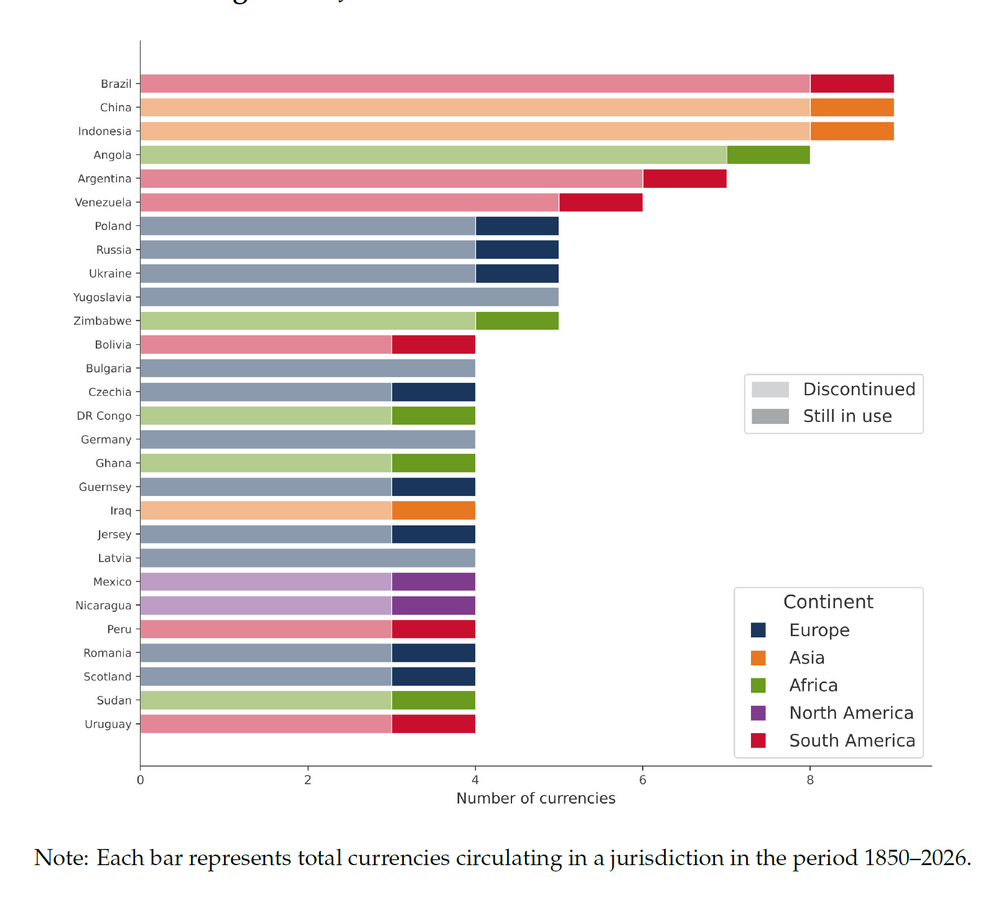 Fig. 07: Jurisdictions with the highest number of different currencies since 1850: [Source: Aldasoro / Frost / Kansal / Schenk (2026): Gaining (and losing) currency: a global database of currencies, 1850–2026, BIS Working Papers No. 1392, Figure 11, p. 28]
The implication is important: A high number of historical currency changes is not a uniform risk indicator. The causes must be analyzed. Inflationary loss of institutional control is distinct from a monetary reorganization triggered by decolonization or state formation.
History is marked by extreme breaks
A few examples illustrate the range. According to the authors' classification, the historical pound sterling—before decimalization—existed for approximately 1,171 years. The French livre existed for more than a millennium. On the other hand, certain Ukrainian currencies from 1918 or the Saar mark from 1947 lasted less than a year.
Among the currencies still in existence today, the U.S. dollar is the oldest at 234 years, followed by the Egyptian pound at 192 years and the Colombian peso at 189 years. The Swiss franc has been in existence since 1850. This range underscores the fact that a currency can survive political and economic crises for centuries—or disappear within a few months.
Limitations of the Analysis
Methodological limitations are important for risk management interpretations. The database contains only government-issued or government-authorized currencies. Private cryptocurrencies, stablecoins, and CBDCs are not recorded as independent currencies.
Furthermore, the authors explicitly point out that historical data from the 19th century, in particular, relies more heavily on numismatic and secondary sources. The "Other" category accounts for approximately 26 percent of the reasons for introduction and remains correspondingly heterogeneous. Cross-country comparisons within the 20th century are therefore more reliable than very long-term comparisons extending far into the 19th century.
It is also crucial to note that the database examines currency units rather than exchange rate regimes. The end of the gold standard or the collapse of the Bretton Woods system therefore do not appear as currency changes as long as the respective currency continued to exist. The database thus measures institutional currency changes—not overall monetary instability.
Perhaps the most important insight: Trust is infrastructure
A historical perspective changes how we view money. Through a long process of institutional experimentation, the modern world has moved toward a remarkably stable norm: a political entity generally has a state-authorized currency—possibly shared with other states within a monetary union.
This system has weathered two world wars, episodes of hyperinflation, decolonization, the collapse of the Soviet Union and Yugoslavia, as well as profound technological changes. The authors interpret this persistence as an indication that government-issued currencies represent a robust institutional equilibrium. They explicitly leave open the question of whether this system will endure in the face of digital forms of money.
For risk managers, this conveys a twofold message. Currencies are remarkably robust institutions. At the same time, history shows that their stability is never guaranteed. Therefore, currency risk should not begin only when the exchange rate fluctuates. It begins when confidence in the institution behind the monetary unit erodes.
Info Box: Key Takeaways for Risk Managers
→ Currency risk extends beyond exchange rate risk. Historical experience shows that the monetary unit itself can also be replaced or fundamentally altered.
→ Politics creates currencies; economics destroys many of them. Independence is the single most important reason for their creation; inflation and redenomination are the dominant factors behind their abolition.
→ The first few years are particularly critical. The probability of a new currency being reformed or abolished is especially high in the first decade.
→ Inflation crises can trigger a series of currency changes. Argentina, Brazil, Venezuela, Angola, and Zimbabwe demonstrate that redenomination without credible stabilization is not a lasting solution.
→ Regime changes create discontinuous risks. Traditional market risk models based on historical exchange rate volatility are insufficient to capture such breaks.
→ Redenomination risk should be an integral part of country risk and treasury scenarios.
→ Contract law becomes a risk factor in the event of a crisis. For international claims, the key factor is which legal system governs a currency changeover and conversion.
→ Currency reforms create operational risks. IT systems, payment processing, treasury, accounting, and contract management can all be affected simultaneously.
→ Currency unions eliminate certain FX risks but create new institutional dependencies.
→ Historical currency changes are not caused by a single factor. High currency turnover can result from inflation, war, state collapse, decolonization, or institutional restructuring.
→ Early-warning systems should consider monetary, fiscal, and political factors collectively.
→ In extreme cases, reverse stress testing should take into account not only a sharp devaluation but also a redenomination or replacement of the existing currency.
→ Historically, government-issued currencies have proven to be a remarkably robust institutional model. However, robustness does not mean immutability.
Bibliography
- Aldasoro, Iñaki / Frost, Jon / Kansal, Rudraksh / Schenk, Catherine (2026): Gaining (and losing) currency: a global database of currencies, 1850–2026, BIS Working Papers No. 1392, November 2026.