
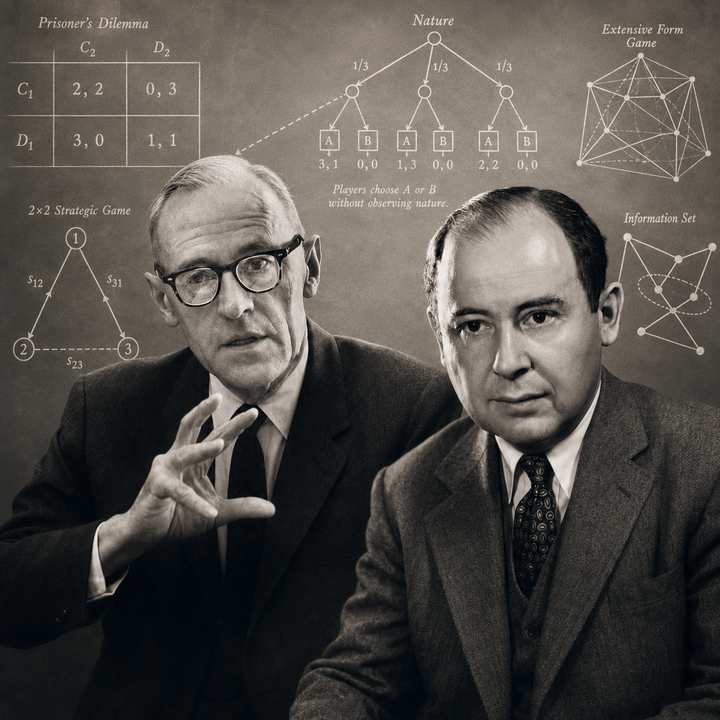
There are encounters that only seem like historical necessities in hindsight. In 1935, the Viennese economist Oskar Morgenstern published an essay on perfect foresight and economic equilibrium. His aim was precisely to show how unrealistic the assumption is that economic actors could know the future with absolute certainty. His colleague, the Czech mathematician Eduard Čech, then drew his attention to a mathematical article that had appeared seven years earlier: John von Neumann's "On the Theory of Games", published in 1928. In it, a young Hungarian mathematician addressed conflict situations in which not everything is known and in which every rational decision depends on the expected behavior of the opponent. From this intellectual spark—an economist who doubted the idea of perfect foresight and a mathematician who formalized strategic rivalry—one of the most influential books of the 20th century emerged a few years later at Princeton: "Theory of Games and Economic Behavior" (1944).
Anyone who reads this book today merely as the founding document of game theory underestimates its historical impact. von Neumann and Morgenstern posed a new question. They no longer asked only how a single actor should behave rationally given certain prices or probabilities. They asked what rationality means when others are doing the same thing at the same time—and when the outcome depends precisely on each player taking the others into account. In this sense, game theory is less a theory of games than a theory of strategic reality: for markets, negotiations, arms races, auctions, cartels, threats, cooperation, and deception.
John von Neumann: The Child Prodigy from Budapest
John von Neumann was born in Budapest in 1903, and almost every early episode of his life reads like an exaggeration that nevertheless persists. Even as a child, he displayed the extraordinary intelligence that future Nobel laureates such as Eugene Paul Wigner never forgot. As a six-year-old, he is said to have divided eight-digit numbers in his head; above all, however, his memory was impressive. He could reproduce pages from a book almost word for word after just a brief glance and later memorized entire passages from Goethe's "Faust". Such anecdotes are not merely embellishments of the cult of genius. They point to a mindset that combined extraordinary speed with an almost uncanny reliability of memory.
Von Neumann attended the German-language, humanistic Lutheran high school in Budapest—the same school that also shaped the Hungarian-American physicist and Nobel laureate Eugene Paul Wigner. Among his teachers there was the legendary mathematics teacher László Rátz, who became a formative figure for several of Hungary's most gifted minds of the century. While still a high school student, von Neumann published his first mathematical paper together with his teacher Michael Fekete. He thus grew up in an educational environment where mathematical excellence, linguistic education, and historical scholarship were not seen as opposites but rather as mutually reinforcing.
However, in accordance with his father's wishes, he did not initially study mathematics as a pure discipline, but rather chemical engineering—first in Berlin, then at ETH Zurich, where he earned his diploma in 1926. At the same time, he pursued his actual scientific career at the University of Budapest, where he earned his doctorate in mathematics. Important teachers and contacts during these years included Lipót Fejér, David Hilbert, Hermann Weyl, Erhard Schmidt, George Pólya, Emmy Noether, and other leading figures of the mathematical elite of the time. His time in Göttingen was particularly formative, where Hilbert's program for the formal foundation of mathematics still seemed like an ambitious project for the future.
Von Neumann's early work initially focused on set theory, mathematical logic, and axiomatics. However, this phase took a decisive turn when Kurt Gödel published his incompleteness theorem in 1931, thereby severely undermining Hilbert's program. Von Neumann recognized the far-reaching implications of this result with extraordinary speed. Later, Gödel, von Neumann, and Albert Einstein reunited as colleagues at Princeton—a circle that stands almost symbolically for the dramatic 20th century of logic and physics.
The fact that von Neumann refused to be confined to a single discipline thereafter is one of the most astonishing aspects of his biography. In quantum mechanics, he formulated a mathematical language—based on Hilbert spaces and operators—that remains fundamental to this day; his 1932 book "Mathematical Foundations of Quantum Mechanics" is among the seminal texts of the field. During World War II, he worked on the Manhattan Project, focusing in particular on the mathematical problems of implosion and explosive lenses. After the war, he became a key figure in the emerging field of computer science: the description of the stored program in his "First Draft of a Report on the EDVAC" from 1945 became the reference point for what would later be called von Neumann architecture. He was thus not only a co-founder of game theory but also a co-architect of the modern computer world.
Oskar Morgenstern: The Economist Who Distrusted Foresight
Oskar Morgenstern, born in Görlitz in 1902 and raised in Vienna, appears at first glance to be the polar opposite of von Neumann. He was not a mathematical prodigy, but rather an economist with a keen sensitivity to the ambiguities of real-world processes. He studied in Vienna, earned his doctorate in 1925, and completed his habilitation in 1928. Beginning in 1929, he served as director of the Austrian Institute for Business Cycle Research, succeeding Friedrich August von Hayek; from 1935 to 1938, he was a professor in Vienna.
Morgenstern was thus at the very center of those Viennese debates in which economics, methodology, and political experience were closely intertwined. He was familiar with Ludwig von Mises, Hayek, and the discussions on forecasting, equilibrium, and business cycles—and precisely for this reason, he was skeptical of the self-assurance of many models. His distrust of the assumption of perfect foresight was not merely methodological in nature. He had a keen sense that economic actors react not only to given data but also to one another. This insight alone shattered the simplistic image of an equilibrium that arises almost automatically from complete information.
Austria's "Anschluss" to Nazi Germany abruptly ended his career in Vienna. Morgenstern was stripped of his teaching license and emigrated to the United States in 1938. At Princeton University, he became a professor and director of the Economic Research Program. There he met von Neumann—and the Viennese skeptic of economic forecasting and the Hungarian mathematician of almost superhuman speed went on to form one of the most extraordinary scientific and interdisciplinary teams of the century.
From Equilibrium to Adversary
For a long time, classical economics was heavily influenced by situations in which prices, quantities, preferences, and expectations could be treated as if they existed in a kind of frozen world. Although the actors took action, their mutual strategic interplay remained underemphasized. Morgenstern recognized early on that this stillness was often artificial. For example, anyone who sets a price, plans an investment, negotiates a contract, or issues a political threat never does so in a vacuum. They act under the watchful eyes of others. And these others react not only to the world, but to the expected reaction of the first actor—who, in turn, anticipates their anticipation.
This is precisely where game theory begins. It is the formal study of situations in which the outcome of a decision depends not solely on natural conditions or chance, but on the decisions of multiple actors who observe, assess, deceive, deter, or coordinate with one another. This is what makes it so fundamentally different from many classical optimization problems. Here, the opponent, partner, or competitor is not a peripheral parameter, but part of the problem itself.
Von Neumann's mathematical starting point was the zero-sum game: a situation in which one player's gain corresponds exactly to another's loss. His minimax theorem of 1928 showed that in such games there is a rational strategy by which a player can minimize their maximum possible loss. This insight sounds almost self-evident today; at the time, it was by no means so. It meant that conflicts are not merely chaotic interactions, but possess a strictly mathematical structure under certain conditions. Morgenstern immediately saw that this idea extended far beyond board games.
"Theory of Games and Economic Behavior"
When "Theory of Games and Economic Behavior" was published by Princeton University Press in 1944, the book was more than just a new textbook. It was a challenge to an economics that had too often hidden strategic rivalry behind the veil of smooth equilibria. In it, von Neumann and Morgenstern did not simply construct a theory of chess or poker, but rather a general toolkit for situations involving multiple actors, conflicting interests, and imperfect information. It is precisely in this that its enduring significance for the topic of risk lies: risks often do not arise in isolation from natural events or technical malfunctions, but from the reactions of other actors—competitors, negotiating partners, states, regulators, attackers, or market participants.
The book became famous above all as the founding work of game theory. But it contains a second, often underestimated aspect: it combines strategic interaction with a theory of utility under uncertainty. The authors sought to show how rational preferences can be ordered across uncertain payoffs. What later came to be known as the von Neumann–Morgenstern utility thus became a cornerstone of modern decision theory. Game theory and expected utility are thus intertwined in this work from the very beginning. This has significant implications for risk management, as it makes clear that risks cannot be assessed solely based on probabilities of occurrence and the magnitude of losses, but also on how the decisions of others affect one's own situation.
It was no coincidence that a mathematician and an economist, of all people, formed this alliance. Von Neumann provided the formal rigor; Morgenstern, the economic restlessness. One knew how to axiomatize strategies; the other knew why real markets and political constellations do not fit into the language of pure competitive models. It was only through this combination that game theory became the discipline that continues to shape politics, the military, economics, biology, and computer science to this day. At the same time, it provides an important methodological insight for modern risk management: Where risks are shaped by strategic adversaries—such as in price wars, negotiations, geopolitical conflicts, cyberattacks, or market reactions to political decisions—a purely statistical analysis is insufficient. In such cases, risk management must also anticipate that other actors are thinking strategically, taking countermeasures, and pursuing their own strategies.
What Game Theory Actually Achieves
At its core, game theory analyzes four elements: players, strategies, payoffs, and information. Players pursue goals; strategies describe their possible actions; payoffs indicate what is favorable or unfavorable to them; and the information structure determines who knows what about the state of the game and when. These four elements alone illustrate why game theory enables a wide range of applications. It can be applied to cartels, price competition, collective bargaining, deterrence, elections, auctions, cyberattacks, or supply chain conflicts.
In simple zero-sum games, the situation is still relatively clear. When two players have exactly opposing interests, it is often possible to find a strategy that remains robust against any attack by the opponent. Things become more interesting where interests only partially conflict: in negotiations, coordination problems, coalitions, or deterrence situations. Then it is no longer just a matter of defeating the opponent, but of factoring in their behavior, stabilizing expectations, sending signals, and sometimes choosing cooperation precisely because conflict would be worse for both parties.
The deeper insight offered by von Neumann and Morgenstern was to conceive of rationality not as solitary calculation, but as strategic consistency. An actor is rational not merely when he uses his own resources efficiently, but when he understands that his decision is part of a reciprocal network of expectations. Every strategy therefore implicitly contains a model of the other player: their incentives, their possible reactions, their threats, and their misperceptions. This idea was later further developed by John Nash, the founder of the Nash equilibrium; by John C. Harsanyi, who significantly expanded game theory under incomplete information; and by Thomas C. Schelling, who analyzed strategic interdependence, deterrence, and credible threats. But the decisive shift in perspective had already taken place in 1944.
This is precisely why game theory is so well-suited to everyday conflict and decision-making situations where there is imperfect knowledge of the opponent's intentions. It considers not merely natural uncertainty, but strategic uncertainty. The risk here lies not solely in the environment, but in the thinking counterpart. Anyone who negotiates, plays poker, invests, threatens, or deterres must reckon not only with the world, but with others' judgments about the world.
Why This Was Revolutionary
Before von Neumann and Morgenstern, markets could still be portrayed relatively easily as places where prices convey information and equilibria arise from preferences and scarcity. After von Neumann and Morgenstern, it became clear that many of the most interesting situations are strategic in nature. An oligopolist does not set the price as if the competitor were a natural constant. A government does not build up its military as if there were no adversary. An insurer, a lender, or a negotiating partner cannot rule out the other party's reaction from the model.
This also changed the image of the rational actor. He was now no longer seen merely as someone who makes the best choice under fixed conditions, but as someone who always aligns his decision with the expected decisions of others. Many subsequent developments are based on this shift in perspective: the theory of auctions, the analysis of rules and incentive systems—that is, the question of how to design decision-making environments so that participants are steered toward specific outcomes—as well as the logic of deterrence and threats during the Cold War. Without this new perspective on strategic reciprocity, all of this would have been hardly conceivable.
The fact that the book was published in 1944 is historically significant. It emerged in a world where strategy was not merely an economic issue but a matter of survival. War, deterrence, deception, coalitions, mobilization, and industrial planning made it clear that decisions are often not made in isolation but in response to one another. Game theory was the conceptual response to an era of strategic intensification.
Game Theory and Risk Management: Why You Have to Think Like Your Opponent
For modern risk management, this very insight is of immeasurable importance. Many risks are not purely stochastic in nature, but strategic. A cyberattacker reacts to defensive measures. A competitor changes its pricing strategy when a company expands its capacity. A supplier uses its bargaining power differently when it knows that its customer has few alternatives. A government, a regulator, or an activist investor, for its part, acts proactively.
Anyone who describes such situations solely in terms of statistical loss distributions or historical frequencies underestimates their essence. For the core issue here lies not in the repetition of the same coincidences, but in the adaptability of other actors. Game theory is therefore particularly helpful in situations where risks do not arise in isolation but stem from the behavior of multiple actors: when signals are sent, threats are made, commitments are made credible, coordination problems are overcome, and free-riding or mutual escalation play a central role.
This is particularly evident in the world of cyber threats. The extent of damage depends not only on technical vulnerabilities but also on how attackers observe, test, and circumvent defenses. The same applies to supply chain management. Dependencies on individual suppliers are not merely operational problems, but also negotiation problems. Even when it comes to reputational risks and communication during crises, strategic expectations play a major role: Who is sending which signal? Who interprets which action as a sign of weakness, toughness, or an invitation to take the next step?
In this sense, game theory has added a second rationality to risk management. Alongside the question of what is likely, there arises the question of what the other party will do if they know that we are doing something—and that we know that they know. These loops may sound convoluted in everyday language; in reality, they form the basic pattern of strategic observation of the world.
Game-theoretic example: Should we invest in cybersecurity, redundancies, and crisis preparedness?
A particularly illustrative example of the importance of game-theoretic thinking in risk management is the Prisoner's Dilemma in an organizational context. Imagine two companies operating in the same digital value chain, each of which must decide whether to invest in cybersecurity, redundancies, and crisis preparedness or to keep these expenses as low as possible. For each company individually, the temptation is strong to opt for the more cost-effective short-term approach and forego comprehensive preparedness. As long as the other company invests, one can indirectly benefit from its stability and save on costs. However, if both act this way, their collective vulnerability increases: attack vectors remain open, interfaces are poorly secured, and in the event of a crisis, robust emergency mechanisms are lacking.
This is precisely where it becomes clear why risk management must take into account the adversary, the partner, or, more generally, the other actor. Risks arise not only from technical defects, natural events, or chance, but often from mutual expectations and strategic incentives. What appears to be a rational cost-saving measure from an isolated perspective can, in the context of interaction, lead to a systemically fragile situation. What appears, from an isolated perspective, to be a rational cost-cutting measure can systematically lead to a fragile situation. Game theory thus reveals that risks often must not merely be measured, but also understood as the result of incentive structures, cooperation problems, and mutual uncertainty.
This is highly relevant for effective risk management. Many problems in supply chains, in information security, in investments in resilience, or in geopolitical conflict situations follow precisely this pattern: All parties involved would be collectively better off if they took precautions, shared information, or adhered to standards. From an individual economic perspective, however, it may seem attractive to rely on others' precautions or to minimize one's own effort. The result is a classic free-rider problem with increased overall risk. Good governance, contractual obligations, minimum regulatory standards, joint testing, and credible sanctions are therefore not merely organizational add-ons, but solutions to a fundamental strategic problem.
| Company B invests in resilience and cybersecurity | Company B cuts back on resilience and cybersecurity | |
|---|---|---|
| Company A invests in resilience and cybersecurity | A: moderate costs, low risk B: moderate costs, low risk Overall result: most stable situation | A: high costs, increased risk to others B: low costs, short-term advantage Overall result: unstable, asymmetrical |
| Company A cuts back on resilience and cybersecurity | A: low costs, short-term advantage B: high costs, increased external risk Overall result: unstable, asymmetric | A: low costs, high risk B: low costs, high risk Overall result: collectively worst solution |
Table 01: Prisoner's Dilemma in Risk Management—Individual Cost Minimization and Collective Vulnerability
As Table 01 shows, the best collective solution lies in the upper-left cell: Both companies invest in resilience and cybersecurity; although each incurs additional precautionary costs, they thereby significantly reduce the overall risk of the shared value chain. Strategically, however, the problem is that from the perspective of each individual company, there is a temptation to forgo part of these investments. As long as the other player invests in security, redundancies, and emergency preparedness, one can indirectly benefit from its stability and keep one's own costs low. This is precisely where the game-theoretical tension arises.
It becomes clear that individual rationality and collective rationality can diverge. In the short term, it is attractive for each actor to minimize its own effort and hope that the other will ensure the system's robustness. However, if both companies follow this logic, they end up in the lower-right cell: Both save money, both reduce their immediate costs, but their shared vulnerability increases significantly. Cyberattacks, interface failures, a lack of redundancies, or inadequate emergency procedures then strike a system that becomes unstable precisely because each actor believes they have acted rationally in isolation.
The true value of game theory for risk management thus lies in revealing that vulnerability often arises not only from uncertainty but also from the interaction of rational yet uncoordinated actors.
Limitations of Game Theory
As powerful as game theory is, it can just as easily lead to overestimation. Its formal elegance can easily make us forget that real-world actors are not perfectly rational, not fully informed, and not always consistent in their preferences. Many game-theoretic models rely on assumptions about shared knowledge, clear payoffs, and consistent strategies, which in reality only hold approximately (see the article "Why We Misjudge Risks" by Daniel Kahneman and Amos Tversky).
For this reason alone, the subsequent development of economics did not stop with von Neumann and Morgenstern. It had to be supplemented to account for learning processes, bounded rationality, psychological biases, repeated games, asymmetric information, and institutional details. Precisely where trust, ambiguity, or emotional dynamics play a role, pure equilibrium models are often insufficient. But this limitation is not an objection to game theory as such. Rather, it is an indication that strategic rationality itself remains historically and institutionally embedded.
There is also an ironic twist from a mathematical perspective. The more general the interactions become, the more difficult the solutions become. Game theory, therefore, does not explain why the world is simple; it explains why strategic worlds are difficult—and which structures nevertheless remain recognizable within them.
The Legacy of Princeton
The legacy of their joint publication is immense. John Nash, the American mathematician and later Nobel laureate in economics, expanded the theory from zero-sum games to general equilibrium states of strategic interaction. With the Nash equilibrium—named after him—he demonstrated how stable strategic situations can be described even when the interests of the parties involved are not strictly opposed to one another. Nash later became known to a wider audience through the film "A Beautiful Mind," which explored both his genius and his mental illness.
John C. Harsanyi, a Hungarian-American economist and Nobel laureate, systematically incorporated situations of incomplete information into game theory, thereby laying the foundation for the analysis of strategic decisions under asymmetric information. Reinhard Selten, the German economist and long-time researcher at the University of Bonn, refined the theory through his work on subgame perfection and demonstrated that not every mathematically possible equilibrium is also strategically sound. Together, Nash, Harsanyi, and Selten were awarded the Nobel Prize in Economics in 1994.
Thomas C. Schelling, an American economist, strategist, and 2005 Nobel laureate, demonstrated how threats, self-commitment, coordination, and deterrence operate in international conflicts, particularly under Cold War conditions. Later, additional areas of research emerged: auction theory, which examines how bidding processes function strategically; mechanism design, which addresses the question of how rules and incentive systems can be designed to produce desired outcomes; evolutionary game theory, which analyzes strategic behavior in biological and social adaptation processes; matching theory, which deals with the pairing of actors in markets without a price mechanism; and finally, algorithmic game theory, which examines strategic interaction in digital platforms, networks, and computer-based decision-making systems.
At the same time, a distinctive underlying tone of the original work has been preserved. It repeatedly returns to the same insight: that many of life's crucial situations are not isolated acts of choice, but rather constellations of mutual observation. Those who fail to take their opponent, partner, or competitor into account do not understand the situation.
Perhaps this is precisely what explains the enduring fascination with the two scientists, von Neumann and Morgenstern. They gave modernity a language for conflicts in which reason presupposes not isolation but opposition. They showed that mathematics can reveal not only the orders of nature but also the orders of strategic behavior. And they reminded economists that markets involve not only prices but also expectations, maneuvers, and power relations.
Conclusion and Outlook
With game theory, John von Neumann and Oskar Morgenstern did not merely create a theory of games, but a theory of strategic reality. One brought the precision of mathematical form to the problem; the other, the economist's skepticism toward overly simplistic models. It was precisely this combination that made their work so productive. They made it clear that, under conditions of conflict, rationality is something other than mere optimization based on given data: it is the art of thinking from the other's perspective.
This insight remains highly relevant for economics, politics, and risk management. The more decisions are made within networks of mutual observation and strategic interdependence, the less sufficient it is to work solely with probabilities, expected values, or historical average data. Rather, one must also analyze the possible reactions of other actors, counter-moves, signals, threats, perverse incentives, and expectations of expectations. This is precisely where the enduring relevance of these two scholars lies. Their theory is not significant because it resolves conflicts, but because it shows that conflicts, negotiations, and strategic risks follow their own logic.
For the practice of risk management, this means that risks must not be understood merely as isolated damaging events, but often as the result of strategic interaction. This applies particularly to cyber risks. A cyberattack is not simply a random incident, but frequently the result of an adversary who observes, tests, learns, and adapts their strategy to the company's protective measures. Those who merely catalog probability of occurrence, loss amounts, and technical vulnerabilities therefore often capture only part of the problem. Equally crucial is the question of how attackers react to new controls, what incentives they have, what signals a company sends, and how defense, deterrence, resilience, and recovery capabilities interact.
This leads to clear practical implications. First, good risk management requires not only statistics and scenario analysis but also strategic thinking: Which actors have which interests, what options for action, and what capacity to adapt? Second, companies should not only plan protective measures but also consider their credibility and visibility: A measure that exists on paper but is not perceived as effective by the adversary often has only a limited deterrent effect. Third, it becomes clear why red teams, tabletop exercises, attack simulations, and game-theoretic scenarios are so valuable: They force us to consider the adversary's perspective rather than treating risks as purely technical variables. Fourth, it becomes apparent that many risks in supply chains, platform markets, or geopolitical conflicts cannot be managed through individual optimization alone, but require coordination, common standards, and robust institutional rules.
Therefore, anyone who wants to understand risks must not only observe the world but also the actors who are actively shaping it.
Bibliography and further reading:
- Leonard, Robert (2010): Von Neumann, Morgenstern, and the Creation of Game Theory: From Chess to Social Science, 1900–1960, Cambridge University Press, Cambridge 2010.
- Morgenstern, Oskar (1928): Wirtschaftsprognose: Eine Untersuchung ihrer Voraussetzungen und Möglichkeiten [Economic Forecasting: An Investigation of Its Prerequisites and Possibilities], Julius Springer, Wien 1928.
- Morgenstern, Oskar (1934): Die Grenzen der Wirtschaftspolitik [The Limits of Economic Policy], Julius Springer, Wien 1934.
- Morgenstern, Oskar (1935): Perfect Foresight and Economic Equilibrium. In: Zeitschrift für Nationalökonomie, Bd. 6, S. 337–357.
- Morgenstern, Oskar (1950): On the Accuracy of Economic Observations, Princeton University Press, Princeton 1950.
- von Neumann, John (1928): Zur Theorie der Gesellschaftsspiele [On the Theory of Social Games], in: Mathematische Annalen, Bd. 100, S. 295–320.
- von Neumann, John (1932): Mathematische Grundlagen der Quantenmechanik [Mathematical Foundations of Quantum Mechanics], Springer, Berlin 1932.
- von Neumann, John / Morgenstern, Oskar (1944): Theory of Games and Economic Behavior, Princeton University Press, Princeton 1944.
- von Neumann, John (1945): Moore School of Electrical Engineering, University of Pennsylvania, Philadelphia 1945.
- von Neumann, John (1958): The Computer and the Brain, Yale University Press, New Haven 1958.