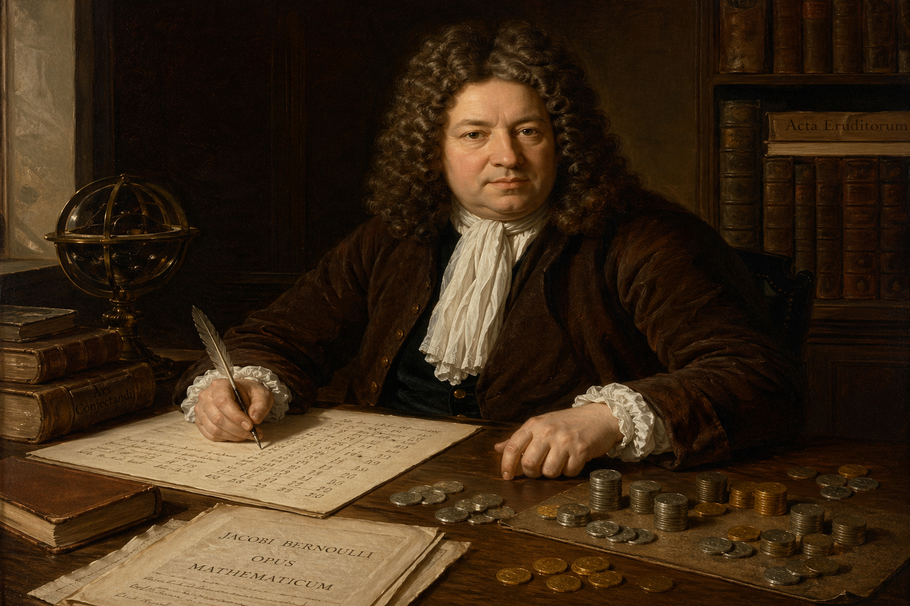

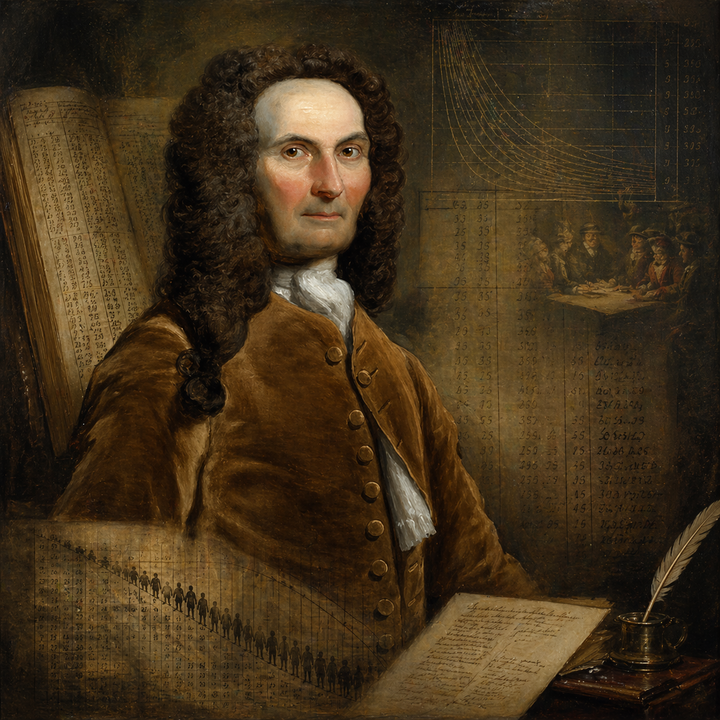
London, on a cold evening in the early decades of the 18th century. In a coffeehouse, amid clouds of tobacco smoke, newspapers, and the restless murmur of merchants and scholars, a gaunt man with a French accent sits poring over his calculations. All around him, people are talking, trading, betting, and arguing. Chessboards are opened, cups clink, newspapers pass from hand to hand. The man's name is Abraham de Moivre. He has fled religious persecution in France, lives in England without a secure position, and earns his living as a private tutor. And yet he is one of the sharpest minds in London. It was later said that Isaac Newton would sometimes pick him up from the coffeehouse in the evening to continue discussing mathematics and natural philosophy with him at his home. Hardly any image sums up de Moivre's life better than this: an exile without a professorship, poor in money, rich in insight – and at the very heart of the intellectual life of his time.
A Refugee at the Center of Science
Abraham de Moivre was born in Vitry-le-François in 1667. He came from a Huguenot family and grew up in a world where religious affiliation could determine one's life prospects. The revocation of the Edict of Nantes in 1685 meant the loss of rights, protection, and future prospects for many French Protestants. Louis XIV thereby ended the limited religious tolerance previously granted to the Huguenots and paved the way for new repression, forced conversion, and flight. De Moivre, too, came under pressure, was temporarily detained, and eventually left France for England. What in later histories of science easily shrinks to a biographical footnote was for him not an episode, but a way of life: exile, insecurity, and economic fragility.
In London, he made a living as a mathematics teacher. He taught wealthy students, explained arithmetic, moved between private homes and coffeehouses, and in this way carved out an astonishing scholarly existence from the bottom up. De Moivre was not one of those scholars who had a secure professorship, a court, or an academy to fall back on. He had to think, write, and calculate while simultaneously struggling for income and recognition.
It is precisely this precarious situation that lends his career a peculiar character. Intellectually, he moved in the immediate vicinity of Isaac Newton, the great English mathematician and physicist; of Edmond Halley, the astronomer, geophysicist, and mathematician; and later also of Gottfried Wilhelm Leibniz, the German mathematician, philosopher, and polymath – yet the institutions remained largely closed to him. Leibniz advocated for him in attempts to secure a professorship on the continent; Newton and Halley supported him in England. None of this was successful. De Moivre remained highly respected scientifically – – until the end of his life, but was never truly financially secure. His life, measured against his significance, was marked by remarkable poverty.
From Dice Games to the Theory of Probability
That a man in this very situation became a pioneer of probability theory is more than just an ironic footnote. De Moivre took up a subject area that initially seemed lighthearted and almost frivolous: games of chance. Cards, dice, betting sequences, odds of winning – that was the stuff early probability theory was made of. Yet beneath the surface of the gaming tables lay a new intellectual program: the insight that uncertainty can be calculated.
Beginning in 1708, de Moivre – building on the work of Christiaan Huygens and engaging in dialogue, but also in dispute, with Pierre Rémond de Montmort – systematically addressed such problems. The dispute over priority with Montmort in particular demonstrates just how much the discipline had come into its own. Who had solved certain problems first? Who had formulated which method first? Behind these vanities lay a serious matter: the question was who could translate the new science of chance into a rigorous form.
The result was the 1718 publication of "The Doctrine of Chances." The title alone reveals the ambition. This was not merely a reflection on luck and misfortune; it was intended to establish a doctrine of chances. De Moivre turned scattered problems into a coherent edifice. He organized concepts, systematized procedures, and transformed probability theory from scholarly correspondence and gaming salons into the form of a textbook. The work became so influential that "Doctrine of Chances" was at times used almost as a synonym for probability theory.
This is precisely where his true historical achievement lies. De Moivre treated games of chance not as trivial entertainment, but as model spaces for uncertainty. Where the future is open, where multiple outcomes are possible, and where decisions are made under risk, structures of probability can be discerned. Cards and dice thus became a laboratory for rational judgment.
The Quiet Revolution of 1733
Anyone who views de Moivre merely as the author of an early textbook on probability theory underestimates him. He published one of his most far-reaching insights in 1733: the approximation of the binomial distribution by a bell-shaped curve. What sounds technical at first has enormous significance. When a random process is repeated very often – such as in a coin toss – the exact individual probabilities become tedious to calculate. De Moivre showed that the shape of this distribution can be approximated surprisingly well by a continuous curve for large numbers of trials.
In retrospect, this seems like a precursor to modern statistics. For it built a bridge between discrete individual events and a smooth, regular overall pattern. Later, this came to be known as the de Moivre-Laplace theorem, an early special case of what, much later, w d as the central limit theorem – one of the cornerstones of statistics. This is a decisive moment in the history of risk thinking: from many small random events emerges a structured, mathematically accessible distribution.
The intellectual gain can hardly be overestimated. Individual events remain unpredictable, yet mass phenomena exhibit regularities. It is precisely this step – from the disorder of individual cases to order in the collective – that makes modern risk quantification possible in the first place. Anyone today who models loss portfolios at an insurer, default rates at a bank, or operational loss series in an industrial company is, in a sense, still working in the shadow of this insight.
When Death Became Calculable
De Moivre's work becomes even more fascinating where it leaves the world of games and turns to the more serious business of mortality. For by the 18th century at the latest, it was clear: probability is useful not only for betting, but for cash flows that depend on the life and death of people. Annuities, life annuities, insurance contracts, survivor benefits – all of these required a mathematics that treated death not metaphysically, but calculatively.
De Moivre therefore turned his attention increasingly to mortality assumptions and life annuities. In 1725, he published "Annuities upon Lives," a work that is considered one of the seminal texts of actuarial science. His now-famous, deliberately simple mortality assumption – often referred to as de Moivre's law – assumed a linear decline in the number of survivors up to a maximum age. This was certainly not a biologically accurate description of life. But it was a surprisingly useful approximation for calculating the values of life annuities and similar contracts in a manageable way.
Here, too, the harshness of his thinking becomes apparent. Death no longer appears solely as fate, catastrophe, or a theological problem, but as a variable in a calculation of future cash flows. This is precisely where the ambivalence lies that gives this article its title: mortality tables and the business of death. What at first sounds cold or even grim was, in truth, a breakthrough of enormous civilizational significance. For it was only the mathematical treatment of mortality that made reliable pension promises, life insurance, and large collective mutual insurance schemes practicable in the first place.
Actuarial Science as Early Risk Management
In modern terms, one could say: De Moivre helped turn existential uncertainty into a calculable risk class. That is the very essence of actuarial science. A single death is a singular, often devastating event for the family affected. For an insurer or pension provider, however, it appears within the collective as part of a larger statistical context. Many individual life stories together form a pattern on the basis of which premiums, reserves, and benefits can be planned.
This is not a trivialization of human life, but a shift in perspective. De Moivre demonstrated that uncertainty need not be taken seriously only when it manifests as a catastrophe. It can be structured, weighted, and translated into contracts beforehand. Precisely for this reason, he is not only an early probability theorist but also a forerunner of what is now called quantitative risk management.
Life insurance is the most obvious example of this. Its business model is based on the fact that while it is unknown when an individual policyholder will die, there is a reasonably robust expectation structure for many policyholders collectively. The same applies to pension systems and pension portfolios. There, the perspective shifts even further: not only early deaths, but also long lifespans become a risk. What is a stroke of luck for the individual – a long life – can become a significant financing problem for pension systems. Thus, mortality risk simultaneously becomes longevity risk.
Why de Moivre Remains Important for Today's Risk Management
The connection to the present is stronger than the historical distance might suggest. Even today, insurers, pension funds, and risk managers grapple with questions that de Moivre had already posed in an early form: How can uncertain future payments be valued? How robust are mortality assumptions? What happens when medical, demographic, or social conditions change? How significant are the consequences if people systematically live longer than previously expected?
Longevity risks are a particularly illuminating example of this. A life insurer or pension fund can make sound calculations over decades and still come under pressure if life expectancy rises faster than assumed in the model. This is precisely where we see how relevant de Moivre's fundamental problem remains today. It is not the formula alone that matters, but the quality of the assumption. A mortality table is never merely a table; it is a condensed judgment about the future of a population.
Furthermore, even modern risk models balance between utility and simplification. De Moivre's linear mortality assumption was useful precisely because it was simple. But it was not reality itself. This tension continues to accompany quantitative models to this day. Good risk models are not valuable because they know the future perfectly, but because they give form to uncertainty in a way that enables decision-making. This is precisely one of de Moivre's enduring lessons.
A Final Glance at the Coffeehouse
Perhaps that is why the image from the London coffeehouse is more than just a charming anecdote. There sits a man who lacks almost everything that usually secures a career: advantages of birth, institutional stability, financial comfort, a tenured professorship. And yet he is working on a way of thinking without which the modern insurance industry, statistical forecasting, and a significant part of quantitative risk management would be hard to imagine.
De Moivre belongs to those figures in the history of science whose intellectual greatness can almost be read from their social disparity. He lived modestly, debated with the greatest minds of his time, and died without the position that would have matched his achievements. His ideas, however, endured. The exile became a classic, gambling calculations became probability theory, and mortality tables became an early mathematics of risk-bearing.
This is precisely why it makes sense to view him as more than just a historical specialist in cards, dice, and annuities. De Moivre demonstrates how closely the history of risk management is linked to the history of the civilizing of uncertainty. Only when death, duration, and chance are captured in numbers can contracts emerge that promise protection. And only when these numbers are critically examined, refined, and calibrated against experience does the art of calculation become responsible judgment.
In the end, an almost paradoxical impression remains. Ironically, it was an impoverished refugee who helped modernity formulate one of its most dispassionate and yet most useful insights: that even the business of death need not be left to fate alone, but can be managed through mathematics, measure, and sound judgment.
Bibliography and Further Reading
- Bernstein, Peter L. (1998): Against the Gods: The Remarkable Story of Risk, John Wiley & Sons, New York 1998.
- de Moivre, Abraham (1718): The Doctrine of Chances: or, A Method of Calculating the Probabilities of Events in Play. London 1718.
- de Moivre, Abraham (1725): Annuities upon Lives: or, The Valuation of Annuities upon any Number of Lives. London 1725.
- de Moivre, Abraham (1730): Miscellanea Analytica. London 1730.
- Bellhouse, David R. (2011): Abraham De Moivre: Setting the Stage for Classical Probability and Its Applications. CRC Press, Boca Raton 2011.
- Hald, Anders (1990): A History of Probability and Statistics and Their Applications before 1750. John Wiley & Sons, New York 1990.