
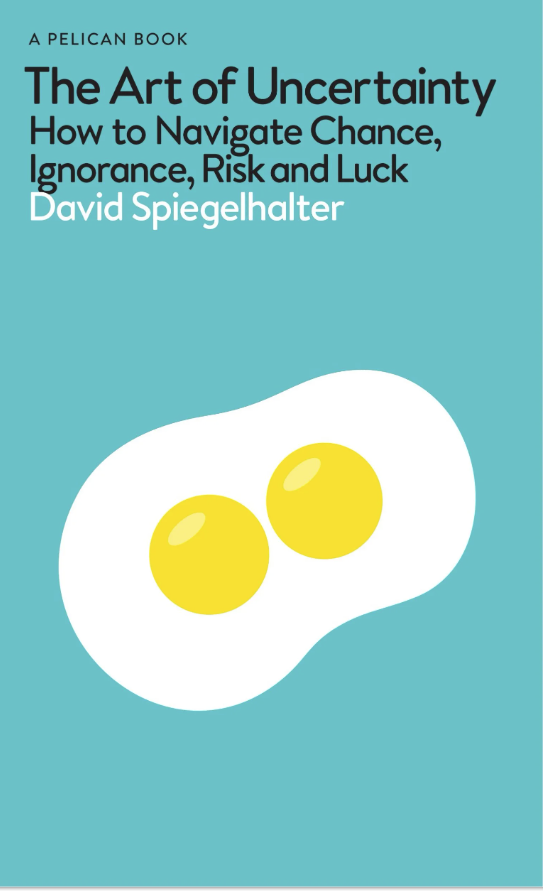
In The Art of Uncertainty: How to Navigate Chance, Ignorance, Risk and Luck, Sir David Spiegelhalter presents a comprehensive, interdisciplinary analysis of dealing with uncertainty. The Emeritus Professor of Statistics at the University of Cambridge succeeds in conveying complex concepts of probability and risk theory in such a way that they appear accessible and insightful to both laymen and experts. The focus is not on the mathematical formulation, but on the epistemological and practical significance of uncertainty in a social, political and individual context.
Spiegelhalter starts from the fundamental premise that uncertainty is not an avoidable disruptive moment in rational decision-making, but a constitutive element of the reality of modern life. Instead of suggesting certainty through deterministic models, he advocates a constructive and transparent approach to uncertainty. This applies both to the medical field, for example in the interpretation of diagnostic data, and to political decisions in times of crisis – such as during the COVID-19 pandemic, on which Spiegelhalter has commented in earlier works.
The historical contextualization is particularly successful: starting with the beginnings of probability theory with Cardano and Pascal through to modern statistical methods such as Bayesian inference, Spiegelhalter traces the development of a way of thinking that attempts to work with uncertainty – not to eliminate it. In doing so, he emphasizes that many seemingly objective risk figures are constructions based on assumptions, models and interpretations – in other words, they are themselves uncertain.
Another key aspect is the psychological dimension: how do people react to uncertainty? Spiegelhalter uses numerous studies and examples to show that cognitive distortions - such as availability heuristics, illusions of control or the tendency towards deterministic narratives – have a considerable influence on how we deal with probabilities. He derives a central requirement from this: Risk and uncertainty communication must be clear, honest and context-sensitive. Instead of suggesting "false certainty", experts should disclose uncertainties and explain what is known – and what is not.
Spiegelhalter's ability to illustrate abstract concepts using concrete, often humorous examples is particularly didactic. Whether it is about birthday paradoxes, Shakespeare-writing monkeys (Monkey Simulator program) or the correct interpretation of corona tests – he always manages to make the intellectual relevance of statistical considerations tangible. His language remains precise, but never over-academicized a role model for scientific communication.
The Art of Uncertainty is a plea for a rationally reflective yet humble attitude towards the world. In times when uncertainties are increasing in many areas of society – from climate to health to geopolitical developments – Spiegelhalter not only provides analytical tools, but also an attitude: scientific integrity does not mean having an answer to everything, but recognizing the limits of knowledge – and communicating them.
Conclusion: David Spiegelhalter's The Art of Uncertainty is a brilliant combination of statistics, scientific theory and social responsibility. The book is both insightful and relevant to practice – an indispensable contribution to contemporary risk literacy.
David Spiegelhalter (2024): The Art of Uncertainty: How to Navigate Chance, Ignorance, Risk and Luck, Penguin Random House, Dublin 2024.